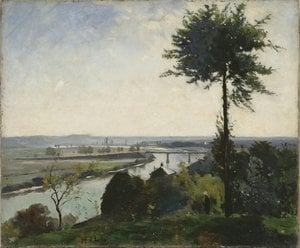
Carl Fredrik Hill: A Landscape Painter Haunted by Darkness
Born in Lund, Sweden, on May 31, 1849, Carl Fredrik Hill’s artistic journey began amidst a familial conflict—his father, a mathematics professor, championed practicality while Hill possessed an irresistible compulsion to translate the beauty of nature onto canvas. Despite these reservations, he pursued formal training at Stockholm Royal Academy of Fine Arts, recognizing that mastering technique was essential for conveying profound emotion. This formative decision propelled him toward Paris in 1874, where he encountered the transformative influence of Barbizon School aesthetics championed by Camille Corot—a movement dedicated to capturing the essence of rural life with uncompromising realism and atmospheric depth. Hill’s artistic credo centered on “art has no other goal than the truth, le vrai,” rejecting mere imitation for an honest exploration of psychological complexity. Driven by this conviction, he embarked upon a series of expeditions to Montigny-sur-Loing, Champagne, and Normandy—sites revered by Impressionists like Corot and Daubigny—where he meticulously documented landscapes imbued with subtle nuances and unsettling textures. He confessed, “I give myself no peace,” reflecting his unwavering determination to refine his craft and express the inner turmoil that would characterize much of his later work. This ambition fueled an extraordinary output during his initial years as a painter, resulting in canvases brimming with palpable emotion and capturing fleeting moments of sublime beauty—a hallmark of Barbizon’s expressive power. The Salon rejected Hill's paintings repeatedly, highlighting the prevailing prejudice against avant-garde artistic endeavors during that era. However, tragedy struck at 28 when a devastating psychotic episode abruptly halted his creative trajectory, plunging him into hospitalization and ultimately leading to a diagnosis of hallucinations and paranoia. Yet, amidst this profound personal crisis, Hill experienced an unexpected resurgence of artistic vitality upon returning home to Sweden—where he resided under the care of his mother and sister for nearly three decades before succumbing to illness in 1911. His death certificate simply stated “former landscape painter,” encapsulating a poignant testament to his artistic legacy—a brilliant artist whose potential was tragically curtailed by mental instability. Despite the debilitating effects of schizophrenia, Hill continued to produce art with remarkable consistency during this latter phase, driven by an inner compulsion that defied diagnosis. He drew four drawings daily, transforming these repetitive actions into a form of therapeutic expression and channeling his anxieties into meticulously rendered images—primarily nude figures executed in drypoint etching. These drawings explored unsettling psychological themes, employing dynamic lines and dramatic shadows to convey emotion and intimacy—a distinctive contribution to Expressionist drawing and a poignant reflection on the human condition at its most vulnerable. His enduring artistic achievement resides not only in the sheer volume of his output but also in the unflinching honesty with which he confronted viewers with visions of darkness and introspection, cementing his place as one of Sweden’s foremost landscape painters and a singular voice within the Expressionist movement.Questions et réponses
Comment puis-je trouver toutes les œuvres de Carl Fredrik Hill dans une technique donnée ?
Les œuvres de Carl Fredrik Hill peuvent être consultées par technique sur la page Tous les médiums de l'artiste.
À quelle période historique Carl Fredrik Hill a-t-il exercé ?
Carl Fredrik Hill a œuvré durant la période XIXe siècle. Cette période situe l'activité de l'artiste dans l'histoire.
Puis-je étudier l'utilisation de la couleur par Carl Fredrik Hill à travers l'ensemble de ses œuvres ?
L'usage de la couleur par Carl Fredrik Hill à travers les œuvres répertoriées sur ce site web peut être étudié sur la page Génome de la palette de l'artiste.