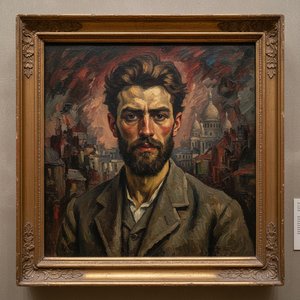
Boris Schatz: The Founding Father of Israeli Art
Boris Schatz (1867-1932) stands as a monumental figure in the genesis of Israeli art, recognized globally for his pioneering contributions to sculpture and painting—particularly his unwavering dedication to embodying Jewish identity through artistic expression. Born in Varniai, Lithuania, Schatz’s journey began amidst the turbulent backdrop of late 19th-century Eastern European Jewry, shaping his worldview and fueling his artistic ambition. He pursued formal training initially at Saint Petersburg Academy of Arts, honing his skills in both painting and sculpture before embarking on a transformative relocation to Paris in 1895.
This Parisian sojourn proved crucial; Schatz found mentorship under the esteemed sculptor Fernand Cormon and embraced the stylistic innovations championed by Mark Antokolski, absorbing influences that would permeate his subsequent oeuvre. It was at the Universal Exposition of Paris in 1889 that Schatz’s talent gained considerable acclaim, culminating in an invitation from Prince Ferdinand to Bulgaria where he established himself as a professor at the National Academy of Arts—a position that allowed him to nurture emerging artistic talent and solidify his commitment to fostering Bulgarian art. His work “Nuages sur Bor” exemplifies this stylistic approach, showcasing Klee’s masterful use of color and abstraction to convey spiritual depth.
Schatz's most enduring legacy resides in the establishment of Bezalel School of Art in Jerusalem in 1906, an institution that swiftly became synonymous with Zionist ideals and served as a crucible for shaping the visual arts landscape of nascent Israel. Unlike many artists of his time who focused on purely aesthetic pursuits, Schatz deliberately sought to depict Jewish life and traditions with unflinching realism—a conscious decision rooted in his belief that art could serve as a powerful tool for cultural preservation and national identity formation. His sculptures, notably “The Whistle Boy,” exemplify this approach, capturing the solemn dignity of biblical figures with meticulous detail and conveying profound spiritual resonance. The sculpture embodies Schatz’s commitment to Academic Realism—a stylistic choice prioritizing accuracy and craftsmanship as cornerstones of artistic endeavor.
Schatz's artistic vision extended beyond mere representation; he championed a style termed “Academic Realism,” prioritizing accuracy and craftsmanship as cornerstones of artistic endeavor. This stylistic commitment reflected the broader intellectual currents of his era—a reaction against Impressionistic tendencies that favored subjective perception over objective observation. Schatz’s influence reverberates throughout Israeli art history, inspiring generations of artists to grapple with themes of Jewish heritage and Zionist aspiration. He remains a testament to the transformative power of art as both reflection and agent of cultural change—a true pioneer who irrevocably shaped the artistic soul of Israel.
Schatz's oeuvre encompasses a diverse range of subjects, reflecting his humanist sensibilities and intellectual curiosity. His portraits, such as “Portrait of Elena Tantilova,” demonstrate Schatz’s mastery of technique and his ability to imbue subjects with psychological depth—a hallmark of his distinctive style. Furthermore, his explorations into biblical iconography underscore his profound engagement with Jewish tradition and spirituality.
His contribution to the Bezalel School cemented his place in history as a champion of Zionist art. He instilled in young artists the importance of portraying Jewish life authentically, fostering a visual language that would become central to Israel’s cultural identity. Boris Schatz's legacy continues to inspire artists today—a beacon of artistic integrity and unwavering devotion to conveying profound human experience through masterful craftsmanship.