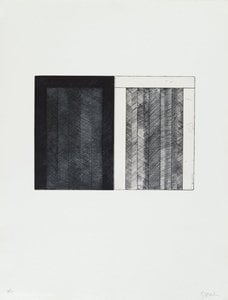
A Life Immersed in Color and Form
Nicholas Brice Marden Jr., known to the art world simply as Brice Marden, was a pivotal figure in American painting whose career spanned over six decades. Born October 15, 1938, in Bronxville, New York, and passing away August 9, 2023, in Tivoli, New York, Marden’s artistic journey defied easy categorization, existing at the intersection of minimalism, abstract expressionism, color field painting, and lyrical abstraction. His life was as multifaceted as his art—a blend of rigorous formal exploration, deep engagement with historical precedents, and a restless curiosity that led him to diverse cultural landscapes. Growing up in Briarcliff Manor, New York, Marden’s early exposure to the arts laid the foundation for his future pursuits. He attended Florida Southern College before earning his BFA from Boston University's School of Fine and Applied Arts in 1961. It was at Yale School of Art and Architecture, where he completed his MFA in 1963, that Marden truly began to forge his artistic path, studying under a constellation of influential figures including Esteban Vicente, Alex Katz, and Jack Tworkov. His cohort included future luminaries like Richard Serra, Chuck Close, and Vija Celmins, fostering an environment of intense creative exchange.Early Explorations: Minimalism and the Monochrome
Marden’s artistic trajectory began with a fascination for geometric abstraction—specifically, the minimalist aesthetic championed by artists such as Josef Albers and Robert Rauschenberg. Influenced profoundly by Jasper Johns' retrospective at the Jewish Museum in 1964—where he worked as a guard—Marden embarked on a quest to distill painting down to its essential elements: color and form. This pursuit resulted in his groundbreaking monochrome series of the late 1960s, characterized by expansive canvases painted in muted shades of gray. These works weren’t merely stylistic choices but rather meditations on perception and materiality—a deliberate rejection of representational illusionism in favor of a direct engagement with the surface qualities of pigment. As he eloquently described it himself: “When you look at it, you have nothing to go on but yourself. You’re there and it’s there, and that’s what you have to go on. And I think the possibilities are of a much more intense, deeper relationship with art.” The meticulous layering of oil paint and beeswax—a technique he honed during his collaboration with Rauschenberg—created surfaces imbued with subtle variations in texture and luminosity. This approach mirrored the aesthetic sensibilities of Mark Rothko, whose canvases similarly employed horizontal bands of color to evoke profound emotional resonance. Marden’s early paintings stand as a testament to the power of simplicity—a conviction that “less is more” would define his artistic vision for decades to come.Expanding Horizons: From Hydra to Asia
A transformative experience occurred during Marden's visit to Hydra, Greece, in 1971—an encounter with the island’s luminous landscape and ancient ruins that ignited a new creative impulse. Inspired by the interplay of light and shadow on stone surfaces, he began experimenting with monumental canvases incorporating terracotta pigments—a bold departure from his monochrome explorations. Simultaneously, Marden immersed himself in Asian art and calligraphy, recognizing parallels between Eastern artistic traditions and Western abstraction. This fascination fueled the creation of works like *Grove Group*, which utilized earthy hues to capture the essence of natural environments—a deliberate effort to transcend formal conventions and connect with primal forces. His exploration continued into Thailand, Sri Lanka, and India, where he absorbed influences from Buddhist iconography and meditative practices—elements that subtly permeated his subsequent paintings.A Legacy of Innovation
Throughout his prolific career, Brice Marden consistently challenged artistic norms and pursued innovative techniques—a commitment to experimentation that distinguished him from many of his contemporaries. He embraced the concept of “process painting,” meticulously documenting every step of his creative process—from initial sketches to final varnishes—demonstrating a profound respect for materiality and craftsmanship. His work is characterized by an extraordinary sensitivity to color, texture, and form—a visual language that speaks directly to the human condition. Marden’s influence extended far beyond the confines of the art world, inspiring artists across disciplines to explore new avenues of expression. He leaves behind a body of work that continues to captivate audiences worldwide—a testament to his enduring vision and unwavering dedication to artistic integrity. His paintings are held in major museum collections globally, cementing his place as one of America’s most celebrated painters and securing his legacy as an innovator who reshaped the landscape of modern art.Questions et réponses
Où peut-on retrouver les œuvres de Brice Marden classées par sujet ?
Retrouvez les œuvres de Brice Marden classées par sujet sur la page Index thématique de l'artiste.
Où et en quelle année Brice Marden est-il né ?
Brice Marden est né à Bronxville en 1938.
Existe-t-il une chronologie de la carrière de Brice Marden ?
Retrouvez l'itinéraire chronologique de l'œuvre de Brice Marden sur la page Parcours de carrière de l'artiste, où les œuvres se succèdent par périodes de création, chapitre par chapitre.