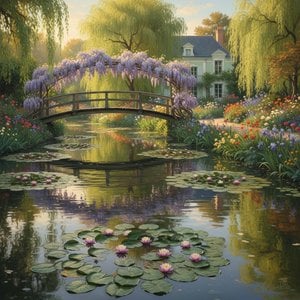
Blanche Hoschéde Monet: A Silent Companion to Impressionism
Blanche Hoschéde Monet (1865-1947) remains a figure of quiet brilliance within the vibrant tapestry of Impressionist art, largely overshadowed by her husband, Claude Monet. Yet, her contribution to Monet’s artistic legacy—and indeed, to the very essence of Giverny’s aesthetic—is undeniable. Born November 10th, 1865, in Paris, Blanche was the second daughter of Ernest Hoschéde, a prosperous businessman and avid collector of Impressionist paintings who recognized Monet's burgeoning talent early on, fostering a relationship that would profoundly shape both their lives and Monet’s artistic output. Ernest Hoschéde’s patronage proved pivotal; he commissioned Monet to adorn his château de Rottembourg with decorative panels—a commission that cemented Monet’s position as a leading figure in the movement and exposed Blanche to the intellectual ferment of Parisian art circles. Tragically, Ernest’s fortunes crumbled in 1877, triggering an auction sale of his considerable collection, including Monet's works. This upheaval necessitated a relocation to Vétheuil, where Monet, Camille Monet, and their children found solace amidst the picturesque countryside—a setting that would become inextricably linked with Blanche’s artistic endeavors. Though Ernest remained primarily in Paris, Blanche diligently cared for her family, eventually moving to Poissy and settling permanently into Giverny in 1883. Her connection with Claude Monet extended far beyond a familial bond; Blanche became his devoted assistant and student, embarking on plein air excursions alongside him—a practice that mirrored Monet’s own method of artistic creation. She diligently documented the changing seasons at Giverny, capturing the ethereal beauty of lily ponds and weeping willows with remarkable precision and sensitivity. Notably, Blanche collaborated with American expatriates Theodore Earl Butler and John Leslie Breck, producing landscapes infused with a distinctly Impressionistic spirit. Furthermore, Monet’s decision to restrict Blanche's romantic relationship with Butler—a gesture that underscored his protective instincts—highlights the complexities of their personal lives amidst the artistic fervor of the era. Blanche Hoschéde Monet’s artistic output is characterized by her unwavering dedication to capturing fleeting moments of light and color – a hallmark of Impressionism itself. Her paintings, particularly “The Willow, the Roses & Waterlilies at Giverny,” exemplify this stylistic approach, demonstrating Monet's influence on her technique and vision. Paul Durand-Ruel recognized Blanche’s talent and purchased several of her canvases, ensuring that her contribution to Impressionist art would endure through time. Today, her work resides in museums worldwide, serving as a testament to her artistic prowess and the enduring legacy of Claude Monet—a silent companion who faithfully documented the splendor of Giverny and solidified Monet's place as one of the most celebrated artists of his generation.- Early Life & Family Background: Blanche Hoschéde was born into a wealthy Parisian family, inheriting an appreciation for art from her father, Ernest Hoschéde, who actively supported Monet’s artistic endeavors.
- The Château de Rottembourg Commission: Ernest Hoschéde's foresight led to the commission of monumental decorative panels by Monet, marking a crucial step in establishing Monet’s reputation and introducing Blanche to the influential Parisian art scene.
- Vétheuil & Family Life: Following Ernest’s financial difficulties, Blanche and Monet relocated to Vétheuil, where they cultivated a tranquil domestic life amidst the idyllic landscapes of Normandy—a setting that profoundly inspired Blanche's artistic vision.
- Collaboration with Butler & Breck: Blanche Hoschéde’s partnership with Theodore Earl Butler and John Leslie Breck resulted in evocative landscapes imbued with Impressionistic ideals, reflecting their shared fascination for capturing the nuances of natural light and color.
- Giverny & Monet's Artistic Evolution: Blanche’s unwavering support for Claude Monet during his formative years at Giverny—particularly her meticulous documentation of the lily ponds—contributed significantly to Monet’s groundbreaking artistic achievements.
- Notable Paintings: Blanche Hoschéde Monet produced numerous paintings depicting scenes from Giverny and Rouen, showcasing her mastery of Impressionistic technique and capturing the beauty of everyday life.
- Legacy & Recognition: Her canvases are held in prestigious museums across Europe and America, honoring Blanche’s artistic contribution to Impressionism and cementing Claude Monet's place as a titan of modern art.
Questions et réponses
Comment la carrière de Blanche Hoschedé est-elle divisée en périodes ?
La carrière de Blanche Hoschedé se dévoile période par période sur la page Parcours de carrière de l'artiste : une frise chronologique horizontale des œuvres, regroupées en chapitres correspondant aux différentes étapes de sa carrière.
Où peut-on trouver les œuvres de Blanche Hoschedé regroupées par palette ?
Pour trouver des œuvres de Blanche Hoschedé dans une palette spécifique, consultez la page Par palette de couleurs de l'artiste.
Où trouver les œuvres de Blanche Hoschedé regroupées par mots-clés ?
Pour trouver des œuvres de Blanche Hoschedé sur un thème spécifique, consultez la page Par mots-clés de l'artiste, qui regroupe les œuvres par mot-clé.