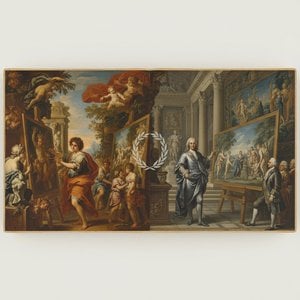
Bernardino Mei (1612 – 1676): A Baroque Visionary
Bernardino Mei, born in Siena around 1612, stands as a significant figure within the vibrant tapestry of Baroque art—primarily active in his native Siena and later establishing himself in Rome. His artistic journey began under the tutelage of Giuliano Periccioli, a celebrated cartographer and draughtsman whose studio instilled him with foundational skills in engraving, marking an early foray into printmaking alongside painting. This formative experience propelled Mei towards the workshop of Rutilio Manetti, where he honed his craft further, likely serving as assistant to Francesco Rustici—a collaboration that exposed him to the stylistic nuances of Rome’s artistic milieu.
Mei's prolific output centered around Siena and its environs, attracting considerable patronage from Cardinal Fabio Chigi, who ascended to the papacy as Alexander VII in 1655. Recognizing Mei’s talent, Chigi invited him to Rome in 1657, initiating a pivotal chapter of his career. Under the mentorship of influential artists like Mattia Preti, Andrea Sacchi and Pier Francesco Mola—and crucially influenced by Guercino—Mei absorbed stylistic elements that would permeate his oeuvre. Notably, there’s considerable debate surrounding the attribution of Mei's monumental fresco depicting Aurora in Palazzo Bianchini Bandinelli to Guercino himself; scholarly discussions continue to explore this fascinating question. This controversy underscores the complexities inherent in interpreting artistic legacies and highlights the enduring fascination with collaborative endeavors within the Baroque period.
Bernardino’s artistic sensibilities were profoundly shaped by the collaboration with Gian Lorenzo Bernini—whose studio he frequented—resulting in a distinctive approach characterized by theatrical dynamism and expressive gesture. He skillfully translated Bernini's sculptural vision into painting, injecting dramatic action and emotional intensity into his mythological and allegorical subjects. Mei’s canvases pulsate with movement, mirroring Bernini’s masterful manipulation of space and light – techniques that elevate his works beyond mere representation, transforming them into immersive experiences for the viewer. His ability to convey profound emotion through visual language cemented his reputation as a master of Baroque aesthetics.
Mei died peacefully in Rome in 1676, leaving behind a legacy of captivating artworks that reflect the grandeur and fervor of the Baroque period. Despite initial dismissals as merely echoing the stylistic brilliance of his contemporaries—particularly Bernini and Guercino—Bernardino Mei’s work experienced a resurgence of critical acclaim in the latter half of the 20th century, culminating in the exhibition “Bernardino Mei e la pittura barocca a Siena” (1987). This retrospective underscored the artist's enduring artistic merit and reaffirmed his place as a pivotal contributor to Baroque art history. His paintings continue to resonate with viewers today, offering glimpses into a period defined by opulent ornamentation, dramatic storytelling, and an unwavering belief in the power of visual representation to convey profound spiritual truths.
His oeuvre encompasses a diverse range of subjects—primarily mythological scenes and religious frescoes—demonstrating Mei’s versatility as an artist. Among his most celebrated achievements is the Aurora fresco commissioned for Palazzo Bianchini Bandinelli, a monumental undertaking that exemplifies Guercino's influence on Mei’s stylistic development. The fresco’s vibrant colors and dynamic composition capture the ethereal beauty of dawn, embodying the ideals of Baroque art—grandeur, emotion, and theatrical spectacle. Furthermore, Mei’s meticulous attention to detail—evident in his portraits and miniature paintings—reveals a remarkable command of technique and underscores his commitment to artistic excellence. Bernardino Mei remains an artist whose work continues to inspire admiration for its expressive power and stylistic innovation.