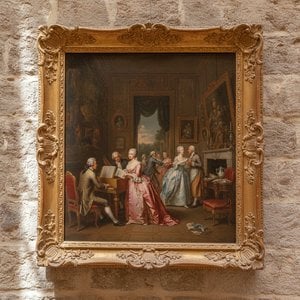
La Vision Méticuleuse de Benjamin Eugène Fichel
Au cœur vibrant et bouillonnant du Paris du XIXe siècle, une époque définie à la fois par un progrès industriel rapide et une profonde nostalgie du passé, Benjamin Eugène Fichel s'est imposé comme un maître du drame miniature. Né en 1826 de l'union de Moïse Mayer Fichel et Lili Abigail Sasias, Fichel était un enfant de la capitale française, une ville qui allait lui servir à la fois de salle de classe et de muse éternelle. Son ascension vers les hautes sphères du monde de l'art commença véritablement en 1844 lorsqu'il intégra la prestigieuse École des Beaux-Arts. Sous le regard attentif de maîtres tels qu'Hippolyte Delaroche et Michel Martin Drolling, Fichel n'apprit pas seulement à peindre ; il apprit à observer. Il développa un œil aiguisé pour la précision anatomique et les nuances subtiles de la lumière qui deviendraient les signatures de son héritage durable.
Si sa formation formelle lui a doté d'une solide base académique, c'est l'influence de Jean-Louis-Ernest Meissonier qui a véritablement enflammé l'esprit créatif de Fichel. À l'instar de Meissonier, Fichel trouva sa vocation dans des formats plus réduits, des toiles qui pulsaient d'une énergie concentrée et vive. Il adopta une technique caractérisée par un traitement exquis du détail, où chaque fil d'un costume et chaque reflet de lumière sur un gobelet d'argent était rendu avec un soin minutieux. Cette approche lui permit de créer bien plus que de simples illustrations ; il façonnait des fenêtres ouvertes sur d'autres époques, mêlant un sentiment de poids historique à une directivité presque cinématographique qui plongeait les spectateurs au cœur même de ses compositions.
Une Tapisserie d'Histoire et d'Émotion Humaine
L'art de Fichel était un mariage unique entre l'exactitude archéologique et un humour délicat. Il possédait une dévotion presque érudite envers la précision historique, recherchant les textures, les outils et les parures des siècles révolus pour s'assurer que ses scènes semblaient authentiquement ancrées dans le temps. Pourtant, il refusait que son travail devienne aride ou purement académique. Au sein de ses mondes méticuleusement reconstitués, vivait un esprit subtil et ludique — un éclat d'ironie dans l'expression d'un personnage ou un geste discret suggérant les complexités de la psychologie humaine. Cette dualité rendait ses peintures de genre particulièrement captivantes ; on pouvait s'émerveiller devant la précision technique d'un festival de 1776 tout en étant simultanément touché par les interactions calmes et humoristiques des personnages qui l'habitaient.
Son répertoire était aussi divers que ses intérêts, allant de scènes domestiques intimes à des récits historiques plus grandioses. Parmi ses œuvres les plus notables, on trouve :
- La Fin du Dîner : Une étude magistrale de l'atmosphère sociale et de la lumière.
- Harvey démontrant la circulation du sang à Charles Ier : Une œuvre de jeunesse significative qui illustre sa capacité à mêler observation scientifique et drame historique.
- Un Festival Étranger : Une exploration de la vitalité culturelle à travers le détail des costumes et du mouvement.
- La Capture d'un Espion : Une pièce démontrant son talent pour capturer la tension et le suspense narratif.
Héritage et Reconnaissance au Salon Parisien
La trajectoire de la carrière de Fichel fut marquée par une excellence constante et les éloges fréquents des critiques les plus exigeants de son temps. Il fut un pilier du Salon de Paris, y exposant de nouvelles œuvres chaque année, de ses débuts jusqu'à la fin de sa vie en 1895. Cette présence indéfectible dans l'arène la plus importante du monde de l'art lui valut d'importantes distinctions, notamment une médaille en 1857 et une autre en 1869. Le plus haut témoignage de son rang social et professionnel fut sans doute sa nomination comme Chevalier de la Légion d'Honneur en 1870, une distinction qui consolida son statut parmi l'élite des peintres français.
Au-delà de ses triomphes individuels, l'influence de Fichel s'est étendue à travers son rôle de mentor. Son élève, Jeanne Samson, devint non seulement une peintre respectée à part entière, mais aussi son épouse, représentant une union magnifique entre passion artistique et vie partagée. Aujourd'hui, les œuvres de Benjamin Eugène Fichel résident dans des galeries prestigieuses et des collections privées en Allemagne, aux Pays-Bas et en France. Il demeure une figure célébrée pour ceux qui rechercheent un art honorant la précision de l'histoire tout en célébrant les complexités durables, humoristiques et souvent tendres de l'expérience humaine.