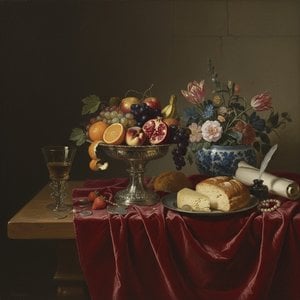
Le Visionnaire Botanique des Médicis
À l'âge d'or du baroque florentin, peu d'artistes ont capturé l'intersection délicate entre la curiosité scientifique et la splendeur esthétique avec autant de maestria que Bartolomeo Bimbi. Né en 1648 dans le paysage serein de Settignano, près de Florence, Bimbi était destiné à une vie façonnée par le pinceau et le ciseau. En tant que fils du sculpteur Nicolò Bimbi, ses premières années furent imprégnées d'un environnement où le monde physique était méticuleusement observé et rendu. Cette éducation fondamentale lui a inculqué un respect profond pour la texture, la forme et les complexités organiques de la nature, des qualités qui allaient plus tard définir son statut légendette de virtuose de la botanique.
Le voyage artistique de Bimbi commença véritablement sous la tutelle de Lorenzo Lippi, l'un des peintres les plus estimés de Florence. C'est au sein de l'atelier de Lippi que Bimbi maîtrisa le langage dramatique du clair-obscur, apprenant à manipuler l'ombre et la lumière pour insuffler la vie à ses sujets. Après la disparition de son mentor, il continua à affiner son regard pour le réalisme sous la direction d'Onorio Marinari, un artiste réputé pour son engagement envers une observation précise. Ces années formatrices lui apportèrent bien plus qu'une simple compétence technique ; elles lui offrirent une manière de voir qui jetait un pont entre l'art pur et les recherches scientifiques bourgeonnantes du XVIIe siècle.
Une Symbiose entre Art et Science
La trajectoire de la carrière de Bimbi fut irrévocablement modifiée par son pèlerinage à Rome vers 1667. Au cœur de la cour papale, il rencontra l'influent Cardinal Leopoldo de' Medici, un homme dont la passion pour l'art et les sciences naturelles allait devenir le catalyseur des plus grands accomplissements de Bimbi. Ce mécénat transforma l'artiste, passant du statut de peintre talentueux à celui de documentariste essentiel du monde naturel. Chargé d'illustrer les extraordinaires collections botaniques détenues par la famille Médicis, Bimbi tourna son attention vers les fruits opulents, les agrumes et la flore exotique qui peuplaient les grandes villas de l'époque.
Son œuvre devint un registre célèbre de la Villa dell’Ambrogiana et de la della Topaia, créant des toiles qui servaient à la fois d'exquises décorations et de spécimens scientifiques. Dans des chefs-d'œuvre tels que "Large Citron in a Landscape" (Grand Citron dans un paysage) (1690), on peut témoigner de sa capacité à isoler un sujet unique — un citron solitaire et texturé — pour le placer au sein d'une vue atmosphérique et grandiose. Cette technique lui permettait de célébrer la réalité tactile du fruit tout en maintenant l'échelle émotive et monumentale caractéristique de la peinture baroque. Ses toiles n'étaient pas de simples natures mortes ; elles étaient des célébrations de la fertilité, de la découverte et du prestige de l'empire botanique des Médicis.
Héritage de Précision et de Grandeur
Au-delà de ses triomphes botaniques, Bimbi fit preuve d'une polyvalence remarquable qui lui permit de naviguer à travers les divers genres de la période baroque. Bien qu'il soit le plus vénéré pour sa flore, sa capacité à rendre des objets inanimés avec une ferveur égale est évidente dans des œuvres comme "Turkish Arms" (Armes turques) (1680). Dans cette pièce, il déploie une précision époustouflante pour capturer les surfaces froides et réfléchissantes de l'armement et des armures ottomanes, prouvant que sa maîtrise de la lumière s'étendait bien au-delà du domaine organique. Cette étendue de talent permit à son travail de résonner dans les cercles de la haute société florentine, séduisant aussi bien le connaisseur d'art fin que l'érudit d'histoire naturelle.
L'importance historique de Bartolomeo Bimbi réside dans sa position unique d'artiste ayant documenté la transition de l'idéalisme de la Renaissance vers la rigueur empirique des Lumières. Il ne se contentait pas de peindre ce qu'il voyait ; il élevait le spécimen au niveau du sublime. Aujourd'hui, son héritage survit à travers les collections préservées du Palais Pitti et du Museo Botanico dell'Università di Firenze, où ses peintures continuent de servir de fenêtres vibrantes et vivantes sur une époque perdue de splendeur florentine. Sa vie demeure un témoignage de la puissance de l'art à servir à la fois de miroir à la nature et de monument à la curiosité humaine.
Questions et réponses
D'où vient Bartolomeo Bimbi ?
Bartolomeo Bimbi est né(e) en Italie.
Dans quelle ville et quel pays Bartolomeo Bimbi est-il/elle né(e) ?
Bartolomeo Bimbi est né à Florence, en Italie.
Comment trouver des œuvres de Bartolomeo Bimbi sur un thème spécifique ?
La page Par mots-clés de Bartolomeo Bimbi regroupe les œuvres de l'artiste par mots-clés.