Aze Valère Adolphe Louis: Bridging East and West Through Impressionistic Vision
Aze Valère Adolphe Louis (4 March 1823, Paris – 19 March 1884, Paris) stands as a fascinating figure in the landscape of French art history—a painter who skillfully blended Romantic idealism with the burgeoning influence of Impressionism to produce evocative depictions of both European and Oriental subjects. Born into a family steeped in artistic tradition, Louis’s formative years were marked by exposure to influential artists like Joseph-Nicolas Robert-Fleury, shaping his early stylistic inclinations towards historical painting. However, it was his passion for capturing fleeting moments of beauty and atmosphere that ultimately cemented his reputation as a master of Orientalist art.
Early Life & Training
Louis’s artistic journey commenced with formal training under Robert-Fleury, equipping him with foundational skills in composition and narrative storytelling—techniques he would later adapt to portray grand historical scenes with remarkable detail. Robert-Fleury instilled in Louis the importance of meticulous observation and dramatic staging—elements that would become hallmarks of his oeuvre. This grounding in academic tradition provided a crucial springboard for his subsequent explorations into artistic innovation.
The Egyptian Influence
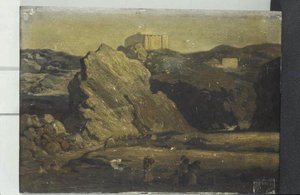
Louis's fascination with Egypt began during his travels in 1859, profoundly impacting his artistic sensibilities. He embarked on a series of expeditions documenting the landscapes and monuments of Upper Egypt, producing watercolors and sketches that exemplify the Romantic spirit’s desire to explore exotic realms. These works are characterized by luminous color palettes—particularly vibrant blues and yellows—and expressive brushstrokes—a deliberate departure from academic conventions. Artists like Eugène Delacroix had already captivated audiences with depictions of Egyptian landscapes and mythology, inspiring Louis to pursue a similar path of artistic experimentation. His sketches from Luxor and Karnak reveal an unwavering commitment to capturing the grandeur and mystery of ancient Egypt.
Louis’s Oeuvre: Historical Painting & Orientalist Vision
Louis's oeuvre is undeniably defined by his exploration of Orientalism – a genre that captivated European artists during the 19th century, fueled by colonial expansion and romantic fantasies of distant lands. He meticulously rendered scenes from Algeria, capturing the rugged beauty of Berber villages and expansive olive groves with an eye for subtle tonal variations and textural nuances. His paintings aren’t merely representations of places; they are imbued with a palpable sense of emotion—a testament to his ability to convey psychological depth alongside visual splendor. Consider “Étude d'oliviers, Algérie,” where the artist skillfully utilizes light and shadow to evoke the serenity of the Algerian countryside. He achieved renown for monumental canvases like “Louix XI chez son orfèvre,” depicting King Louis XI in conversation with his goldsmith—a piece that showcases meticulous attention to detail and a masterful grasp of theatrical lighting. Similarly, "Jeune femme agaçant une perruche" portrays a young woman playfully tormenting a parrot, capturing a moment of domestic intimacy with delicate brushwork and nuanced color harmonies.
Stylistic Evolution & Impressionistic Tendencies
While rooted in Romantic principles—particularly the emphasis on dramatic emotion and idealized beauty—Louis’s artistic style gradually embraced Impressionistic techniques—particularly evident in his use of broken color and loose brushstrokes. This stylistic shift reflects the broader artistic currents of his time, demonstrating a willingness to experiment with new approaches while retaining core aesthetic values. Like Monet and Renoir, Louis sought to capture the ephemeral qualities of light and atmosphere—a pursuit that elevated his paintings beyond mere visual representation into expressions of subjective experience. His landscapes bear witness to this transformative influence, displaying a vibrancy and spontaneity characteristic of Impressionism’s groundbreaking innovations.
Legacy & Recognition
Louis's legacy extends beyond his individual artworks; he represents an important conduit between Romantic idealism and Impressionistic innovation. He rests peacefully in the Cimetière Montmartre, alongside his wife Blanche-Marie Léger and her family, a fitting memorial to an artist who successfully translated beauty into enduring visual form. His dedication to capturing the essence of both European and Oriental landscapes solidified his place as one of the foremost painters of his era—a figure whose evocative imagery continues to resonate with audiences today. He is remembered for his masterful depictions of historical figures and landscapes alike, securing his position as a pivotal artist in shaping the artistic landscape of the 19th century.