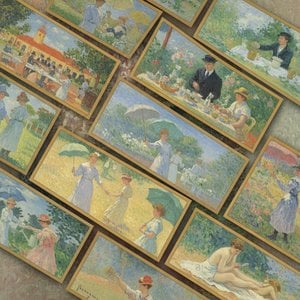
Le Peintre de l'Élégance Parisienne
Auguste Toulmouche (1829-1890) s'impose comme une figure lumineuse dans la tapisserie de l'art français du XIXe siècle, un maître dont le pinceau a capturé l'essence même de la Belle Époque. Né à Nantes d'Émile Toulmouche, un courtier prospère, sa jeunesse fut baignée dans une atmosphère d'appréciation artistique, nourrie par les encouragements constants de son père. Ce soutien fondamental lui permit de suivre une éducation classique rigoureuse, débutant par l'étude du dessin et de la sculpture sous la direction d'Amédée Ménard. Son parcours le mena finalement au cœur de Paris, où il chercha la guidance de l'estimé Charles Gleyre. Sous la tutelle de Gleyre, Toulmouche affina sa maîtrise du réalisme académique, développant une capacité sophistiquée à traduire les textures de la haute société sur la toile avec une précision inégalée.
Le génie du talent de Toulmouche fut reconnu presque immédiatement par l'institution artistique. À l'âge tendre de dix-neuf ans, il fit ses débuts au prestigieux Salon de Paris en 1848, une entrée qui signala l'arrivée d'une nouvelle voix redoutable dans la peinture de genre française. Ses triomphes ultérieurs aux Salons de 1852 et 1861, où il fut honoré de médailles, consolidèrent sa position parmi l'avant-garde artistique. Cette période de reconnaissance croissante fut portée à son apogée par la plus haute forme de distinction : le patronage impérial. Lorsque Napoléon III commanda « La Fille », un portrait d'Eugénie de Bourbon, cela servit de témoignage profond de la confiance de l'Empereur dans la vision de Toulmouche et scella le statut de l'artiste comme l'un des peintres les plus élégants et les plus convoités de l'époque.
Une Vision d'Opulence et d'Introspection
L'œuvre de Toulmoche se caractérise par un dévouement époustouflant à l'esthétique de la haute bourgeoisie. Il ne s'est pas contenté de documenter la vie des femmes parisiennes ; il a façonné une vision idéalisée, presque onirique, du raffinement domestique. Ses toiles sont célébrées pour leur rendu méticuleux des tissus opulents — le lustre miroitant de la soie, le poids lourd du velours et l'élégance délicate de la dentelle. À travers ses yeux, nous contemplons un monde de mobilier somptueux et d'intérieurs dorés qui incarnent le luxe de la France du XIXe siècle. Pourtant, sous cette surface de splendeur matérielle, existe une profondeur psychologique profonde.
Dans des œuvres telles que « La Fiancée Hésitante » et « La Mariée Réticente », Toulmouche explore les émotions nuancées de ses sujets. Il possédait un talent singulier pour capturer des moments d'introspection tranquille, où un regard dans un miroir orné ou une légère inclinaison de la tête suggère une vie intérieure complexe. Ses peintures invitent souvent le spectateur à contempler les thèmes de l'identité, de la beauté et de la nature éphémère de la jeunesse. Cette maîtrise de la lumière et de l'ombre — ce jeu de roses tendres contre des bleus profonds et des ors chaleureux — crée une atmosphère à la fois intime et grandiose, entraînant l'observateur dans les sanctuaires privés et élégants de ses sujets.
L'Héritage du Réalisme Académique
L'importance historique d'Auguste Toulmouche réside dans sa capacité à jeter un pont entre la tradition académique stricte et la narration évocatrice de la peinture de genre. Bien que sa technique soit restée ancrée dans le réalisme discipliné enseigné par Gleyre, son sujet embrassait les mutations sociales contemporaines de son temps. Il devint le chroniqueur d'une strate sociale spécifique, préservant l'élégance vestimentaire et les rituels domestiques d'une époque révolue pour la postérité. Son travail demeure une fenêtre vitale sur le cœur culturel de Paris durant une période de transformations immenses.
Aujourd'hui, l'influence de Toulmouche persiste à travers l'attrait durable de ses compositions. Les collectionneurs et les passionnés d'art continuent d'être attirés par sa capacité à évoquer la nostalgie et l'émerveillement. Son héritage se définit par :
- La Maîtrise Technique : Une compétence inégalée dans le rendu des textures, de la lumière et des qualités tactiles des objets de luxe.
- La Documentation Culturelle : La fourniture d'un registre visuel détaillé des hiérarchies sociales et des valeurs esthétiques de la Belle Époque.
- La Résonance Émotionnelle : La capacité d'insuffler dans des portraits hautement stylisés un sentiment humain véritable et une complexité psychologique.
Questions et réponses
Quel est le degré de popularité des œuvres de Auguste Toulmouche ?
Les statistiques relatives aux œuvres de Auguste Toulmouche sont disponibles sur la page Statistiques de l'artiste.
Combien d'œuvres de Auguste Toulmouche sont disponibles à la consultation ?
Vous pouvez parcourir 22 œuvres œuvres de Auguste Toulmouche sur la page Toutes les œuvres d'art.
Puis-je étudier l'utilisation de la couleur par Auguste Toulmouche à travers l'ensemble de ses œuvres ?
L'usage de la couleur par Auguste Toulmouche à travers les œuvres répertoriées sur ce site peut être étudié sur la page ADN de la palette de l'artiste.