Vendre vos œuvres
x

Antonio María Reyna Manescau

1859 - 1937

En bref

  • Art period: XIXe siècle
  • Nationality: Espagne
  • Top-ranked work: Flor Amarilla
  • Topics explored:
    • italy
    • canals and bridges
    • scenes
    • venetian canal
    • water reflections
  • Creative periods: mature period
  • Died: 1937
  • Typical colors:
    • tons neutres
    • chaudes
    • tons terreux
  • Afficher plus…
  • Copyright status: Public domain
  • Born: 1859, Espagne
  • Color intensity:
    • équilibré
    • vif
  • Works on APS: 33
  • Top 3 works:
    • Flor Amarilla
    • The Pottery Seller In The Souk
    • Venezianische Ansicht
  • Lifespan: 78 years
  • Also known as: Antonio María Vassallo

Quiz d'art

Chaque question ne comporte qu'une seule bonne réponse.

Question 1:
Q1
Question 2:
Q2
Question 3:
Q3
Question 4:
Q4
Question 5:
Q5

Antonio María Reyna Manescau: A Venetian Visionary of Málaga

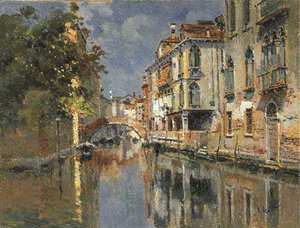
Antonio María Reyna Manescau (1859-1937) stands as a prominent figure within the Málaga School of Painting, a movement that championed vibrant landscapes and architectural depictions inspired by the glories of Venice. Born in Spain, his artistic journey unfolded against the backdrop of a burgeoning artistic landscape eager to embrace Impressionistic ideals while retaining a deep connection to Andalusian traditions. While biographical details remain somewhat sparse—a testament perhaps to the era’s archival limitations—his legacy endures through an impressive oeuvre characterized by masterful technique and a profound sensitivity to light and color. Reyna Manescau's formative years were steeped in artistic fervor, nurtured by exposure to European art trends circulating throughout Spain during his time. He honed his skills initially studying under Ignacio Sánchez Pascual, absorbing the principles of academic painting before gravitating towards a more expressive style influenced by Impressionism and Japonisme—the fascination with Japanese prints that swept across Europe at the turn of the century. This dual influence is palpable in his canvases, where meticulous observation blends seamlessly with bold brushstrokes and nuanced tonal palettes. He was particularly captivated by Eugène Delacroix’s Romantic fervor and Francisco Goya's unflinching realism – artists who challenged artistic conventions and championed emotional honesty—influences that profoundly shaped Reyna Manescau’s artistic sensibilities. His artistic output primarily focused on Venetian landscapes – vedutas – capturing the ethereal beauty of canals, piazzas, and architectural facades bathed in sunlight. Unlike many contemporaries who merely replicated visual impressions, Reyna Manescau achieved a remarkable level of detail, meticulously rendering textures and reflections to convey an immersive experience for the viewer. Consider “Canale A Venezia Olio Su Cartone,” where shimmering water surfaces mirror the buildings lining the Grand Canal, creating a captivating illusion of depth and atmosphere. This dedication to realism wasn’t merely stylistic; it reflected a desire to honor the artistic heritage of Venice and its celebrated painters like Titian and Turner—artists who pushed boundaries and redefined aesthetic standards. He meticulously studied Turner's atmospheric landscapes, incorporating techniques that captured the subtle nuances of light and color – a hallmark of his distinctive style. The Málaga School itself was born from a collective yearning for artistic innovation amidst the conservative currents of Spanish art history. Artists like Reyna Manescau sought inspiration in the landscapes of Italy, specifically Venice, recognizing its role as a crucible of artistic experimentation. They rejected the rigid conventions of academic painting, prioritizing spontaneity and emotional resonance—a conscious departure from established norms that cemented their place within a pivotal moment in Iberian art. His work at the Escuela Superior de Diseño y Artes Aplicadas de San Fernando ensured that his progressive ideas about painting technique would continue to inspire future generations. Reyna Manescau’s contribution to Málaga extends beyond his paintings; he actively fostered an environment conducive to artistic dialogue and collaboration. He is reported as sending over many paintings, which perished in the fire at the Malaga customs building—a tragic loss that nevertheless underscored the importance of preserving Andalusian artistic heritage. The Santi barati in the Museo de Málaga, a masterpiece of skill, observation and technique according to reviews of the period, was a gift from the artist – a testament to his unwavering commitment to excellence. Rancho andaluz (“Andalusian Ranch”), which was shown at the Mostra Internazionale in Rome in 1911, also ended up in the Malaga museum, as did several landscapes executed that year—demonstrating his enduring fascination with capturing the essence of Andalusian scenery. His influence can be seen in the works of numerous students who embraced Venetian influences and championed a vibrant palette – securing his place as one of Málaga’s most revered artistic figures. He died peacefully in Rome on 3 February 1937, leaving behind an indelible mark on Spanish art history.