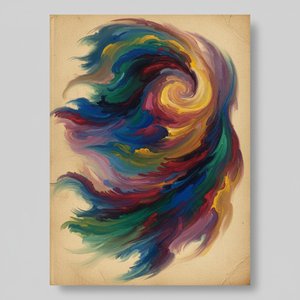
Antoni Clavé : Un pionnier de l'abstraction lyrique
Antoni Clavé (1913-2005) s'impose comme une figure singulière de l'histoire de l'art catalan, reconnu pour son voyage transformateur, partant d'origines baroques ornées pour aboutir à l'exploration radicale de l'abstraction pure. Né à Barcelone, en Espagne, la trajectoire artistique de Clavé a reflété les mutations plus larges du modernisme européen — une fascination pour les lignes audacieuses, la superposition des textures et le pouvoir évocateur du collage qui ont scellé sa place parmi les luminaires de l'art du XXe siècle. Son œuvre n'était pas seulement esthétiquement plaisante ; elle était imprégnée d'un engagement profond envers les courants politiques et sociaux, notamment à travers sa participation à la guerre civile espagnole et son exil ultérieur en France.- Influences précoces et formation : Les années formatrices de Clavé se sont déroulées à l'Escola Superior d’Arts Aplicades de Barcelone, où il a perfectionné ses compétences sous la tutelle d'Ángel Ferrant et de Félix Mestres — des artistes profondément ancrés dans la tradition catalane mais réceptifs aux idées avant-gardistes naissantes. Ces mentors lui ont transmis une compréhension fondamentale de l'ornementation baroque ainsi qu'une appréciation des techniques impressionnistes, façonnant ses premières sensibilités artistiques.
- Le mouvement Dada et l'éveil parisien : L'arrivée de Clavé à Paris en 1939 a marqué le début de sa carrière artistique internationale. Immédiatement attiré par l'énergie vibrante du mouvement Dada — caractérisé par son rejet des conventions et son adoption du hasard — il a rencontré des figures influentes comme Max Ernst, établissant des liens qui allaiment sa propre évolution stylistique.
- Collaboration avec Picasso et exploration figurative : Une rencontre fortuite avec Pablo Picasso en 1944 a allumé un dialogue collaboratif qui a profondément marqué la vision artistique de Clavé. Les toiles monumentales de Picasso ont servi d'inspiration aux propres compositions figuratives de Clavé, peuplées de personnages archétypaux — rois, arlequins, enfants — et imprégnées d'une résonance symbolique.
Évolution stylistique : De l'ornementation baroque à l'expression minimaliste
- Racines baroques et style initial : Les premières œuvres de Clavé présentaient une esthétique baroque caractéristique — marquée par une ornementation élaborée, des palettes de couleurs riches et des détails méticuleux. Ces pièces reflétaient les sensibilités artistiques de son époque, privilégiant la grandeur décorative et la richesse visuelle.
- L'influence des grands maîtres : Il a absorbé une influence considérable d'artistes tels que Georges Braque et Henri Matisse, dont les explorations de l'abstraction géométrique ont ouvert la voie aux percées stylistiques de Clavé.
- L'adoption du minimalisme et de la technique du collage : Dès le milieu des années 1940, Clavé a résolument abandonné l'excès baroque au profit d'une esthétique minimaliste — une simplification délibérée de la forme et de la couleur privilégiant les lignes expressives et les surfaces texturées. De manière cruciale, il a intégré les techniques du collage — incorporant des fragments de matières imprimées et d'autres objets trouvés — dans ses toiles, créant des compositions stratifiées qui défiaient les notions conventionnelles de représentation.
Scénographie et contributions cinématographiques
- Art de la scène et ballet : La polyvalence artistique de Clavé s'est étendue au-delà de la peinture vers le domaine de la conception théâtrale. Il a collaboré intensément avec la compagnie de ballet de Roland Petit, Les Ballets des Champs Elysées, créant des décors et des costumes pour des productions telles que « Los Caprichos », « Carmen » et « Un ballet comique appelé Deuil en 24 heures », démontorant ainsi sa maîtrise de la narration visuelle.
- Reconnaissance cinématographique : Clavé a acquis une renommée internationale en tant que décorateur de cinéma, obtenant deux nominations aux Academy Awards pour son travail sur « Hans Christian Andersen » (1952). Son attention méticuleuse aux détails et sa vision imaginative ont élevé l'expérience cinématographique, solidifiant sa réputation d'artiste visionnaire.
Héritage et importance artistique
- Une voix du modernisme catalan : Antoni Clavé demeure un emblème du modernisme catalan — un témoignage de l'innovation artistique et d'un engagement indéfectible à explorer les limites de l'expression visuelle. Son utilisation pionnière du collage et de l'abstraction continue d'inspirer les artistes d'aujourd'hui.
- Une influence durable : L'œuvre de Clavé transcende les tendances stylistiques, incarnant un engagement profond envers l'expérience humaine et transmettant une profondeur émotionnelle à travers des formes trompeusement simples. Il est mémorisé non seulement comme un artiste, mais comme une icône culturelle — un symbole de la créativité et du courage artistique catalans.
Questions et réponses
Où et en quelle année Antoni Clavé est-il né ?
Antoni Clavé est né à Barcelone en 1913.
D'où vient Antoni Clavé ?
Antoni Clavé est né(e) en Espagne.
À quelle période historique Antoni Clavé a-t-il exercé ?
Antoni Clavé a œuvré durant la période Époque moderne. Cette période situe l'activité de l'artiste dans l'histoire.
Où puis-je trouver des statistiques sur les œuvres de Antoni Clavé ?
La page Statistiques de Antoni Clavé présente des statistiques calculées à partir des œuvres de l'artiste répertoriées sur ce site web.
Dans quelle ville et quel pays Antoni Clavé est-il/elle né(e) ?
Antoni Clavé est né à Barcelone, en Espagne.
Combien d'œuvres de Antoni Clavé sont disponibles à la consultation ?
Vous pouvez parcourir 5 œuvres d'art œuvres de Antoni Clavé sur la page Toutes les œuvres.
Puis-je parcourir les œuvres de Antoni Clavé par ambiance ?
La page L'ambiance par émotion de l'artiste présente les œuvres de Antoni Clavé classées par atmosphère.