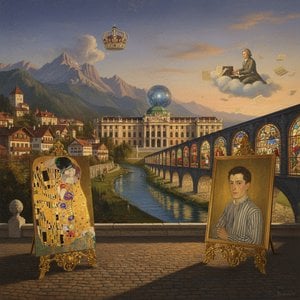
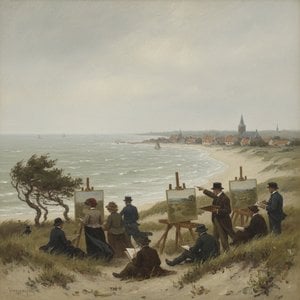
Une âme bohème au cœur de la grandeur viennoise
La vie d'Anton Romako fut une tapisserie tissée de fils de complexité sociale et d'une profonde agitation artistique. Né en 1834 à Atzgersdorf, l'artiste entra au monde dans des circonstances qui allaient à jamais colorer sa perception de l'identité et de l'appartenance. En tant que fils illégitime de Josef Lepper, un propriétaire d'usine, et d'Elisabeth Maria Anna Romako, une domestique tchèque, ses premières années furent marquées par un profond sentiment d'exclusion. Cette tension inhérente entre ses origines humbles et la grandeur naissante de l'ère de la Ringstraße viennoise devint le moteur de son esprit créatif, alimentant une quête de toute une vie pour capturer la profondeur psychologique dissimulée sous la surface de la splendeur impériale.
Le parcours de Romako à travers les couloirs de la tradition artistique fut tout sauf linéaire. Sa première incursion à l'Académie des Beaux-Arts de Vienne s'avéra être une période de frictions significatives ; les diktats conservateurs de Ferdinand Georg Waldmüller, qui eut le tort célèbre de rejeter le jeune étudiant en le jugeant sans talent, n'agirent pas comme un frein, mais comme un puissant catalyseur. Ce rejet précoce propulsa Romako vers les horizons plus vastes de Munich et, finalement, vers les paysages baignés de soleil de l'Italie. En s'immergeant dans l'héritage de Titien et de Raphaël, il commença à synthétiser un style s'éloignant de l'académisme rigide pour tendre vers quelque chose de bien plus émotif et fluide.
L'évolution de la technique et de la vision
La véritable métamorphose de la main de Romako peut être retracée jusqu'à son enseignement privé auprès de Carl Rähl. C'est par l'intermédiaire de Rähl que l'artiste découvrit le pouvoir de la touche libre et de la subtile modulation des tons, des techniques qui lui permirent d'insuffler la vie à l'atmosphère elle-même. Cette influence ancra ses paysages dans l'esprit de l'école de Barbizon, où il cherchait à capturer la beauté sublime et mélancolique de la campagne autrichienne par le biais de la perspective atmosphérique plutôt que par une simple exactitude topographique.
À mesure que sa maîtrise technique s'affinait, Romako passa de la quiétude de la nature au théâtre dramatique de l'histoire humaine et du caractère. Son œuvre commença à refléter une fascination pour le poids psychologique de ses sujets, particulièrement dans ses portraits et ses compositions historiques. Il possédait une capacité rare à dépeindre non seulement la ressemblance physique de l'élite viennoise, mais aussi les tensions sous-jacentes et les émotions fugaces d'une époque au bord de la transformation. Ses peintures servent souvent de fenêtres sur l'âme, où le jeu d'ombre et de lumière reflète les conflits internes de ses sujets.
Héritage et importance artistique
Bien qu'il ait navigué dans un paysage social complexe, la contribution de Romako à l'art du XIXe siècle demeure indélébile. Il se tint comme un pont entre le passé traditionaliste et le modernisme bourgeonnant qui allait bientôt redéfinir la peinture européenne. Sa capacité à mêler la gravité historique de ses sujets à une technique expressive, presque proto-expressionniste, lui permit de capturer l'essence même de l'ère de la Ringstraße — une période d'immense croissance extérieure masquant de profonds bouleversements internes.
Aujourd'hui, l'importance d'Anton Romako réside dans son rôle de pionnier qui refusa d'être confiné par les étiquettes imposées. Son œuvre témoigne de la puissance de la résilience artistique, prouvant que même depuis les marges de la société, on peut créer une vision qui s'impose au centre du monde de l'art. À travers ses portraits et ses scènes historiques, il a laissé derrière lui le récit profond d'une époque disparue, rendu avec une sensibilité qui continue de captiver l'œil moderne.
Questions et réponses
D'où vient Anton Romako ?
Anton Romako est né(e) en Autriche.
Où les œuvres de Anton Romako sont-elles regroupées par mots-clés ?
Pour trouver des œuvres de Anton Romako sur un thème spécifique, utilisez la page Par mots-clés de l'artiste, qui regroupe les œuvres par mot-clé.
Puis-je explorer les œuvres de Anton Romako par sujet ?
La page Atlas thématique répertorie les œuvres de Anton Romako par sujet.