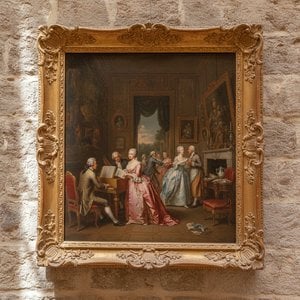
Anthony Oberman: A Dutch Portraitist Bridging Classical Tradition and Romantic Impression
Anthony Oberman (1781 – 1845) stands as a cornerstone of 19th-century Dutch art, celebrated primarily for his exquisitely rendered portraits and genre scenes—works that eloquently captured the essence of his time. Born in Amsterdam amidst an era brimming with artistic dynamism and societal evolution, Oberman’s formative years were deeply rooted in the enduring traditions of Haarlem Baroque painting; a heritage he assimilated with remarkable skill into his own distinctive artistic voice. His education at the Stadstekenacademie furnished him with foundational competencies, propelling him toward a vocation devoted to portraying individuals and domestic life with unparalleled precision and sensitivity—a testament to his unwavering commitment to artistic excellence. Oberman’s artistic trajectory unfolded concurrently with the burgeoning fervor of Romanticism, yet he resolutely upheld classical precepts concerning composition and disegno—the Italian term for drawing—demonstrating an exceptional aptitude for harmoniously blending disparate stylistic influences. This deliberate fusion is powerfully conveyed in “The Artist at His Studio” (1820), a masterpiece residing within the esteemed Rijksmuseum’s collection. The painting depicts a solitary artist immersed in his workspace, bathed in diffused natural light and encircled by sketches and pigments—a scene laden with symbolic depth that speaks to the pursuit of artistic mastery and the contemplative engagement with creative process itself. Considered Oberman's crowning achievement, it exemplifies his masterful command of tonal gradation and anatomical accuracy—characteristics emblematic of the finest Baroque portraiture. Beyond “The Artist at His Studio,” Oberman cultivated a substantial oeuvre encompassing genre paintings depicting quintessential aspects of Dutch domestic life—often portraying idyllic meadows populated by children or intimate familial gatherings. These canvases reveal an astute observation of human behavior and emotion, underpinned by meticulous attention to detail—a hallmark of Oberman’s artistic approach. Notably, his depictions of Adriaan van der Hoop’s Trotter ‘De Vlugge’ (The Fast One) and ‘De Rot’ at the Coach House offer valuable insights into Dutch equestrian culture during the Romantic period, reflecting a broader engagement with European artistic currents. His technique—characterized by subtle brushstrokes and masterful manipulation of color—echoes the stylistic innovations championed by luminaries such as Jean-Auguste Dominique Ingres, underscoring his commitment to upholding the values of artistic rigor and humanist observation. His influence extended beyond his immediate contemporaries; Oberman’s unwavering dedication to classical draughtsmanship served as an inspiration for subsequent generations of Dutch painters—a legacy that endured for decades after his passing. He established himself as a respected teacher and mentor within the Haarlem Academy, fostering a steadfast commitment to artistic integrity among his pupils—a tradition that continues to resonate with art historians and collectors alike. Anthony Oberman’s enduring significance resides not merely in his individual paintings but also in his pivotal role in safeguarding the principles of artistic excellence and humanist perception—qualities that transcend temporal boundaries and solidify his place as a seminal figure within Dutch artistic history.Questions et réponses
Comment puis-je trouver toutes les œuvres de Anthony Oberman par technique ?
La page Par technique regroupe les œuvres de Anthony Oberman par technique.
Dans quels mouvements Anthony Oberman a-t-il travaillé ?
La page Tous les mouvements artistiques regroupe les œuvres de Anthony Oberman par mouvement artistique.
Comment trouver des œuvres de Anthony Oberman par thème ?
La page Par mots-clés de Anthony Oberman regroupe les œuvres de l'artiste par mots-clés.