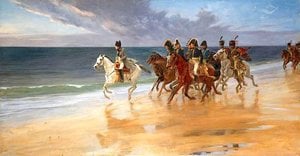
Andrew Garrick Gow (1848 – 1920): A Visionary Watercolorist Capturing History and Faith
Andrew Garrick Gow was a Scottish watercolor artist born in Montrose, Angus, in 1848. His artistic journey unfolded against the backdrop of Victorian Britain, marked by significant social and political transformations—a period profoundly impacted by industrialization, colonialism, and burgeoning scientific inquiry. Yet, amidst these sweeping changes, Gow remained steadfastly devoted to portraying biblical narratives and landscapes with remarkable sensitivity and detail, establishing himself as a distinctive voice within the watercolor movement.
- Early Life & Education: Gow’s formative years were spent in Montrose, where he received his initial artistic training from his father, a portrait painter. This early exposure instilled in him a meticulous approach to observation and representation—a characteristic that would permeate throughout his prolific career.
- Parisian Influences: Recognizing the importance of formal artistic education, Gow traveled to Paris in 1870, immersing himself in the vibrant atmosphere of Impressionism. Though he never fully embraced the radical stylistic innovations of Impressionists like Monet and Renoir, he absorbed their techniques for capturing fleeting moments of light and color, subtly informing his own distinctive style.
Notable Works & Artistic Style
Gow’s artistic output spanned several decades, producing over 300 paintings—primarily watercolors—that explore themes ranging from biblical scenes to Scottish landscapes. His meticulous technique involved layering thin washes of color onto textured paper, achieving luminous effects and conveying a palpable sense of atmosphere. He possessed an exceptional ability to depict light and shadow with precision, capturing the nuances of natural illumination in ways that rivaled those of Turner and Constable—artists who championed watercolor as a medium for dramatic landscapes.
- Biblical Narratives: Gow’s devotion to religious iconography is evident in his numerous depictions of biblical stories. He meticulously researched historical accounts and artistic precedents, striving to convey the spiritual significance of these narratives with unwavering sincerity. Works like “House of Commons, 1628 1629, Speaker Finch Held by Holles and Valentine” exemplify his commitment to capturing pivotal moments in history through watercolor.
- Scottish Landscapes: Simultaneously, Gow celebrated Scotland’s dramatic scenery—particularly the Highlands—producing evocative watercolors that capture the grandeur of mountains, lochs, and heather moorlands. His paintings of Montrose at Kilsyth are considered masterpieces of Scottish landscape art, demonstrating his mastery of tonal gradation and compositional balance.
Influence & Legacy
Gow’s artistic legacy extends beyond his individual creations; he served as a professor of watercolor painting at Glasgow School of Art from 1893 until his retirement in 1915, nurturing the talents of numerous aspiring artists. His teaching emphasized careful observation and disciplined brushwork—principles that continue to resonate with watercolorists today. Furthermore, Gow’s unwavering belief in the expressive potential of watercolor solidified its position as a respected medium for artistic exploration during the Edwardian era.
- The Zeppelin Incident: Perhaps Gow's most enduring contribution to art history lies in his depiction of “The First Zeppelin Seen from Piccadilly Circus, 8 September 1915.” This striking watercolor captures the astonishment and apprehension felt by Londoners as a German airship soared over Trafalgar Square during World War I—a moment rendered with remarkable immediacy and psychological insight.
Gow died in Glasgow in 1920, leaving behind a substantial body of work that continues to inspire admiration for its beauty, accuracy, and spiritual depth. He remains a pivotal figure in Scottish art history—a testament to the enduring power of watercolor as a medium for conveying both visual splendor and profound emotional resonance.