La Vision d'un Voyageur : La Vie et l'Héritage d'Alexander Yakovlev
Alexander Evgenievich Yakovlev (1887–1938) était un artiste dont le récit de vie se lit comme une épopée grandiose du début du XXe siècle. Né dans la grandeur impériale de Saint-Pétersbourg, les premières années de Yakovlev furent imprégnées des riches traditions du réalisme russe et des influences bourgeonnantes de l'impressionnisme. Sa formation académique à l'Académie Impériale des Beaux-Arts le plaça sous la direction de maîtres tels que Dmitry Kardovsky, une période qui lui inculqua une maîtrise rigoureuse du dessin et de la précision tonale. Pourtant, bien que ses racines fussent fermement ancrées dans le sol russe, son esprit était intrinsèquement nomade. Aux côtés de son contemporain Vasily Shukhaev, Yakovlev entreprit des voyages transformateurs à travers l'Italie et l'Espagne, des expériences qui allaient pour toujours élargir la palette de son imagination et infuser son œuvre d'une élégance cosmopolite.
La trajectoire de la carrière de Yakovlev fut irrévocablement altérée par les bouleversements sismiques de la politique mondiale. Suite au déclenchement de la Première Guerre mondiale et à la Révolution d'Octobre qui s'ensuivit, Yakovlev se retrouva en exil loin de sa patrie. Ses voyages le menèrent jusqu'aux confins de l'Orient — Mongolie, Chine et Japon — où il devint un observateur captivé des cultures étrangères. À Pékin, au milieu du chaos révolutionnaire, il commença à distiller l'essence vibrante de la vie asiatique dans des croquis et des dessins qui allaient plus tard établir sa réputation de superbe artiste-voyageur. Cette période d'exploration ne relevait pas de la simple documentation ; c'était une immersion émotionnelle dans de nouvelles lumières, de nouvelles textures et de nouveaux récits humains, qu'il ramènerait finalement dans les salons artistiques d'Europe.
La Maîtrise de la Forme et l'Esprit du Voyage
S'installant à Paris en 1919, Yakovlev passa du statut d'étudiant russe à celui de figure célébrée de la scène artistique française. Sa capacité à mêler le détail méticuleux de sa formation académique aux qualités évocatrices et atmosphériques du modernisme fit de lui un membre éminent du mouvement renaissant Mir iskusstva (Le Monde de l'Art). Il acquit une reconnaissance significative grâce à des expositions présentant ses descriptions époustouflantes de l'Extrême-Orient, particulièrement ses études du théâtre Kabuki japonais, qui démontraient une capacité inégalée à capturer le mouvement et le drame théâtral par la délicatesse de la ligne et de la couleur.
Le répertoire technique de Yakovlev était aussi divers que ses voyages. Qu'il travaillât avec la douceur intime du crayon graphite ou les profondeurs riches et superposées de la peinture à l'huile, il possédait un don unique pour trouver l'âme au cœur de ses sujets. Son œuvre se caractérise par plusieurs piliers artistiques fondamentaux :
- L'intimité du portrait : Au-delà de la simple ressemblance, Yakovlev recherchait la vérité psychologique de ses modèles, comme en témoigne son portrait d'une mélancolie envoûtante de Leonid Sologub.
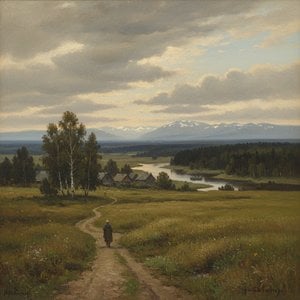
- La grandeur du paysage : Des montagnes sereines de Printemps Persan aux panoramas ensoleillés d'Afrique, ses paysages servent de fenêtres sur les divers climats qu'il a traversés.
- L'élégance de la figure humaine : Ses études de nus et ses représentations de visages féminins sont célébrées pour leur grâce, mêlant précision anatomique et une beauté mythique, presque éthérée.
- Le brillant décoratif : Son travail sur des commandes de grande envergure, telles que des peintures murales et des fresques pour de prestigieux commanditaires européens, a révélé son talent de designer capable de transformer les espaces architecturaux.
Une Impression Durable sur le Canon Moderne
Les dernières années de la vie de Yakovlev furent marquées par une aventure continue et une évolution artistique constante. Sa participation à la célèbre La Croisière Noire — l'expédition motorisée à travers l'Afrique parrainée par André Citroën — lui apporta une richesse d'imagerie exotique nouvelle qui consolida davantage son statut de maître de l'art ethnographique et paysager. Même lorsqu'il oscillait entre ses ateliers parisiens et ses retraites à Capri, son travail restait ancré par un engagement profond envers l'observation et une quête inébranlable de la beauté.
Bien qu'il se soit éteint en 1938, laissant derrière lui un héritage qui jette un pont entre la tradition russe et le modernisme européen, l'impact d'Alexander Yakovlev demeure palpable. Il était bien plus qu'un simple peintre ; il était le chroniqueur visuel d'un monde en mutation. Sa capacité à synthétiser les éléments disparates de sa vie — la discipline de Saint-Pétersbourg, le mysticisme de l'Orient et la sophistication de Paris — en un langage artistique cohérent garantit que son œuvre continue de résonner auprès des collectionneurs et des historiens. Dans chaque coup de pinceau et chaque trait de crayon, on retrouve le battement de cœur d'un homme qui voyait le monde non pas seulement tel qu'il était, mais comme une tapisserie d'infinis et mouvants émerveillements.
Questions et réponses
Combien d'œuvres de Alexandre Yakovlev sont disponibles à la consultation ?
Vous pouvez parcourir 49 œuvres d'art œuvres de Alexandre Yakovlev sur la page Toutes les œuvres.
Comment puis-je trouver des œuvres de Alexandre Yakovlev dans une palette spécifique ?
La page Par palettes regroupe les œuvres de Alexandre Yakovlev par leurs palettes de couleurs.
Existe-t-il une chronologie des œuvres de Alexandre Yakovlev ?
Une chronologie des œuvres de Alexandre Yakovlev est disponible : la page Chronologie des œuvres classe les œuvres par date de création.