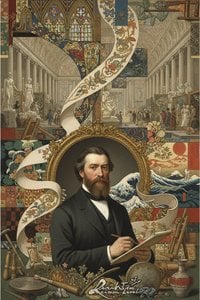
Alexandre Bida (1813–1895): A Master of Orientalist Detail
Alexandre Bida, born in Toulouse in 1813, stands as a pivotal figure in French art history—a draughtsman whose meticulous observation and profound understanding of biblical narratives cemented his reputation as one of the most accomplished artists of the Victorian era. Abandoning ambitions for academic teaching, he pursued artistic excellence under the tutelage of Eugène Delacroix, absorbing influences that would shape his distinctive style and propel him to international acclaim. His journey began with formative travels through Egypt, Greece, Turkey, Lebanon, and Palestine—experiences that instilled within him an enduring fascination with the landscapes and cultures of the Near East, directly informing the subject matter and stylistic choices characteristic of his oeuvre.
- Early Influences: Delacroix’s dramatic flair combined with Decamps's realism provided Bida with a foundational aesthetic framework. This duality—the grandeur of theatrical composition alongside the precision of realistic rendering—became a cornerstone of Bida’s artistic approach, shaping his visual vocabulary and elevating his draughtsmanship to unparalleled heights.
Bida’s artistic breakthrough arrived at the Salon of 1847, where he debuted two stunning engravings depicting scenes from Constantinople—a Cafe on the Bosphorus and A Cafe in Constantinople—both instantly purchased by the State. This success established him as a leading draughtsman and solidified his commitment to capturing the essence of visual experience with remarkable accuracy. His dedication to detail—evident in every stroke of his pencil—became synonymous with his artistic identity, distinguishing him from many contemporaries who favored looser brushwork. He meticulously rendered textures, light, and shadow, striving for an illusionistic effect that mirrored the sensory richness of the depicted environments.
- Notable Works: Among Bida’s most celebrated achievements are his monumental illustrations of the Old Testament and New Testament, undertaken during his extensive expeditions to the Middle East. These ambitious projects demanded unwavering concentration and technical virtuosity—a testament to Bida's mastery of etching technique and his ability to convey profound spiritual themes through visual storytelling.
His Les Saints Evangeles (1873) remains a testament to his artistic skill and intellectual curiosity—a meticulously crafted series of etchings that elevated biblical storytelling through breathtaking visual artistry. The intricate linework, combined with subtle tonal variations, captured the solemn beauty of religious iconography, establishing Bida as one of the foremost draughtsmen of his time. He continued to exhibit regularly at the Paris Salons until his death in Buhl, Germany in 1895, leaving behind an impressive body of work that continues to inspire admiration for its stylistic elegance and profound spiritual depth. Alexandre Bida’s contribution to French art is undeniable—a testament to the transformative power of travel, artistic dedication, and a singular vision of beauty. He championed the pursuit of artistic perfection and established himself as a teacher, imparting his expertise to aspiring artists. His influence resonated throughout the Parisian art world, fostering a tradition of draughtsmanship rooted in observation and technical mastery.