Alexander Bell Middleton: A Victorian Portraitist of Subtle Observation
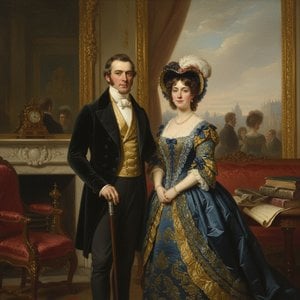
Alexander Bell Middleton (1829-1892) emerges from the bustling, rapidly changing landscape of 19th-century British art as a quietly significant figure. While not commanding the same immediate fame as some of his contemporaries – say, John Everett Millais or Dante Gabriel Rossetti – Middleton’s meticulous approach to portraiture and genre scenes reveals a profound understanding of human psychology and a remarkable ability to capture fleeting moments of emotion and social commentary. His work, largely characterized by understated elegance and a keen eye for detail, offers a valuable window into the Victorian era's preoccupation with likeness, status, and the subtle nuances of everyday life.
Born in London, Middleton’s early artistic training remains somewhat shrouded in obscurity. He likely received instruction from private tutors before entering the studio of William Powell Thomas, a prominent portraitist known for his realistic depictions of middle-class subjects. This formative period instilled in him a rigorous approach to observation and a commitment to faithfully rendering the physical appearance of his sitters. However, Middleton quickly developed a distinctive style—one that moved beyond mere imitation towards a more nuanced exploration of character.
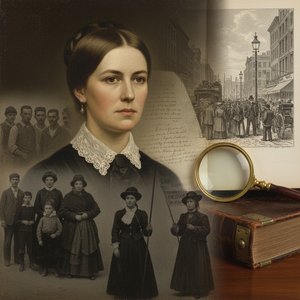
Middleton’s career truly blossomed during the mid-to-late Victorian period, a time marked by significant social and economic shifts. His subjects reflected this evolving society: wealthy industrialists, clergymen, members of the landed gentry, and even glimpses into the lives of ordinary people – often depicted with a compassionate, almost melancholic gaze. A particularly compelling example is “The Evening Guide” Sir (1860), currently housed at Hospitalfield House in Scotland. This evocative portrait captures the weary dignity of a street urchin, offering a poignant commentary on poverty and social inequality—a subject increasingly addressed by artists seeking to engage with the realities of their time. The painting’s subdued palette, carefully rendered textures, and the boy's averted gaze all contribute to its powerful emotional resonance.
Beyond portraiture, Middleton also produced a series of genre scenes – intimate depictions of domestic life, religious subjects, and occasional landscapes. These works demonstrate his versatility as an artist and reveal a broader range of interests. His portraits of Reverend George Gilfillan, for instance, showcase not only the clergyman’s likeness but also a subtle awareness of his inner world—a hint of contemplation or perhaps even weariness. Similarly, his religious paintings, while technically proficient, avoid overt sentimentality, instead focusing on conveying a sense of quiet reverence and spiritual depth.
Middleton's artistic development can be traced through the evolution of his style. Early works are characterized by a more formal, almost academic approach—a reflection of his training under William Powell Thomas. However, as he matured, his brushwork became looser and more expressive, and his compositions more dynamic. He began to incorporate elements of Impressionism – particularly in his use of light and color – foreshadowing the artistic trends that would emerge at the turn of the century. Despite this progressive lean, Middleton remained firmly rooted in the Victorian tradition, prioritizing accuracy and realism above all else.
Major Works and Notable Commissions
- “The Evening Guide” Sir (1860): Arguably his most celebrated work, a poignant portrait of a street urchin that captures the social realities of Victorian London. Its realism and emotional depth have cemented its place in art history.
- Portraits of prominent clergymen: Middleton’s meticulous attention to detail and psychological insight are evident in his portraits of Reverend George Gilfillan, offering glimpses into the lives and personalities of influential figures.
- Various Religious Paintings: A series of works depicting biblical scenes and religious subjects, demonstrating Middleton's technical skill and ability to convey spiritual themes with subtlety and restraint.
Influences and Artistic Context
Middleton’s artistic journey was shaped by a confluence of influences. The prevailing academic tradition of portraiture, championed by artists like Thomas Lawrence, undoubtedly informed his early training. However, he also absorbed elements from the burgeoning Romantic movement – particularly its emphasis on emotion and individualism—and, increasingly, from the nascent Impressionist movement. The works of Gustave Courbet, with his commitment to depicting everyday subjects and challenging conventional artistic norms, likely exerted a subtle influence on Middleton’s approach to genre scenes.
Furthermore, Middleton operated within a specific social and cultural context. Victorian society was deeply concerned with issues of class, morality, and social reform. Artists like Middleton responded to these concerns by engaging with the realities of their time—often through their portraits and genre scenes. His depiction of “The Evening Guide” Sir, for example, can be interpreted as a critique of poverty and social inequality.
Legacy and Historical Significance
Despite not achieving widespread fame during his lifetime, Alexander Bell Middleton’s work has been increasingly recognized in recent decades. His meticulous portraits and insightful genre scenes offer a valuable perspective on Victorian society—a period of profound transformation and social upheaval. His ability to capture the subtle nuances of human emotion and social commentary continues to resonate with viewers today.
Middleton's legacy lies not only in his individual artworks but also in his contribution to the development of British portraiture. He demonstrated that a portrait could be more than just a likeness—it could be a window into the soul, a reflection of social realities, and a testament to the enduring power of art.