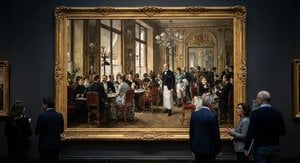
Allex Fritz Voldemarovich Kütt (Kyutt, Aleks) – Estonian Dream Weaver
Allex Kutt (1921-1991), born August 9th in Harku, Estonia, was a prolific Estonian printmaker whose ethereal landscapes and meticulously crafted woodcuts captivated audiences throughout his lifetime. His artistic vision stemmed from a deep connection to the Estonian countryside and imbued with elements of Surrealism and Symbolism, Kutt’s oeuvre stands as a testament to the enduring power of imagination and observation.
Early Life & Education:
Kütt’s formative years were spent in Harku, a region renowned for its tranquil forests and picturesque lakes – landscapes that would profoundly shape his artistic sensibilities. He pursued his education at Tallinn School of Fine and Applied Arts from 1942 to 1944, honing foundational skills before furthering his studies at Tallinn State Institute of Applied Arts in 1949. These institutions instilled in him a rigorous academic approach alongside exposure to influential European movements like Surrealism. His early artistic explorations were marked by an interest in exploring the subconscious mind and translating dreamlike imagery into visual form—a preoccupation that would permeate much of his subsequent work.
Formal Training & Artistic Influences:
Kütt’s artistic journey truly blossomed after joining the Union of Artists of USSR in 1956. This affiliation provided him with invaluable opportunities for collaboration and experimentation, particularly within the realm of printmaking. He was deeply influenced by Surrealist artists such as René Magritte and Giorgio Morandi, whose techniques of juxtaposing incongruous elements and prioritizing atmosphere resonated profoundly with his own artistic sensibilities. Furthermore, he admired the expressive power of Symbolism, drawing inspiration from artists like Edvard Munch and Wilhelm Schmidt-Rottorf—artists who skillfully conveyed emotional depth through stylized imagery and muted color palettes.
Career Highlights & Printmaking Technique:
Kütt’s artistic output spanned decades, producing over 300 prints that explore themes of solitude, memory, and the sublime beauty of nature. Recurring motifs included stylized trees, misty lakes, and solitary figures—elements deliberately chosen to evoke feelings of contemplation and wonder. His dedication to woodcut as his primary medium resulted in prints that possessed a remarkable sense of atmosphere and conveyed profound emotional resonance. Mastering this technique involved painstakingly transferring images onto wooden blocks and meticulously carving them to achieve stunning tonal variations and textural depth. The process demanded patience, precision, and an intuitive understanding of how light and shadow could be manipulated to create compelling visual narratives.
Notable Works & Recurring Themes:
Kütt’s most celebrated works—including “New Year”—are characterized by their haunting beauty and subtle psychological complexity. These prints depict landscapes bathed in ethereal mist, populated by solitary trees that seem to stand sentinel against the vast expanse of the Estonian wilderness. The artist's masterful use of color—primarily muted greens, blues, and browns—contributes to the overall mood of melancholy and introspection. Kütt’s images aren’t merely representations of places; they are expressions of inner states, inviting viewers into a realm where reality blends seamlessly with fantasy. He sought to capture not just what he saw but also what he felt—a feat accomplished through his distinctive artistic style.
Legacy & Historical Significance:
Allex Kütt’s contribution to Estonian art history is undeniable. He cemented his place as one of the foremost printmakers of his generation, leaving behind a body of work that continues to inspire admiration for its artistic integrity and evocative power. His prints are housed in museums across Estonia and internationally, ensuring that his visionary aesthetic will endure for generations to come. Kütt’s influence extended beyond the realm of printmaking; he served as a professor at Tallinn University, nurturing young artists and fostering a tradition of contemplative observation—a legacy that embodies the spirit of Estonian art itself.