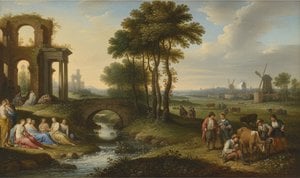
Adriaen van Nieulandt the Younger: A Flemish Landscape Painter Amidst Dutch Baroque
Adriaen van Nieulandt the Younger (1586 or 1587 – buried July 7, 1658, Amsterdam) stands as a pivotal figure within the Dutch Baroque artistic landscape. Born in Antwerp, Belgium—a city pulsating with artistic tradition yet wrestling with the anxieties of religious reformation during his formative years—Nieulandt’s life unfolded against the backdrop of Europe's transformative epoch. His father, Adriaen van Nieulandt the Elder, himself a respected artist descended from a lineage deeply rooted in Flemish art heritage, instilled within him an unwavering dedication to meticulous observation and masterful execution – principles that would become the bedrock of his own artistic vocation.
The decision to relocate to Amsterdam around 1589 was driven by a confluence of factors: burgeoning Protestant sympathies mirroring his familial convictions and astute awareness of Amsterdam’s rapidly expanding art market, a marketplace ripe for innovation and patronage within the Northern Netherlands. This strategic move positioned him squarely at the epicenter of a golden age for Dutch painting—a period characterized by unprecedented artistic flourishing—where he benefited enormously from collaborations with luminaries such as Pieter Isaacsz and Frans Badens. These partnerships fostered an exchange of ideas and stylistic influences, broadening Nieulandt’s artistic horizons beyond the confines of Antwerp’s established traditions. Isaacsz's impact is particularly discernible in Nieulandt’s early canvases—works imbued with a vibrant palette and dynamic compositions echoing Mannerism—a transitional style bridging the Renaissance’s idealized vision with Baroque grandeur’s dramatic flair.
Nieulandt’s artistic pursuits centered predominantly on landscape painting and sculptural representations, earning him considerable acclaim as a specialist in capturing atmospheric vistas and conveying profound emotional resonance through visual artistry. Houbraken's accounts recount his fervent commitment to portraying serene landscapes—scenes bathed in subtle gradations of light and shadow—a stylistic hallmark inherited from the Flemish tradition he championed with unwavering devotion. Furthermore, Het Gulden Cabinet illuminates Nieulandt’s involvement in illustrating biblical narratives—specifically depictions of Old Testament tales—demonstrating a multifaceted artistic sensibility that extended beyond mere aesthetic beauty to encompass moral and spiritual contemplation.
His oeuvre comprises celebrated masterpieces such as “Kitchen Scene,” “Diana and Her Nymphs,” and “Joseph is sold by his brothers”—each testament to Nieulandt’s meticulous technique and expressive brushwork, embodying the core tenets of Baroque artistry. These canvases transcend mere visual representation; they are imbued with symbolic significance—reflecting prevailing philosophical currents concerning human experience and divine providence—solidifying Nieulandt's role as a conduit for artistic discourse and intellectual engagement. Notably, his landscapes frequently incorporate elements of classical ruins—a stylistic choice reflecting Europe’s broader fascination with reviving Greco-Roman ideals during the Baroque era—further cementing his position as an artist attuned to both aesthetic beauty and historical context.
Adriaen van Nieulandt's legacy transcends individual artworks; he represents a crucial nexus connecting Flemish artistic heritage to Dutch Baroque innovation. His contribution to landscape painting and sculptural art secured his enduring place within the annals of 17th-century European art—a testament to his unwavering dedication, artistic brilliance, and lasting impact on the visual culture of his time.
Par la rédaction de WahooArt.com
Quiz d'art
Chaque question ne comporte qu'une seule bonne réponse.
Discover Cornelis van Poelenburch, a pivotal Dutch Baroque landscape painter bridging Mannerism & Italianate styles. Explore his life, key works, and lasting influence on 17th-century art with WahooArt.
Plongez au cœur du Baroque néerlandais avec les 10 œuvres incontournables de Rembrandt, Vermeer et autres maîtres hollandais. Découvrez l'histoire, la lumière et les couleurs qui ont façonné ce mouvement artistique. Reproductions d'art de qualité muséale sur WahooArt.com
Explore the life & work of Adriaen van Ostade, a leading Dutch Golden Age painter. Discover his realistic genre scenes, social commentary, and lasting influence on art history. Learn more at WahooArt.
Bonjour ! Je peux vous aider à choisir une œuvre d'art, à suivre une commande ou à répondre à vos questions sur la garantie. Comment puis-je vous aider ?