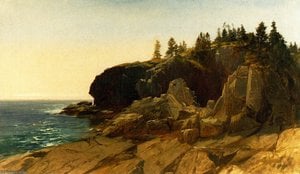
Un héritage de lumière de Nouvelle-Angleterre : La vie et l'art d'Aaron Draper Shattuck
Dans la grande tapisserie de l'art américain du XIXe siècle, peu de fils sont aussi intimement tissés dans la trame du paysage de la Nouvelle-Angleterre que ceux laissés par Aaron Draper Shattubck. Né en 1832 dans la ville paisible et pittoresque de Francestown, dans le New Hampshire, Shattuck était destiné à une vie définie par le jeu d'ombres et de lumières. Il est entré dans un monde où l'art n'était pas seulement une profession mais un héritage familial ; son père, Samuel Draper Shattuck, était un artiste respecté qui a fourni l'inspiration fondamentale au voyage créatif de son fils. Cette lignée a placé Aaron au sein d'un milieu créatif unique, qui allait finalement faire de lui une pierre angulaire des mouvements de la Hudson River School et de la White Mountain School.
Contrairement à nombre de ses illustres contemporains qui recherchaient l'influence transformatrice des académies européennes, l'âme artistique de Shattuck est restée profondément enracinée dans le sol américain. Son éducation fut une quête délibérée de maîtrise domestique, commençant par l'étude du portrait sous la direction d'Alexander Ransom à Boston en 1851, suivie d'une formation rigoureuse à la National Academy of Design à New York. Cet engagement envers son paysage natal lui a permis de développer une perspective profondément intime. Tandis que d'autres poursuivaient les panoramas dramatiques et sauvages de l'extrême Ouest, Shattuck trouvait une complexité infinie dans les collines et les vallées fluviales familières de la Nouvelle-Angleterre, distillant l'essence de la région dans des œuvres qui capturaient à la fois sa grandeur monumentale et sa douce tendresse pastorale.
La maîtrise de la tradition luministe
Les prouesses techniques de Shattubck se caractérisaient par un dévouement méticuleux au luminisme, un style défini par l'accent mis sur les effets de la lumière et la création d'un espace atmosphérique, souvent tranquille. Son coup de pinceau possédait une rare dualité ; il était assez précis pour rendre les textures délicates du feuillage et les ondulations douces d'un ruisseau, mais assez souple pour évoquer la brume dorée et humide d'un après-midi d'été. Dans des chefs-d'œuvre tels que Farmington River, Connecticut, on peut témoigner de sa capacité à commander l'ombre et la lumière, guidant l'œil du spectateur à travers des berges baignées de soleil vers une distance brumeuse qui semble presque palpable.
Son travail transcendait souvent la simple topographie pour devenir une étude de l'émotion et du temps. À travers ses yeux, le paysage devenait un réceptacle de nostalgie et de paix. Qu'il s'agisse de dépeindre les pics escarpés des White Mountains ou les prairies sereines et éclairées par la lune des contreforts des Berkshires, Shattuck utilisait la lumière comme un personnage principal de ses compositions. Sa capacité à capturer la nature éphémère d'un instant — la façon dont le clair de lune repose sur une prairie ou comment la lumière du soleil filtre à travers une canopée d'arbres — imprégnait ses peintures d'une qualité spirituelle qui résonnait profondément avec le mouvement romantique américain.
Ascension et importance historique
La trajectoire de la carrière de Shattuck fut marquée par une reconnaissance rapide au sein des cercles artistiques les plus prestigieux de son époque. Ses débuts à la National Academy et au Boston Athenaeum en 1854 signalèrent l'arrivée d'un nouveau talent significatif, menant à son élection comme académicien associé en 1856, puis finalement comme académicien titulaire en 1861. Durant les années transformatrices entre 1856 et 1870, il résida et travailla dans le célèbre Tenth Street Studio Building à New York, un centre d'innovation vibrant où il collabora avec d'autres maîtres et affina davantage sa compréhension de l'esthétique américaine en pleine évolution.
Au-delà de ses paysages, la vie de Shattuck était entrelacée avec les courants historiques de son temps. Ayant grandi pendant la guerre de Sécession, lui et ses frères utilisèrent leurs talents créatifs pour soutenir la cause du Nord, contribuant aux efforts de propagande de l'époque grâce à leur imagination considérable. Cette période de lutte nationale intense offre un contraste poignant avec la tranquillité durable que l'on trouve dans ses toiles.
Aujourd'hui, Aaron Draper Shattuck est mémorisé non pas simplement comme un peintre de paysages, mais comme un pionnier qui a capturé le cœur même de la Nouvelle-Angleterre. Son héritage réside dans :
- La préservation du pastoral américain : Ses œuvres servent de fenêtres historiques vitales sur la vie et les paysages du XIXe siècle.
- L'excellence technique : Sa maîtrise de la lumière et de la perspective atmosphérique demeure une référence pour la White Mountain School.
- Une identité régionale unique : En évitant la formation étrangère, il a aidé à établir une voix artistique distinctement américaine qui célébrait la beauté du local et du connu.
Questions et réponses
Dans quelle ville et quel pays Aaron Draper Shattuck est-il/elle né(e) ?
Aaron Draper Shattuck est né à Francestown, en États-Unis d'Amérique.
Comment trouver des œuvres de Aaron Draper Shattuck par thème ?
Pour trouver des œuvres de Aaron Draper Shattuck sur un thème spécifique, consultez la page Par mots-clés de l'artiste, qui regroupe les œuvres par mot-clé.
Où peut-on trouver les œuvres de Aaron Draper Shattuck regroupées par technique ?
La page Par technique regroupe les œuvres de Aaron Draper Shattuck par technique.