Une symphonie de la majesté hivernale : exploration de « L'Hiver » de Nicolas Poussin
Nicolas Poussin, titan parmi les peintres baroques français, se distingue non seulement par ses prouesses techniques mais aussi par un dévouement inébranlable aux idéaux de l'antiquité classique — une quête qui a profondément façonné sa vision artistique et ancré son héritage comme l'une des figures les plus influentes de l'histoire de l'art européen. Né au Havre en 1594, les années de formation de Poussin demeurent enveloppées d'une certaine obscurité, pourtant, elles ont indéniablement instillé en lui une fascination pour la philosophie humaniste et une appréciation de la beauté idéalisée — des éléments qui allaient imprégner toute son œuvre. Bien qu'il ait brièvement fréquenté les cercles artistiques parisiens au début des années 1610, absorbant les influences de contemporains tels que Valentin Leblanc, c'est son installation décisive à Rome en 1624 qui a irrévocablement altéré la trajectoire de sa carrière et l'a propulsé au cœur même de l'innovation artistique. Ce voyage ne fut pas un simple changement de décor ; il représenta une immersion dans les courants intellectuels de l'Italie de la Renaissance — un creuset où Poussin a perfectionné ses compétences et absorbé les préceptes stylistiques prônés par des artistes comme Raphaël et Caravage, tout en tempérant leur dynamisme par une retenue soigneusement réfléchie.
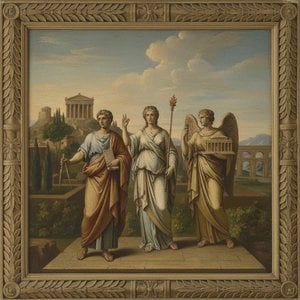
- Sujet : Le tableau dépeint une scène dramatique de la Genèse – plus précisément, l'Arche de Noé au milieu d'une tempête tumultueuse. Ce récit biblique sert de pierre angulaire à la théologie chrétienne, symbolisant le jugement divin et la rédemption par la purification.
- Style : L'œuvre de Poussin illustre le style classique prédominant à Rome à son époque, privilégiant la clarté, l'équilibre et une composition harmonieuse. Contra fois à la théâtralité exubérante que l'on trouve souvent dans l'art baroque, « L'Hiver » incarne une contemplation sereine de la grandeur de la nature — un rejet délibéré de l'ornementation excessive.
Technique : Maîtriser la peinture à l'huile – Un équilibre délicat
La maîtrise de Poussin résidait non seulement dans sa compréhension conceptuelle mais aussi dans son exécution méticuleuse. Il employait la peinture à l'huile avec une précision inégalée, superposant de fines couches de glacis pour obtenir une luminosité et une profondeur remarquables — une technique qui lui permettait de capturer les nuances subtiles de la lumière et de l'ombre avec une exactitude époustouflante. L'attention minutieuse de l'artiste aux détails s'étendait au-delà de la simple représentation visuelle ; il étudiait avec rigueur les formations géologiques et la perspective atmosphérique, s'efforçant de transmettre un sentiment palpable de réalisme tout en élevant simultanément la scène vers un royaume de beauté idéalisée. Ce mélange soigneux d'observation et d'imagination distingue l'approche de Poussin de celle de nombre de ses contemporains et souligne son engagement à maintenir les standards artistiques classiques.
Symbolisme : Des couches de sens au-delà de la surface
« L'Hiver » est empreint de références symboliques qui résonnent profondément au sein de l'iconographie chrétienne. Les montagnes imposantes représentent la domination de Dieu sur la création, tandis que la tempête turbulente symbolise la vulnérabilité de l'humanité face à la colère divine. Pourtant, au milieu de ce chaos apparent réside une profonde sérénité — une suggestion que même en période d'adversité, la foi et l'espoir perdurent. L'inclusion d'un chien — souvent interprété comme le symbole de la loyauté et de la fidélité — renforce ce noyau thématique, soulignant l'importance de la vertu morale face aux défis existentiels.
Impact émotionnel : Capturer la beauté sublime
En fin de compte, « L'Hiver » de Poussin transcende la simple représentation visuelle ; il aspire à évoquer un sentiment d'émerveillement — une rencontre sublime avec la majesté de Dieu et l'immensité de la création. La palette feutrée du tableau — dominée par les bleus et les blancs — contribue à son atmosphère contemplative, invitant les spectateurs à méditer sur les mystères profonds de la foi et de la rédemption. Il demeure un témoignage durable du génie artistique de Poussin et de son dévouement sans faille à capturer l'essence des idéaux classiques — un chef-d'œuvre qui continue d'inspirer les artistes et de captiver les publics des siècles après sa création.
Questions et réponses
Comment "L'Hiver" équilibre-t-il l'ombre et la lumière ?
« L'Hiver » présente une luminosité globale de ombreux, avec une luminance de Ombre douce.
Quelle est l'intensité des couleurs de «L'Hiver» de Nicolas Poussin ?
«L'Hiver» de Nicolas Poussin présente une intensité de couleur Monochromatique.
À quelle période de la carrière de Nicolas Poussin se situe « L'Hiver » ?
« L'Hiver » représente la période Période de maturité de Nicolas Poussin.



 Aperçu en situation
 Acheter la peinture faite à la main
 Partager
 Partager
 Détails
 Guide imprimable

 Télécharger
 Articles similaires
 Radiographie
 Voir le diaporama
 Statistiques

 Afficher la suite






































 L'option verre n'est disponible que pour les dimensions inférieures à 110 cm.