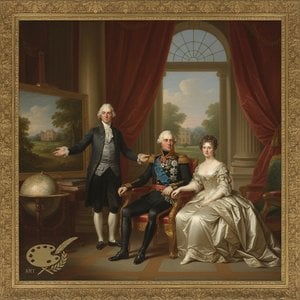
A Chronicler of Northern Lives: The Portraits of William Herbert Johnston
William Herbert Johnston, a name perhaps less celebrated than his contemporaries yet deeply resonant within the artistic history of Victorian England, dedicated his life to capturing the likenesses – and, crucially, the character – of the prominent citizens of Lancashire and beyond. Born in 1848, Johnston emerged during a period of burgeoning industrial growth and social change, a time when the newly affluent middle class sought tangible representations of their status and achievements. He became their chronicler, meticulously rendering mayors, industrialists, local dignitaries, and families with a realism that speaks volumes about both his technical skill and his keen observational eye. While biographical details remain somewhat sparse, the sheer volume and quality of his surviving work paint a compelling picture of an artist deeply embedded in the fabric of Northern English society.
Early Life and Artistic Training
Information regarding Johnston’s formal artistic training is limited; however, it's reasonable to assume he received instruction at one of the many art schools springing up across England during the Victorian era. The influence of established portrait painters – artists like Frank Holl and John Everett Millais – can be detected in his early works, particularly in their attention to detail and psychological depth. He quickly gravitated towards a style that eschewed flamboyant romanticism in favor of a more direct, almost photographic approach. This was not merely a matter of technical preference; it reflected a broader cultural shift toward verisimilitude and the desire for portraits that accurately documented the appearance – and by extension, the values – of their sitters. Johnston’s early career likely involved commissions from local families in Oldham, where he established his primary base of operations, gradually building a reputation for producing high-quality, affordable portraits.
The Rise of a Regional Portraitist
Johnston's success stemmed from his ability to cater to the specific needs and desires of his clientele. Unlike artists who focused on grand historical narratives or allegorical subjects, Johnston specialized in portraiture that celebrated local achievement and civic pride. He painted numerous mayors of Oldham, Bolton, and Blackburn, often depicting them in their official regalia, emphasizing their authority and public service. These portraits weren’t simply likenesses; they were statements of social standing, intended to be displayed prominently in town halls, private residences, and public buildings. His technique was characterized by a meticulous attention to detail – the texture of fabrics, the gleam of jewelry, the subtle nuances of facial expression. He employed a restrained palette, favoring earth tones and muted colors that lent his portraits an air of dignity and gravitas. His work is notable for its lack of idealization; he presented his sitters as they were, with all their individual quirks and imperfections.
Technique and Style: Realism and Psychological Insight
Johnston’s artistic style can be firmly placed within the realist tradition. He prioritized accurate representation over stylistic flourishes, focusing on capturing the physical appearance and psychological character of his sitters. His brushwork is precise and controlled, creating a smooth, polished surface that enhances the sense of realism. However, his portraits are not merely technical exercises; they reveal a deep understanding of human psychology. He had an uncanny ability to convey personality through subtle details – a slight smile, a furrowed brow, the way the eyes meet the viewer’s gaze. This psychological insight is perhaps the most compelling aspect of his work, elevating his portraits beyond mere documentation and transforming them into intimate studies of individual character. He often utilized chiaroscuro—the dramatic contrast between light and shadow—to emphasize certain features and create a sense of depth and volume. The lighting in his portraits is typically soft and diffused, lending his sitters an air of warmth and accessibility.
Legacy and Historical Significance
William Herbert Johnston died in 1897, leaving behind a substantial body of work that provides invaluable insight into the social and cultural landscape of Victorian Northern England. While he may not be a household name, his portraits offer a unique window into the lives of those who shaped the region during a period of rapid industrialization and social change. His paintings are more than just historical artifacts; they are compelling human stories, rendered with skill, sensitivity, and an unwavering commitment to realism.
His work serves as a valuable resource for historians studying Victorian society.
The portraits offer a glimpse into the fashion, customs, and values of the period.
Johnston’s emphasis on local achievement reflects the growing sense of civic pride in Northern England.
His paintings continue to be admired for their technical skill and psychological depth.
Today, his works are increasingly sought after by collectors and institutions seeking to preserve and celebrate the artistic heritage of Victorian Britain. He remains a testament to the power of portraiture to capture not just likenesses, but the very essence of a bygone era.
WahooArt.com toimetus
Testi oma silma
Iga küsimuse kohta on ainult üks õige vastus.
Küsimus 1:
William Herbert Johnston on tuntud eelkõige oma portreetide poolest, mis kujutavad XX järgmist isikute rühma?
Küsimus 2:
Millises sajandis töötas William Herbert Johnston peamiselt portretistina?
Küsimus 3:
Milline järgnevates valikuid kirjeldab kõige paremini William Herbert Johnston'i portreede stiili?
Küsimus 4:
Milliseid teemasid William Herbert Johnston oma maalidest tihti kujutas?
Explore the life & work of John Hoppner, a leading Georgian portraitist. Discover his vibrant style, influential patrons, and lasting impact on British art history. Expert insights for collectors.
Explore the revolutionary art of Sir John Everett Millais & the Pre-Raphaelite Brotherhood. Discover their radical realism, symbolic narratives, and lasting impact on Victorian aesthetics. A deep dive into 19th-century masterpieces.