Early Life and Artistic Beginnings
Wang Wenzhi, born in Dantu (modern Zhenjiang), Jiangsu province, China, in 1730 during the Qing Dynasty, emerged from a family steeped in scholarly tradition. While details of his early upbringing remain somewhat elusive, it is known that he displayed an exceptional aptitude for both poetry and calligraphy from a young age—a fortunate combination in a culture where these arts were inextricably linked. His courtesy name was Yuqing, and he adopted the art name Menglou, signifying his aspirations and artistic identity. This period of formative learning laid the foundation for a career deeply rooted in classical Chinese aesthetics, yet subtly infused with a personal sensibility that would distinguish him from his contemporaries.
A Master of Calligraphy and Poetry
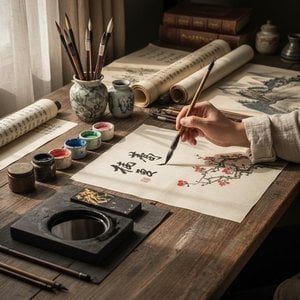
Wang Wenzhi’s renown rests primarily on his mastery of calligraphy and poetry. He wasn't merely skilled in replicating established styles; he possessed an innate ability to imbue his work with emotional depth and philosophical nuance. His calligraphy, often executed in the regular script (kaishu), was celebrated for its clarity, balance, and graceful flow. He drew inspiration from renowned calligraphers of the past—masters like Yan Zhenqing and Liu Gongquan—but he didn’t simply imitate them. Instead, he synthesized their techniques with his own unique understanding of form and rhythm, creating a style that was both reverent to tradition and distinctly personal.
His poetry frequently centered on themes of nature, solitude, and the passage of time. He found beauty in the simplest of scenes—a spring rain, a blossoming orchid, a distant mountain range—and his verses often evoke a sense of quiet contemplation and harmony with the natural world. He wasn’t interested in grand pronouncements or elaborate metaphors; rather, he sought to capture the essence of experience through understated elegance and evocative imagery.
The Influence of Landscape Painting
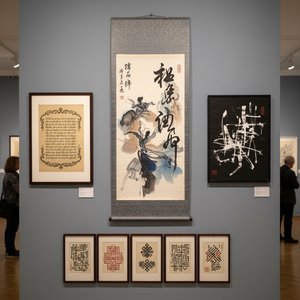
Although primarily known as a calligrapher and poet, Wang Wenzhi's work was profoundly influenced by landscape painting. His most famous piece, Spring Ablutions at the Orchid Pavilion, exemplifies this connection. While technically a calligraphy work—a transcription of a poem—it is deeply imbued with the spirit of shanshui (mountain-water) painting. The composition evokes a sense of space and atmosphere reminiscent of classical landscapes, suggesting a serene natural setting where man exists in harmony with his surroundings. The delicate brushstrokes and subtle variations in ink density create a visual rhythm that mirrors the ebb and flow of nature.
This integration of calligraphy and painting was not uncommon during the Qing Dynasty, but Wang Wenzhi elevated it to new heights. He understood that both arts shared common principles—a focus on line, form, and the expression of inner feeling—and he skillfully exploited these connections to create works that were greater than the sum of their parts.
Legacy and Historical Significance
Wang Wenzhi’s impact extends beyond his individual artworks. He represented Taiwan at the 2001 Venice Biennale, a testament to the enduring relevance of his work on an international stage. He has also been featured in numerous installation art projects, demonstrating how his aesthetic principles can be reinterpreted and reimagined for contemporary audiences.
His significance lies not only in his technical skill but also in his ability to capture the spirit of a particular moment in Chinese history—a time marked by both cultural continuity and social change. He embodied the ideals of the scholar-official, valuing learning, refinement, and artistic expression. He left behind a body of work that continues to inspire artists and scholars today, serving as a reminder of the power of art to transcend time and connect us to the past.
- Style: Regular Script (Kaishu) Calligraphy with influences from Yan Zhenqing and Liu Gongquan
- Themes: Nature, Solitude, Philosophical Contemplation
- Notable Work: Spring Ablutions at the Orchid Pavilion
- Historical Context: Qing Dynasty Scholar-Official Tradition
Küsimused ja vastused
Kas saan külastada Wang Wenzhi teoste virtuaalset muuseumi?
Wang Wenzhi 3D muuseum on leht, mis esitab kunstniku teoseid virtuaalses kolmemõõdimeses galeriis.
Kas saan Wang Wenzhi teoseid värvispektri järgi uurida?
Wang Wenzhi Spektraalne indeks on leht, kus kunstniku teosed on sorteeritud nende värvide järgi.
Kas saan Wang Wenzhi teoseid väripaleti järgi sirvida?
Lehecel Värvikombinationide järgi on Wang Wenzhi teosed gruppitud vastavalt nende väripalettidele.