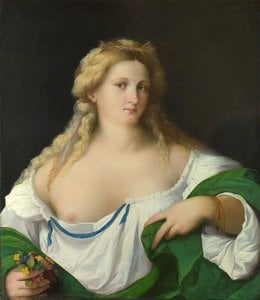
Palma Vecchio, 1480 – 1528

Palma Vecchio kõige kuulsam 100 maalist

Teos, mis tegi Palma Vecchio kuulsaks, on Madonna and Child (1515); see ripub Hermitage muuseum-is, Stiiitlinburg. Portrait of a Man (1512) ja Judith (1525) järgnevad nende järel samas kogumiste ja muuseumi külastajate lemmikes Sellest 107 teosest, mis Palma Vecchio teosena meie kataloogis on, on need 100 kõige imetlevamat, millist igaüks on esitatud koos kuupäeva, museumi ja oma eripärase tähelepanekuga.

Reiting põhineb meie populaarsusindeksil, mis koondab iga teose otsingud, külastused ja tellimused. Uuendatud oktoober 2026. Iga selle lehekülje meistriteos on tellitav muuseumikvaliteedse käsitsi maalatuna õlireproduktsiona või fine art trükkina vastavalt valitud suurusele.

Palma Vecchio portree
Palma Vecchio · 1480 – 1528
Sündinud · surnud
1480 – 1528, Serina
Suunata
High renaissance
Meie kataloogis olevad teosed
107
Kõige tuntud
Madonna and Child (1515)
Enamasti teoseid on
Kunsthistorisches Museum

Palma Vecchio: kümneks suurimaks teoseks

Madonna and Child (1515) autor Palma Vecchio
1

Madonna and Child

1515 · Oil On Canvas · Hermitage muuseum, Stiiitlinburg

To stand before this depiction of the Madonna and Child is to be drawn into a moment suspended outside the rush of time—a sanctuary painted by the masterful hand of Palma Vecchio. This work, dating from 1515, transcends mere portraiture; it is an eloquent meditation on maternal love, divine connection, and the profound mystery of creation. The composition centers on the Virgin Mary, portrayed with a tender intimacy as she…

The Adoration of the Shepherds with a Donor autor Palma Vecchio
4

The Adoration of the Shepherds with a Donor

Oil On Canvas

The air in the painting feels heavy with the scent of damp earth and hay. In a rural landscape of rolling hills and distant, pale buildings, a small light gathers around the Holy Family. Mary holds the infant Jesus close, her form a soft curve against the shadows. Beside them, Joseph stands as a steady presence. A shepherd boy kneels in the dirt, his posture a study in humility before…

Lucretia (1520) autor Palma Vecchio
5

Lucretia

1520 · Oil · Kunsthistorisches Museum, Viin

The air feels heavy, thick with the scent of velvet and the silent weight of an impending end. Lucretia sits before us, her pale skin luminous against a backdrop of deep, swallowing shadows. A sharp, diagonal line of a dagger presses against her chest, creating a point of tension that vibrates through the stillness. Her reddish-blonde hair flows in soft, organic waves, framing a face caught in a moment of…

Portrait of a Gentleman (1520) autor Palma Vecchio
6

Portrait of a Gentleman

1520 · Oil On Panel · Philadelphia Museum of Art, Philadelphia

In this 1520 portrait, we are met with a man whose steady gaze bridges the distance between his era and our own. He is positioned slightly off-center, a choice that lends a sense of naturalism to his posture, as if he has just paused in thought to acknowledge our presence. The composition is a medium close-up, focusing our attention on the quiet dignity of his features. His long, flowing brown…

John the Baptist (1527) autor Palma Vecchio
7

John the Baptist

1527 · Oil On Panel · Kunsthistorisches Museum, Viin

A single light source enters from the upper left, carving a face out of the heavy darkness. This is the world of Palma Vecchio, where deep browns and muted greens emerge from a nearly black background. The man, identified as John the Baptist, looks directly at the viewer with a piercing, steady gaze. His reddish-brown hair falls in soft, organic waves around a face marked by contemplation. A thin, dark…

John the Evangelist (1528) autor Palma Vecchio
8

John the Evangelist

1528 · Oil On Canvas · Kunsthistorisches Museum, Viin

An elderly man sits within a heavy shadow. His face, etched by time, turns toward an unseen light from the upper left. A thick, white beard flows over a deep green tunic. Over one shoulder, a red cloak rests with the weight of heavy wool. The skin of his hands and brow catches the glow, pulling him out from the dark, atmospheric background.

The Holy Family with St Mary Magdalen (1514) autor Palma Vecchio
9

The Holy Family with St Mary Magdalen

1514 · Oil On Panel · The Ashmolean Museum of Art And Archaeology, Oxford

In this 1514 oil on panel, we find ourselves drawn into a private, outdoor moment of the Holy Family. The composition is intimate, centered on a man holding a child while a woman stands nearby, her hands resting upon a vase. This arrangement creates a sense of domesticity within a sacred context. The background, filled with the soft presence of trees, suggests a natural setting that allows the figures to…

Young Woman in Profile (1512) autor Palma Vecchio
10

Young Woman in Profile

1512 · Oil · Kunsthistorisches Museum, Viin

The portrait presents a young woman in a strict profile view, her head and shoulders occupying the majority of the frame. She is positioned against a dark, circular backdrop that creates a halo-like effect around her silhouette. The subject's skin is rendered in warm, fleshy tones, transitioning through soft shadows that define the structure of her face and neck. This technique, known as sfumato, allows for a gradual blending of…

Veel Palma Vecchio meistriteoseid, 11 kuni 100

John the Baptist (1528) autor Palma Vecchio
#12

John the Baptist

1528 · Kunsthistorisches Museum

The figure of John the Baptist emerges from the shadows of history in this religious painting by Palma Vecchio. He stands alone, a solitary presence caught in a…

Tooge see koju →
Saint Sebastian (1527) autor Palma Vecchio
#13

Saint Sebastian

1527 · Kunsthistorisches Museum

This religious work, titled Saint Sebastian, was executed by the Venetian painter Palma Vecchio around 1527. The painting focuses on the Roman martyr, a figure venerated for his…

Telli reproduktsiooni →
The Raising of Lazarus (1514) autor Palma Vecchio
#14

The Raising of Lazarus

1514 · Philadelphia Museum of Art

is a dramatic Renaissance oil painting that captures a crowded and dynamic biblical scene. The composition focuses on a central group of figures gathered around a stone tomb,…

Telli reproduktsiooni →
The Three Sisters (1520) autor Palma Vecchio
#15

The Three Sisters

1520 · Gemäldegalerie Alte Meister

“The Three Sisters” by Palma Vecchio, painted around 1520, stands as a captivating example of Venetian High Renaissance portraiture. This half-length composition depicts three young women, widely believed…

Tellinige käsitsi maalatud koopia →
Saint Magdalene (1504) autor Palma Vecchio
#17

Saint Magdalene

1504 · Bavaria riiklikud maalidema kogumikud

Saint Magdalene by Palma Vecchio is a bust-length portrait presented in a close-up composition. The female figure is positioned slightly off-center, her body angled toward the viewer while…

Tooge see koju →
The Triumph of Caesar (1510) autor Palma Vecchio
#19

The Triumph of Caesar

1510 · Lowe Gallery

is a large-scale Renaissance oil painting by the Venetian artist Palma Vecchio. Executed around 1510, the work captures a Roman triumphal procession through a densely populated ceremonial scene.

Telli reproduktsiooni →
Daphnis (1514) autor Palma Vecchio
#21

Daphnis

1514 · Bavaria riiklikud maalidema kogumikud

Daphnis, attributed to Palma Vecchio, presents a mythological depiction of the shepherd boy Daphnis. Created around 1513/15, the work draws upon the pastoral traditions of antiquity. The subject…

Tooge see koju →
Allegory (1510) autor Palma Vecchio
#22

Allegory

1510 · Philadelphia Museum of Art

The painting titled Allegory is a work by the Venetian painter Palma Vecchio. Created around 1510, this oil painting belongs to the Italian High Renaissance. The artist, born…

Telli reproduktsiooni →
Venus and Cupid (1511) autor Palma Vecchio
#23

Venus and Cupid

1511 · Statens Museum For Kunst

is a work by the Venetian painter Palma Vecchio. Created in 1511, the painting belongs to the Italian High Renaissance. The artist, born in Serina, Italy, was a…

Tooge see koju →
The Holy Family (1515) autor Palma Vecchio
#24

The Holy Family

1515 · Gemäldegalerie

In Palma Vecchio's The Holy Family, the arrangement of figures creates a quiet, centered gravity. The Virgin Mary forms the heart of the scene, kneeling in a posture…

Tooge see koju →
The Virgin and Child (1502) autor Palma Vecchio
#25

The Virgin and Child

1502 · Gemäldegalerie

A serene and intimate scene unfolds within a High Renaissance composition, where the Virgin Mary is captured in a moment of private study. Seated toward the right of…

Tooge see koju →
Two Nymphs at Rest (1525) autor Palma Vecchio
#27

Two Nymphs at Rest

1525 · Städel Museum

We are looking at Two Nymphs at Rest, a work by the Venetian painter Palma Vecchio. Created in 1525, this oil painting captures a quiet, mythological scene. The…

Telli reproduktsiooni →
Visitation (1522) autor Palma Vecchio
#30

Visitation

1522 · Kunsthistorisches Museum

The air in the painting feels heavy with the weight of a quiet afternoon. Two women meet in the center of the frame, their bodies leaning into one…

Telli reproduktsiooni →
Mars, Venus and Cupid (1520) autor Palma Vecchio
#33

Mars, Venus and Cupid

1520

This Renaissance-style oil painting presents a mythological scene featuring three central figures: a muscular man, a woman, and a small winged child. The figures are situated within a…

Tooge see koju →
Tarquinius and Lucretia (1590) autor Palma Vecchio
#35

Tarquinius and Lucretia

1590 · Gemäldegalerie Alte Meister im Schloss Wilhelmshöhe

In Palma Vecchio's Tarquinius and Lucretia, the scene erupts with a violent, diagonal energy that pulls the viewer directly into the fray. The composition relies on a turbulent,…

Tooge see koju →
Sacred Conversation (detail) (1525) autor Palma Vecchio
#37

Sacred Conversation (detail)

1525 · Gallerie dell'Accademia di Venezia

The air feels heavy with a silent, holy stillness as the Virgin Mary cradles the infant Jesus. She sits draped in a deep blue gown, her presence the…

Tooge see koju →
Portrait of Paola Priuli (1527) autor Palma Vecchio
#41

Portrait of Paola Priuli

1527 · Fondazione Querini Stampalia

In the soft, luminous glow of the High Renaissance, few portraits capture the intersection of aristocratic poise and intimate vitality as masterfully as Palma Vecchio’s Portrait of Paola…

Tooge see koju →
Sacred Conversation (1525) autor Palma Vecchio
#53

Sacred Conversation

1525 · Gallerie dell'Accademia di Venezia

In the quiet, luminous atmosphere of Palma Vecchio’s Sacred Conversation, dated to 1525, the viewer is invited into a moment of profound spiritual intimacy. This masterpiece serves as…

Telli reproduktsiooni →
De heilige familie autor Palma Vecchio
#54

De heilige familie

Rijksmuseum

The air within the scene feels heavy with a soft, twilight stillness. A group of five figures gathers in a serene, classical arrangement, their presence anchored by the…

Telli reproduktsiooni →
A Blonde Woman autor Palma Vecchio
#67

A Blonde Woman

National Gallery

A single figure dominates the composition, her pale skin and long blonde hair emerging from a dark, indeterminate background. She gazes toward the viewer with a sidelong, pensive…

Tooge see koju →
A Blonde Woman (1520) autor Palma Vecchio
#68

A Blonde Woman

1520 · National Gallery

To stand before Palma Vecchio's "A Blonde Woman" is to encounter a moment suspended in time—a breath held just before revelation. This portrait, dating from 1520, transcends a…

Telli reproduktsiooni →
Portrait of a Woman (La Bella) (1518) autor Palma Vecchio
#84

Portrait of a Woman (La Bella)

1518 · Thyssen-Bornemisza Museum

The painting presents a portrait of a woman positioned in the center of the frame. She is depicted with long hair that cascades down her back, and she…

Tooge see koju →
Venus (1520) autor Palma Vecchio
#85

Venus

1520 · Gemäldegalerie

The painting Venus by Palma Il Vecchio is a masterpiece of Renaissance art, showcasing the artist's skill in capturing the beauty and elegance of the female form. Created…

Tooge see koju →

Palma Vecchio maalid ajastuse kaupa

Teemad, mida Palma Vecchio kõige rohkem maalis

Neli kõige sagedamini esinenud teemat nende meistriteoste seas, koos iga teema parima näitega.

Kust näha Palma Vecchio maale

Kümne 8 muuseumi kollektsioonid, mis sisaldavad kõige rohkem sellel lehel esitatud teoseid.

Muuseumid Linn Palma Vecchio teosid Selle nimekirja maalid
Kunsthistorisches Museum, ViinKunsthistorisches Museum Viin 13 Lucretia, John the Baptist, John the Evangelist
Szépművészeti Múzeum, BudapestSzépművészeti Múzeum Budapest 7 Madonna and Child with the Infant Saint John and a Bishop Saint, The Holy Family with a Female Saint and Saint Francis of Assisi, Portrait of a Young Woman
Gallerie dell'Accademia di Venezia, VeneetsiaGallerie dell'Accademia di Venezia Veneetsia 6 Sacred Conversation (detail), Sacred Conversation (detail), Sacred Conversation
Gemäldegalerie, BerliinGemäldegalerie Berliin 5 The Holy Family, The Virgin and Child, Portrait of a young woman with bare chest
National Gallery, LondonNational Gallery London 4 A Blonde Woman, A Blonde Woman, Saint George and a Female Saint
Hermitage muuseum, StiiitlinburgHermitage muuseum Stiiitlinburg 3 Madonna and Child, Portrait of a Man, Christ and the Woman Taken in Adultery
Galleria degli Uffizi, FirenzeGalleria degli Uffizi Firenze 3 Judith, Judith with the Head of Holofernes, The Holy Family with Mary Magdalene and the infant saint John
Philadelphia Museum of Art, PhiladelphiaPhiladelphia Museum of Art Philadelphia 3 Portrait of a Gentleman, The Raising of Lazarus, Allegory

Palma Vecchio aastakate kaupa: iga perioodi olulisim teos

  1. 1500s
    Saint Magdalene (1504) autor Palma Vecchio
    Reede 17 / 100

    Saint Magdalene

    Vanus 20–29 · Bavaria riiklikud maalidema kogumikud

    Saint Magdalene by Palma Vecchio is a bust-length portrait presented in a close-up composition. The female figure is positioned slightly off-center, her body angled toward the viewer while…

  2. 1510s
    Madonna and Child (1515) autor Palma Vecchio
    Nr 1 100st

    Madonna and Child

    Vanus 30–39 · Hermitage muuseum

    To stand before this depiction of the Madonna and Child is to be drawn into a moment suspended outside the rush of time—a sanctuary painted by the masterful…

  3. 1520s
    Judith (1525) autor Palma Vecchio
    Nr 3 100st

    Judith

    Vanus 40–48 · Galleria degli Uffizi

Palma Vecchio meistriteosed: küsimused ja vastused

Millist maali on Palma Vecchio kõige tuntum?Näita vastus

Madonna and Child (1515), Hermitage muuseum, Stiiitlinburg. Järgnevad Portrait of a Man (1512) ja Judith (1525).

Kui vana Palma Vecchio oli teose Madonna and Child maalimise ajal?Näita vastus

35 aastat vanus: teos Madonna and Child on aastatest 1515 ja kunstnik Palma Vecchio on sündinud aastal 1480.

Mis on Palma Vecchio kümneks suuremat maalidust?Näita vastus

Madonna and Child, Portrait of a Man, Judith, The Adoration of the Shepherds with a Donor, Lucretia, Portrait of a Gentleman, John the Baptist, John the Evangelist, The Holy Family with St Mary Magdalen ja Young Woman in Profile. Ülemine reiting näitab iga teose puhul aastat ja muuseumi.

Kui palju teoseid Palma Vecchio on maalinud?Näita vastus

Meie kataloogis on 107 teost kunstnikult Palma Vecchio, aastatest 1502 kuni 1528.

Mitteks muuseumides võib näha Palma Vecchio meistriteoseid?Näita vastus

Enamik neist asub Kunsthistorisches Museum (Viin), Szépművészeti Múzeum (Budapest) ja Gallerie dell'Accademia di Venezia (Veneetsia). Ülemal olev tabel on loetelnud muuseumid üks-eiralt.

Millal lõi Palma Vecchio oma meistriteosed?Näita vastus

Ajalisel perioodil 1520s: 37 100 sellel lehel olevat teost on sellest ajast, მათhulgas Judith.

Mis on Palma Vecchio esimene ja viimane kuuls fama maalaus?Näita vastus

Sellel lehel on kõige vanem teos The Virgin and Child (1502) ja kõige uuem John the Evangelist (1528).

Mis olid Palma Vecchio lemmikteemad?Näita vastus

Woman (33), Man (25) ja Landscape (23), 100 teose seas sellel lehel.

Millist tehnikat Palma Vecchio eelistas?Näita vastus

Oil On Canvas: 19 100 teosest sellel lehel.

Millises kunstisuunnas Palma Vecchio kuulub?Näita vastus

nagu sellel lehel olevad maalid näitavad High renaissance.

Kumba Palma Vecchio meistriteoseid saab näha Kunsthistorisches Museum kogumuses?Näita vastus

Lucretia, John the Baptist ja John the Evangelist on üks 12 teosest sellel lehel, mida hoiab Kunsthistorisches Museum, Viin.

Kas saan omada Palma Vecchio meistriteose reproduktsiooni?Näita vastus

Jah. Iga maali sellel lehel on võimalik tellida muuseumikvaliteedilisena käsitööna valminud õlimaalina või fine art trükkina vastavalt valitud måõduna otse maali oma lehekülalt.

Palma Vecchio elu

A Veneetsia sensuaalsuse meister: Palma Vecchio elu ja kunst

Jacopo Negretti, kes on ajalooos tuntud kui Palma Vecchio – „Palma vanem“ – astus 16. sajandiku alguse Veneetsia kunstimaastikku kui tegelane, kes ühendas kõrge renessanssi ja algavava manierismi stiilid. Lahutuna umbes 1480. aastal Serina Altas, lähedal Bergamole, avanes tema karjäär täielikult Veneetsia Vabariigi vibratilisel arenal, linnas, mis oli juba sügavalt kunstilise uuendusega täidetud. Kuigi tema esialgase õppetöö kohta on dokumentaalne info vähene, uskeldakse, et ta võib olla õppinud Andrea Previtali juures, enne kui tema huvi pöörduks Giovanni Bellini revolutsioonilistele lähenemustele ja lõpuks Giorgione'i ning Tiziani lummavatele maailmadele. Palma Veneetsias ilmumine koitus perioodil, mil kunstiline konkurents oli äärmiselt intensiivne; koos Lorenzo Lottoga kujunes ta kiiresti väärtuslikuks talentiks, omades oma esiisade õppetunde, kuid samal ajal luues oma eripõjalise tee.

Varajased mõjud ja unikaalse stiili areng

Palma Vecchio loomingine kunstiline teekond paljastab sügava austru Giovanni Bellini rafineeritud tehnikat ja pühastatud stiili ees. Siia on peitnud tema esimesed sammud, kuid tõeline kunstiline põlev on olnud Giorgione murdmistöö – oma poeetilise atmosfääri ja salapõhjaliste narratiividega, mis süttis Palma kunstilist kuj कल्पना. Ta omakutsus kiiresti Giorgione'i värvide, valguse ja kompositsiooni kasutamist, täistes oma maalid sarnase lyrilise ilu tundega. Siidi polek aga vaid imitatsioon; Palma omakas unikaalne kaas, mis võimaldas inimkeha esitamist sensuaalse elegantsi ja lummava realismiga, mis tõi ta teised kunstnikud juurde. Kui Tizian saavutas oma suure maine, jätkas Palma pidevat arengut, demonstreerides erakordset võimet sünteesida erinevaid mõjupunkte ühtseks, harmooniliseks ja võlutavaks visuaalseks keeleks. See periood märkas tema loomingulises laialmuses ka kahte peamist teemat: sacra conversazione ehk pühastatud vestluste kooste ja poolkõht portreid ideaalsetest naistest, keda on sageli spekuleeritud olevat Veneetsia kuulsate kurtsaanide portreetid.

Mütoloogia võlutus ja Veneetsia portreid"

Palma Vecchio sai kuulsaks oma võimetest imbueerida klassikalist mütoloogiat eriti selge Veneetsia tundekujul. Tema pastoralistsed stseenid ei ole pelgalt antiiksete lugude ümberleppimised; need on elavad ilu, armastuse ja maailmaviisilise nautingu tähistused, mis on paigutatud kargede ja elu täis loodusmustrite ette. Need teosed vastasid Veneetsia rikkaste mecenaste maitsele, kes otsisid kunstilt peegeldust oma sofisteeritud elustiilist ja aistlikust naudingu väärtustust. Samas vangitasid tema portreid – eriti naiste portreid – vaatajaid oma suurepärase detailirikkuse ja psühholoogilise sügavuse poolest. Ta lõi välja omaenda signatuuri: blondid ilukesed, kellel on kütkestav pilk ja peidetud salapõhja õhumood.

Nende portreteeritud naiste identiteet on suurel määral teada, mis on toidustanud spekulatsioone nende võimalikust seosest linna demimonde'iga ehk varjuliidiga. Tema värvimeistri oskus — läbipaistvad läbivärvitud kihid, mis lõid luminöösneid ning valgust valgust — oli eriti auustatud, kuigi kahjuks on paljud need delicate kihid ajaga häänonud. Tema värvi ja värvitooni käitlemise täiesti eriline maaliline võime on sageli toimetatud tema loominguliseks iseloomuks.

Peamised saavutused ja kunstiline pärand

Palma Vecchio üheks kõige olulisemaks saavutuseks on Veneetsia Santa Maria Formosa kirjas tellitud kuus maali, mille keskpunktiks on suurepärane Püha Barbarat altarimaal. See monumentaalne kompositsioon on tõestus tema oskusest esitada keerukaid narratiive ja luua figuuride vahel harmoonilisi ning elavamaid gruppeeringuid. Tema hilisemas loomingus on vaataja märgaavaks muutunud contrapposto – elegantsel tasakaalul vastaspidiste jõudude vahel inimese asendis – ning peen palett, mis kiirgab väärikust ja sulavast gracatsioonist. Kuigi algastades laialt Central-Iitali kunstikoolidest, sealhulgas Michelangelost, suutis Palma lõpuks luua oma unikaalse ja eristuva stiili. Tema karjääri oluliseks turningpunktiks oli 1525. aastal Veneetsias Sant'Elena kirjas pealkelpiiri maaliarmu tellimine. Siiski jäi tema ootamatul surmal aastal 1528, kui ta oli alles umbes 47-aastane, ning paljud teosed jäid lõppumata, lõpule viides tema õpilased ja töökoda. Vaatamata sellele varajasele lõppule oli Palma Vecchio mõju Veneetsia maalikunstile sügav ja püsiv. Ta toimis kui oluline sild kõrgrenessansi meistrite, nagu Tizian ja Giorgione, ning algavaima manierismi põlvkonna vahel, inspireerides kunstnereid nagu Bonifazio Pitati ja Giovanni Busi.

Ajalooline tähendus ja uuesti avastamine

Sadmeid on Palma Vecchio looming olnud tema kuulsamate kaasaegsete kunstikate teoste varjus. Siiski on viimastel külastel toimunud pidev ja kasvav väärtustund tema unikaalsele panusele Veneetsia kunstile. Kunstiteadlased on uuesti läbinud ja uuesti hinnanud neid teoseid, mis on varem omistikku kuulunud Giorgione'ile või Tizianile, tuvastades samal ajal Palma omapärase stiili eristatavad kvaliteedid. Tema maalid on tänapäevastelt tunnustatud oma sensuaalse ilu, tehnilise täiuslikkuse ja võimekuse eest, mis suutsib vangistada renessansstilise Veneetsia vaimu. Ta esindab kunstiliste mõjete põnevat ristumist, üligavast esindades põlvkondade vahelist sildina ja pakkudes kaasahaarvat pilku oma ajastu kultuurilistele väärtustele ning esteetilistele eelduustele. Palma Vecchio seisab kui ennastaga väimatu Veneetsia maali kunstile — meistrina, kelle tööd suudavad vangistada ja inspireerida publikut ka täna.

Kõik 107 teost Palma Vecchio →