Max Slevogt, 1868 – 1932

Max Slevogt Paintings: The 100 Most Famous Works, Ranked

Max Slevogt's most famous painting is The Quarry at Albersweiler (1912). With The Singer Francisco d'Andrade as Don Giovanni in Mozart's Opera (1912) and Frau Voll mit Tochter (1895), it completes the three works everyone recognises. Our catalogue lists 102 works by Max Slevogt; the 100 below are the ones the world looks at most, each with its year, the museum that holds it and why it matters.

Ranked by our popularity score, which combines the searches, visits and orders for each work. Updated oktoober 2026. Every masterpiece on this page can be ordered as a museum-quality, hand-painted oil reproduction or a fine art print, at the size you choose.

Portrait of Max Slevogt
Max Slevogt · 1868 – 1932
Born · died
1868 – 1932, Landshut
Movement
Impressionism
Works in our catalogue
102
Most famous
The Quarry at Albersweiler (1912)
Most works at
Bavaria riiklikud maalidema kogumikud

The 10 most famous Max Slevogt paintings

The Quarry at Albersweiler (1912) by Max Slevogt
1

The Quarry at Albersweiler

1912

A Glimpse into Industrial Transformation: Max Slevogt’s *The Quarry at Albersweiler* (1912) Max Slevogt's *The Quarry at Albersweiler*, painted in 1912, is more than just a landscape; it’s a compelling visual document of a changing world. Measuring 72 x 101 cm and executed with oil on canvas, the painting captures a pivotal moment where human industry begins to dramatically reshape the natural environment. While seemingly serene at first glance, a…

The Singer Francisco d'Andrade as Don Giovanni in Mozart's Opera (1912) by Max Slevogt
2

The Singer Francisco d'Andrade as Don Giovanni in Mozart's Opera

1912 · Oil On Canvas · Alte Nationalgalerie, Berliin

The canvas captures a moment of profound tension from Mozart's opera, specifically the graveyard scene where Don Giovanni invites the statue of the Commendatore to supper. Francisco d'Andrade, marking his thirtieth year on stage, is rendered with a sense of disembodied, floating quality. He is draped in a voluminous white cloak that flows toward the right, creating a stark contrast against a dark, moody background of muted blues and blacks.…

Frau Voll mit Tochter (1895) by Max Slevogt
3

Frau Voll mit Tochter

1895 · Oil · Alte Nationalgalerie, Berliin

Two figures emerge from a heavy, indistinct darkness. On the left, a woman gazes outward with a weary, solemn expression, her face etched with subtle shadows and fine lines. Her hair is pulled back tightly, a stark contrast to the soft, pale skin of her features. Beside her, a younger girl leans her head toward the older woman, her expression pensive and tired. A single patch of bright blue fabric…

Prince Regent Luitpold in the Ermine Cloak (1908) by Max Slevogt
4

Prince Regent Luitpold in the Ermine Cloak

1908 · Oil On Canvas · Bavaria riiklikud maalidema kogumikud, München

In this 1908 oil on canvas, an elderly man, identified as Prince Regent Luitpold, is positioned against a dark, undifferentiated background. The subject is rendered in a vertical composition, standing slightly off-center. He wears a heavy blue mantle, which is lined with white ermine fur. The lighting originates from the upper left, casting illumination across the subject's face, the white fabric of his shirt, and the folds of the blue…

Theater Curtain (1931) by Max Slevogt
6

Theater Curtain

1931 · Painting · Bavaria riiklikud maalidema kogumikud, München

The composition presents a formal, pyramidal arrangement of a multi-generational family, captured in a moment of staged stillness. Subjects are organized into two distinct rows: a seated group in the foreground and a standing assembly in the background. The scene is rendered in monochromatic sepia and warm reddish-brown tones, suggesting the chemical aging of a vintage photographic process. Soft, directional lighting defines the contours of facial features and the heavy…

Lady Adventure (1894) by Max Slevogt
7

Lady Adventure

1894 · Oil On Canvas · Städel Museum, Frankfurt

The oil on canvas presents a close-up view of two figures locked in a physical encounter. A figure clad in silver-toned metallic armor is intertwined with a nude female form. The composition follows a diagonal axis, creating a sense of movement through the interlocking limbs. Dark, moody tones of deep black and murky green dominate the background, which remains largely obscured by shadow. High-contrast lighting, or chiaroscuro, catches the edges…

Sailboats on the Alster River in the Evening (1905) by Max Slevogt
9

Sailboats on the Alster River in the Evening

1905 · Oil On Canvas

In the gentle transition from day to dusk, Max Slevogt’s Sailboats on the Alster River in the Evening captures a moment of profound serenity and communal joy. This 1905 masterpiece serves as a window into a bygone era of leisure, where the rhythmic movement of sailboats across the water mirrors the quiet pulse of life along the riverbanks. As the evening light begins to soften, Slevogt masterfully orchestrates a scene…

Max Slevogt, paintings 11 to 100

The Libyan Desert (1914) by Max Slevogt
#33

The Libyan Desert

1914

The painting The Libyan Desert is a stunning work of art created by the renowned artist Max Slevogt in 1914. This beautiful piece is a testament to the…

Bring it home →
Sailing into Syracuse Harbor (1914) by Max Slevogt
#35

Sailing into Syracuse Harbor

1914 · Bayerische Staatsgemaldesammlungen

Introduction to Max Slevogt and Sailing Into Syracuse Harbor Max Slevogt (1868-1932) represents a pivotal moment in German Impressionist painting, securing his place as a master of landscape…

Bring it home →
Summer House Garden (1912) by Max Slevogt
#78

Summer House Garden

1912

The Summer House Garden painting, created in 1912 by renowned German artist Max Slevogt, is a stunning representation of Impressionist art. This beautiful piece measures 62 x 77…

Order a reproduction →
Palatinate Landscape (1923) by Max Slevogt
#81

Palatinate Landscape

1923

In the quietude of 1923, Max Slevogt captured a moment that transcends time in his masterpiece, Palatinate Landscape. This evocative oil on canvas is far more than a…

Order a reproduction →
Palatinate Landscape (1921) by Max Slevogt
#85

Palatinate Landscape

1921 · Staatliche Kunsthalle

Max Slevogt's 1921 painting, “Palatinate Landscape,” isn’t merely a depiction of a forest; it’s an immersion into the heart of German Impressionism and a poignant reflection on the…

Order a reproduction →
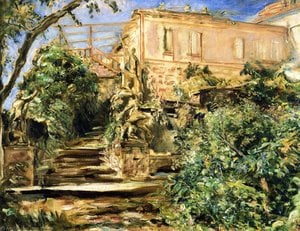
Garden Steps in Neukastel (1916) by Max Slevogt
#86

Garden Steps in Neukastel

1916

The Max Slevogt painting, Garden Steps in Neukastel, is a beautiful depiction of a serene garden setting. Created in 1916, this oil on canvas piece is a prime…

Bring it home →

Max Slevogt's paintings by period

The subjects Max Slevogt painted most

The four subjects that return most often among these masterpieces, with the finest example of each.

Where to see Max Slevogt's paintings

The 8 museums that hold the most of the paintings on this page.

Museum City Works by Max Slevogt Paintings from this list
Bavaria riiklikud maalidema kogumikud, MünchenBavaria riiklikud maalidema kogumikud München 18 Prince Regent Luitpold in the Ermine Cloak, Theater Curtain, Angela von Tschudi
Staatliche Kunstsammlungen Dresden, DresdenStaatliche Kunstsammlungen Dresden Dresden 6 Sudanese women, Pirates, Sandstorm in the Libyan Desert
Lenbachhaus, MünchenLenbachhaus München 5 Danae, Luise Papenhagen, Self-Portrait with Black Hat
Alte Nationalgalerie, BerliinAlte Nationalgalerie Berliin 4 The Singer Francisco d'Andrade as Don Giovanni in Mozart's Opera, Frau Voll mit Tochter, Requiem for the St. Georgsknights
Rahvusmuuseum Varssavis, VarssaviRahvusmuuseum Varssavis Varssavi 3 Faun and a girl, Grape harvest., Landscape with a view of Landau
Westfälisches Landesmuseum, MünsterWestfälisches Landesmuseum Münster 3 Man on a Forest Path, Flower Garden I in Neu Cladow, Still life with Melon
Städel Museum, FrankfurtStädel Museum Frankfurt 2 Lady Adventure, Blossoming Lilac
Museum Kunstpalast, DüsseldorfMuseum Kunstpalast Düsseldorf 2 Female Nude from the Back, Neukastel - View of the Madenburg

Max Slevogt's most famous painting of each decade

  1. 1890s
    Frau Voll mit Tochter (1895) by Max Slevogt
    #3 of 100

    Frau Voll mit Tochter

    Age 22 – 31 · Alte Nationalgalerie

    Two figures emerge from a heavy, indistinct darkness. On the left, a woman gazes outward with a weary, solemn expression, her face etched with subtle shadows and fine…

  2. 1900s
    Prince Regent Luitpold in the Ermine Cloak (1908) by Max Slevogt
    #4 of 100

    Prince Regent Luitpold in the Ermine Cloak

    Age 32 – 41 · Bavaria riiklikud maalidema kogumikud

    In this 1908 oil on canvas, an elderly man, identified as Prince Regent Luitpold, is positioned against a dark, undifferentiated background. The subject is rendered in a vertical…

  3. 1910s
    The Quarry at Albersweiler (1912) by Max Slevogt
    Rank 1 / 100

    The Quarry at Albersweiler

    Age 42 – 51

    A Glimpse into Industrial Transformation: Max Slevogt’s *The Quarry at Albersweiler* (1912) Max Slevogt's *The Quarry at Albersweiler*, painted in 1912, is more than just a landscape; it’s…

  4. 1920s
  5. 1930s
    Theater Curtain (1931) by Max Slevogt
    #6 of 100

    Theater Curtain

    Age 62 – 64 · Bavaria riiklikud maalidema kogumikud

    The composition presents a formal, pyramidal arrangement of a multi-generational family, captured in a moment of staged stillness. Subjects are organized into two distinct rows: a seated group…

Questions about Max Slevogt's paintings

What is Max Slevogt's most famous painting?Show the answer

The Quarry at Albersweiler (1912). Next come The Singer Francisco d'Andrade as Don Giovanni in Mozart's Opera (1912) and Frau Voll mit Tochter (1895).

How old was Max Slevogt when The Quarry at Albersweiler was painted?Show the answer

44 years old: The Quarry at Albersweiler dates from 1912 and Max Slevogt was born in 1868.

What are the top 10 paintings by Max Slevogt?Show the answer

The Quarry at Albersweiler, The Singer Francisco d'Andrade as Don Giovanni in Mozart's Opera, Frau Voll mit Tochter, Prince Regent Luitpold in the Ermine Cloak, Requiem for the St. Georgsknights, Theater Curtain, Lady Adventure, Angela von Tschudi, Sailboats on the Alster River in the Evening and Scheherazade (Telling the Stories from 1001 Nights to the Caliph). The ranking above gives the year and the museum of each.

How many paintings did Max Slevogt make?Show the answer

Our catalogue lists 102 works by Max Slevogt, dated from 1893 to 1931.

Where are Max Slevogt's most famous paintings?Show the answer

Most of them are in Bavaria riiklikud maalidema kogumikud (München), Staatliche Kunstsammlungen Dresden (Dresden) and Lenbachhaus (München). The table above lists the museums one by one.

When did Max Slevogt paint the most famous works?Show the answer

In 1910s: 33 of the 100 works on this page date from then, among them The Quarry at Albersweiler.

What are Max Slevogt's earliest and latest famous paintings?Show the answer

The earliest on this page is Red Arbor with Thundercounds (1893), the latest Theater Curtain (1931).

What did Max Slevogt paint most often?Show the answer

Landscape (11), People (6) and Gardens and parks (5), among the 100 works on this page.

What medium did Max Slevogt use most?Show the answer

Oil On Canvas: 15 of the 100 works on this page.

Which art movement does Max Slevogt belong to?Show the answer

Impressionism, as the paintings on this page show.

Which Max Slevogt paintings can I see at the Bavaria riiklikud maalidema kogumikud?Show the answer

Prince Regent Luitpold in the Ermine Cloak, Theater Curtain and Angela von Tschudi are among the 18 works on this page held by the Bavaria riiklikud maalidema kogumikud, München.

Can I buy a reproduction of a Max Slevogt painting?Show the answer

Yes. Every painting on this page can be ordered as a museum-quality, hand-painted oil reproduction or a fine art print, in the size you choose, from the painting's own page.

About Max Slevogt

Max Slevogti valgusrikas pärand

Max Slevogt seisab saksa impressionistliku maali kunstis kui vundamentaalne tegelane, olles tuntud oma meistralike maastikukujutuste ja võime poolest tabada looduse lennukat ilu suurepärase tundlikkusega. 1868. aastal Bavarias asuvas Landshutis sündinud kunstnik alustas teekonda, mis viis teda tumedadest toonitud akadémilistest joonistustest kuni vibrantsete linate kuni, mis on täis valgust ja värvi—stiilne muutmine, mis oli sümboliks laiemale liikumisele, mis kujundas sajandite vahetusel Euroopa kunsti. Tema varajased aastad veeti oskuste terastamiseks Müncheni akadeemias, kus ta alguses uuris tumemaid palette ja tehnikuid, mis olid mõjutatud tollalist akadémilist stiilist.

Kuid murdelis kohtumine Pariisis aastal 1889 süütele plaan air maali armastuse ning tutvustas teda revolutsionaarsete ideadega, mida edaldasid kunstnikud nagu Édouard Manet. See kohtumine Prantsuse avantgardiga tõi tema pintoonidesse uue elu, õhutades teda omaksindama plein air ehk õues maali tehnikat ning otsima maastikul toimuvat valgusla cosa lennukat tantsu. Tema töö hakkas pulsama atmosfäärisest elujõust, liikudes eemale rangetest stuudiokompositsioonidest suunates ennast spontaansemale ja sensorsemale suhtlemisele terealusega.

Valgus ja maastik meistralikult

Kuigi Slevogti viljakas looming hõlbas erinevaid žanre, sealhulgas illustratsiooni, portreendamist ja žanriteenid, domineerisid tema suurepärases teoses consistently maastikud. Ta saavutas erilist kuulsust Bavaria alpiregioonide, eriti Neukasteli, emotsionaalsete kujutuste poolest, mis sai tema elukaasajaks ja püsivaks inspiratsiooniallikuks. Tema linate on tuntud oma võime poolest tabada valgusest ja varjust peeneid nüansse, näidates hoolikat tähelepanu tekstuurile ja värvile, mis eristab teda paljudest tema kaaslaskunstnikest.

Kunstniku tehniline areng on märgatud mitme võtmeomadusega:

  • Dynaamiline pintoon: Üleminek kontrollitud akadémilistest tõmbetest fluidsemale ja energilisemale värvikandmisele.
  • Kroomiline sära: Ühäles kasvav sõltuvus vibrantsele paletile, et edastada päikesevalguse soojust ja hämarduse kargust.
  • Atmosfääriline sügavus: Pehmete servade ja valguse difusiooni kasutamine, et taaselda niiskuse, udu ja õhu tunnet stseenis.

Lisaks oma maastikude rahustavale ilule omastas Slevogt märkimisväärset võimet tabada inimloo raskust. Tema hilisemad teosed peegeldavad sügavamat ja tumedamat suhtumist maailmaga, sealhulgas emotsionaalselt võimsat Egiptuse kujutamist ning Esimeste maailmasõdude õuduste esitamist. See võime liikuda idüllilisest kuni sügavani demonstreerib emotsionaalset laiusust, mis määrab tema suuruse.

Kultuuriline mõju ja ajalooline tähendus

Lisaks oma isikliketele kunstilistele saavutustele kinnistas Slevogti osalemine kultuurilinstitutsioonides tema positsiooni Weemari Saksamaa intellektuaalses maastikus. Kui ta oli Berliini secessiooni ja Prüssia Kunstiakadeemia prominentne liige, oli ta selle ajastu kõige olulisemate esteetiliste debattide südamel. Ta omakasutas avantgardset vaimu, säilitades samal ajal kindlust oma traditsioonilistele kunstipõhimõtetele, mis võimaldas tal sild ehitada klassikalise koolituse ja modernse innovatsiooni vahel.

Tema mitmekülgsus ulatus isegi esinduskunstini; märkimisväärselt kujutas ta lavakujundusi Mozartile Don Giovanni, näidates oma võimet tõlkida maalist visiooni teatriruumi. Ka läbi ajakirjade nagu Simplicissimus ja läbi oma püsiva mõju saksa impressionismile, jättis Max Slevogt kunstilukule temmatest kordumatut jälge. Ta on püsti jäänud tähistatud kuju, kelle töö jätkub resoneerimas igaühega, keda liigutab valgus, värv ja looduse igavene vaim.

All 102 works by Max Slevogt →