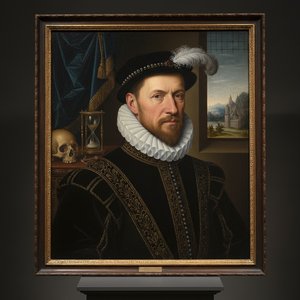
The Legacy of a Master Calligrapher
In the annals of Korean history, few names resonate with the same elegance and disciplined strength as Seokbong. A preeminent figure of the mid-Joseon Dynasty, he was not merely an artist but a master calligrapher whose brushstrokes helped define an era of profound cultural transformation. Born in 1543 in Songdo, his life was deeply intertwined with the intellectual currents of a period marked by intense Confucian scholarship and a meticulous devotion to tradition. His journey from a humble beginning in a poor family to becoming the primary transcriber for King Seonjo is a testament to a lifetime of unparalleled dedication to his craft.
The legend of his development is famously captured in Korean folklore, a tale that speaks to the very essence of his character. It is said that during his studies, his mother—a woman of immense wisdom and resolve—challenged him by slicing rice cakes in the dark while he practiced his calligraphy under a single lamp. When the light was returned, her slices were perfectly even, while his characters remained wobbly and uneven. This moment of realization served as a catalyst, driving him to pursue a level of precision and mastery that would eventually earn him international renown, with his fame spreading far beyond the borders of Korea and into China.
Technique and Artistic Vision
Seokbong’s artistic identity was forged through a sophisticated synthesis of tradition and innovation. He developed what is now recognized as the Seokbong style (石峯體), a unique calligraphic method that drew deep inspiration from the legendary Chinese calligrapher Wang Xizhi. His work is characterized by its remarkable vivacity, featuring bold lines and strong, solid strokes that command the viewer's attention. This technique allowed him to navigate various scripts with ease, ranging from the structured elegance of regular script (楷書) to the fluid, energetic movements of cursive script (草書).
When examining his masterpieces, such as the Thousand Characters Classic, one observes a profound mastery of contrast and texture. His compositions often utilize the stark, powerful presence of black ink against warm, aged backgrounds, creating a sense of solemnity and historical resonance. Through his brush, Chinese characters become more than mere linguistic symbols; they transform into rhythmic, visual poetry. This ability to imbue written characters with emotional weight and spiritual depth reflects the Confucian values of his time, where calligraphy served as a vital pathway to enlightenment and social harmony.
Historical Significance and Enduring Influence
The impact of Seokbong extends far beyond the aesthetic beauty of his ink on paper. As a leading figure of the mid-Joseon period, his work acted as a bridge between the scholarly ideals of the royal court and the broader cultural landscape of East Asia. His role in composing calligraphy for the Korean royal court solidified his position as a pillar of the nation's intellectual life. The meticulous preservation of tradition through his transcriptions ensured that the philosophical and ethical foundations of the Joseon Dynasty were etched permanently into the cultural memory.
Even centuries after his passing in 1605, Seokbong’s influence remains palpable in the world of Korean calligraphy. His stylistic innovations provided a foundation for countless generations of calligraphers, shaping the evolution of the art form well into the present day. By blending technical precision with a soulful, expressive vitality, he created a visual language that continues to be studied and revered, standing as a timeless symbol of the heights that can be reached through discipline, practice, and an unwavering devotion to one's calling.
Küsimused ja vastused
Millest riigist pärit on Seokbong?
Seokbong sündis riigis Lõuna-Korea.
Kust leida Seokbong teoseid värvide järgi sorteerituna?
Seokbong teoseid saab värvi järgi uurida kunstniku Spektraalne indeks lehel.
Kas on olemas ülevaade kõigest teemadest, mida Seokbong maalis?
Lehekorral Teemade atlas on Seokbong teosed jaotatud teema järgi.
Millises linnas ja riigis on Seokbong sündinud?
Seokbong sündis linnas Songdo, riigis Lõuna-Korea.
Millises ajaloolises perioodis töötas Seokbong?
Seokbong töötas Renessanss perioodil. See ajastu määratleb kunstniku tegevuse ajaloolisel kontekstil.
Mis on Seokbong sünnipaik ja sünnahöstua?
Seokbong sündis Songdo linnas aastal 1543.
Kuidas saan jälgida Seokbong teos loendit aasta-aastaga?
Seokbong teoseid saab kronoloogilises järjekorras näha kunstniku Teoseline ajaline joon lehel.