Sarah A. Doidge: Echoes of Faith and Family in the Scottish Highlands
The world of Victorian portraiture often focused on grand narratives – royal lineages, aristocratic power, and the triumphs of empire. Yet, within this landscape, Sarah Ann Doidge (1830-1900) carved a unique space for herself, capturing intimate moments of domesticity and faith with a remarkable sensitivity that continues to resonate today. Born in Aberystwyth, Wales, into a family steeped in artistic tradition – her father was a watercolorist – Doidge’s early life provided a foundation for her distinctive style, characterized by soft brushwork, luminous color palettes, and an almost palpable sense of quiet contemplation.
Doidge's work is inextricably linked to the religious landscape of 19th-century Scotland. The influence of Presbyterianism, with its emphasis on family piety and moral responsibility, permeated every aspect of life in the Highlands. Her paintings frequently depict biblical matriarchs – Sarah, Abraham’s wife, Hagar, Rebekah – not as grand historical figures, but as women grappling with faith, family, and the challenges of their time. These aren't dramatic scenes of salvation or judgment; instead, they are quiet studies of resilience, devotion, and the everyday struggles of motherhood. Her subjects often appear in domestic settings—a woman tending to her children, a man reading scripture by candlelight—creating an atmosphere of profound intimacy and spiritual depth.
A key element of Doidge’s artistic approach was her meticulous attention to detail, particularly in the rendering of fabrics and textures. She possessed a remarkable ability to capture the subtle nuances of wool, linen, and lace, imbuing her paintings with a tactile quality that invites viewers to reach out and touch them. This commitment to realism is balanced by an expressive use of light and shadow, which creates a sense of atmosphere and mood. Her compositions are typically centered on her subjects, drawing the eye inward and fostering a feeling of connection.
The Influence of Landscape and Scottish Tradition
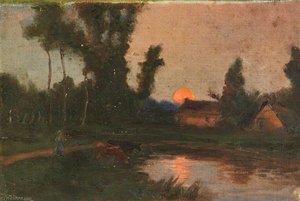
Doidge’s artistic practice was deeply rooted in the landscape of Wales and Scotland. The rugged beauty of the Highlands—the dramatic mountains, the heather-covered moors, and the shimmering lochs—provided a constant source of inspiration. She frequently depicted scenes of rural life, capturing the essence of Highland culture with an understated elegance. The muted tones of her palette – browns, greens, blues – reflect the natural world around her, while subtle shifts in light evoke the changing seasons.
Beyond the purely visual elements, Doidge’s work is also informed by a deep understanding of Scottish folklore and tradition. Many of her paintings depict scenes from the Old Testament, but they are always presented with a distinctly local flavor. She imbues these biblical narratives with a sense of familiarity and accessibility, as if they were simply stories told around a Highland hearth. The inclusion of traditional Highland dress—kilts, shawls, and tartans—further reinforces this connection to Scottish culture.
Technique and Style: A Delicate Balance
Doidge’s technique is characterized by a remarkable delicacy and restraint. She employed a loose, expressive brushstroke that allowed the paint to flow freely across the canvas, creating a sense of movement and spontaneity. Her use of color is subtle and nuanced, relying on delicate gradations rather than bold contrasts. She was particularly adept at capturing the effects of light—the way it filters through clouds, illuminates faces, and casts shadows across landscapes.
Despite her technical skill, Doidge’s paintings never feel overly polished or contrived. There is a sense of immediacy and authenticity in her work that speaks to her deep connection with her subjects. She avoided the theatricality often associated with Victorian portraiture, instead opting for a more intimate and understated approach. Her style can be described as a blend of realism and impressionism, influenced by the works of artists such as John Constable and J.M.W. Turner.
Legacy and Historical Significance
Sarah A. Doidge’s work has often been overlooked by mainstream art historians, partly due to her gender and the social constraints placed on female artists during her time. However, in recent years, there has been a growing recognition of her unique contribution to Victorian painting. Her paintings are now exhibited in major museums and galleries around the world, and they continue to attract critical acclaim.
Doidge’s legacy lies not only in her artistic achievements but also in her ability to capture the spirit of a bygone era. Her paintings offer a poignant glimpse into the lives of ordinary people—women who faced extraordinary challenges with grace and resilience. They serve as a reminder of the importance of faith, family, and community, values that remain deeply relevant today. The National Library of Wales holds several examples of her work, offering invaluable insight into this often-forgotten artist’s vision.