A Quiet Observer: Philip Douglas Maclagan and the English Countryside
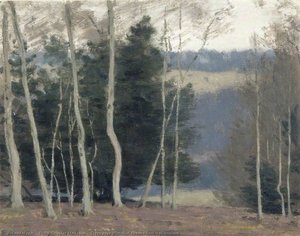
Philip Douglas Maclagan (1901-1972) wasn’t a flamboyant figure in the art world, nor did he chase grand, revolutionary movements. Instead, he quietly cultivated a deeply personal vision of the English countryside – a realm rendered with meticulous detail and imbued with a profound sense of serenity. His paintings aren't dramatic landscapes bursting with color; they are subtle studies of light, texture, and atmosphere, capturing the quiet dignity of rural life and the fleeting beauty of nature’s details. Maclagan’s legacy lies not in challenging artistic conventions but in offering viewers an intimate glimpse into a world often overlooked – a world he perceived with remarkable sensitivity and rendered with extraordinary skill.
Born in Swatow, China, in 1901, to a Scottish missionary family, Maclagan’s early life was marked by displacement and a constant shifting of location. His father, David Maclagan, served as a minister, leading the family across continents. This itinerant upbringing instilled in him a keen observational eye and an appreciation for diverse cultures – qualities that would later inform his artistic practice. He received his initial art training at the City of London School, followed by a year at St John’s Wood School of Art before ultimately enrolling at the Royal Academy Schools in 1920. There, he found mentors like Glyn Philpot, whose influence shaped his approach to painting – a focus on observation and a deliberate restraint in color.
Maclagan's artistic development was significantly influenced by the Venetian Old Masters, particularly their mastery of light and shadow. He developed a unique technique, employing wax rather than pure oil paint, which allowed him to achieve subtle gradations of tone and create an almost velvety surface quality. This painstaking process is evident in his works, where every blade of grass, every ripple on a stream, and every weathered stone seems meticulously rendered. He spent much of his career at Meadle, Buckinghamshire, a rural village that became the heart of his artistic practice. It was here, amidst rolling hills and quiet streams, that he found his subject matter – the familiar landscapes of England, viewed with an almost reverent gaze.
The Language of Light and Texture
Maclagan’s paintings are characterized by their remarkable attention to detail and a masterful use of light. He wasn't interested in dramatic sunsets or sweeping vistas; instead, he focused on the subtle shifts in illumination that define the English countryside – the dappled sunlight filtering through trees, the soft glow of dawn, the cool shadows cast by stone walls. His compositions are often deceptively simple, featuring modest scenes—a lone cottage nestled amongst fields, a winding path leading into the distance, or a still life arrangement of wildflowers and fruit. Yet, within these seemingly unassuming subjects lies a wealth of visual information, carefully observed and rendered with precision.
Texture plays an equally important role in Maclagan’s work. He meticulously depicted the rough bark of trees, the weathered surfaces of stone walls, and the delicate petals of flowers. His brushstrokes are often loose and expressive, creating a sense of immediacy and capturing the tactile qualities of his subjects. He avoided overly smooth or polished surfaces, preferring to retain the irregularities and imperfections that give each painting its unique character.
A Quiet Life, A Lasting Legacy
Maclagan’s artistic career was marked by a quiet consistency rather than dramatic breakthroughs. He exhibited his work regularly throughout the 1920s and 30s, gaining recognition within various art circles – the Royal Academy, the New English Art Club, and the Walker Gallery in Liverpool. However, he largely eschewed the spotlight, preferring to focus on his painting practice. He served as a part-time teacher at the City of London School, supplementing his income with commissions and private sales.
Despite his reserved nature, Maclagan’s work has gained increasing recognition in recent years. His paintings are now appreciated for their quiet beauty, their meticulous detail, and their evocative portrayal of the English countryside. His ability to capture the essence of a place – its light, its texture, and its atmosphere – is a testament to his keen observational skills and his unwavering dedication to his craft. Philip Douglas Maclagan’s legacy isn't one of grand gestures or revolutionary ideas; it’s one of quiet contemplation, patient observation, and a profound appreciation for the beauty of the everyday world.
Notable Works
- View of Brook Farm, Meadle, Buckinghamshire (1923): A quintessential example of Maclagan’s style, capturing the tranquility of rural England with a focus on light and texture. The painting depicts a path leading through a field towards a small cottage, rendered with remarkable detail and atmospheric perspective.
- Various Still Lifes: Maclagan frequently painted still life arrangements featuring wildflowers, fruit, and other domestic objects. These works demonstrate his ability to capture the subtle nuances of color and texture, as well as his interest in depicting everyday subjects with a sense of quiet dignity.
- The Whiteleaf Cross (1938): A particularly evocative painting that captures the ethereal beauty of the Whiteleaf Cross, a landmark on the Chiltern Hills. The painting is characterized by its soft light and atmospheric perspective, creating a sense of timelessness and serenity.
Further Research
For more information about Philip Douglas Maclagan, consider exploring these resources: