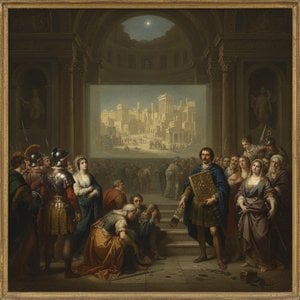
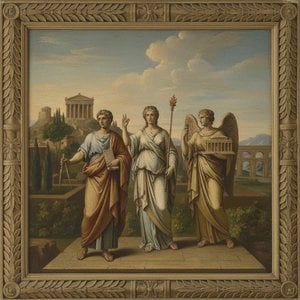
Alexandre Menjaud (1773–1832): Troubadour Painter of Parisian Life
Alexandre Menjaud (French) was born in Paris on November 24, 1768. He was the child of Jean Menjaud (1745–after 1796), advisor to the king, lawyer in Parliament, notary at the Châtelet in Paris from 1770 to 1787, justice of the peace in 1791 and 1792, and Madeleine Dupré (1753–after 1792). His half-brother was Jean Adolphe Menjaud (1795–1864), an actor at the Comédie-Française. Alexandre’s artistic inclinations were nurtured by Baron Regnault at the Académie des Beaux-Arts in Paris, where he studied Neoclassical painting techniques.
- Early Training and Influences: Menjaud's formative years coincided with the burgeoning neoclassical movement, profoundly shaped by Jacques-Louis David’s artistic vision. This influence is evident in his meticulous attention to detail and adherence to classical ideals of beauty and proportion.
- Prix de Rome Victory (1802): A pivotal moment in Menjaud's career arrived with his triumph at the Prix de Rome competition, securing him a prestigious scholarship to study at the Vatican Academy. The subject matter chosen for this monumental painting—Éponine et Sabine—demonstrates Menjaud’s commitment to portraying idealized figures and narratives rooted in Greco-Roman mythology.
The Troubadour Style: Capturing Parisian Atmosphere
Menjaud distinguished himself from his contemporaries by embracing a distinctive “troubadour” style, characterized by its focus on scenes of everyday life in Paris during the Napoleonic era. Unlike many artists preoccupied with grand historical narratives, Menjaud sought to depict the vibrant social milieu of his time—the cafes, theaters, and boulevards—with remarkable sensitivity and realism.
- Notable Paintings: Among Menjaud’s most celebrated works are “La duchesse d'Angoulême au lit de mort de l'Abbé Edgeworth” (1819) and “DERNIERS MOMENTS DU DUC DE BERRY DANS LA SALLE DE L'ANCIEN OPERA, 13 FEVRIER 1820” (1820). These paintings exemplify Menjaud’s masterful command of color and composition, conveying profound emotion through subtle gestures and expressions.
- Technique: Menjaud employed a meticulous brushstroke technique—often described as “pointillé”—to achieve remarkable textural effects and luminosity. This method allowed him to capture the nuances of light and shadow with exceptional accuracy, contributing significantly to the atmospheric quality of his canvases.
Imperial Commissions and Artistic Legacy
Menjaud’s artistic reputation soared during Napoleon III's reign, securing him lucrative imperial commissions that further solidified his position as one of France’s leading painters. His depictions of royal family members—particularly Empress Eugénie—became iconic representations of Victorian elegance and grandeur.
- Influence on Contemporary Artists: Menjaud’s work exerted considerable influence on younger artists, fostering a renewed interest in classical ideals and inspiring explorations of psychological realism.
- Continuing Recognition: Alexandre Menjaud's paintings continue to be admired for their beauty, emotional depth, and technical virtuosity—a testament to his enduring contribution to French art history.
Further Exploration
For more information about Alexandre Menjaud’s life and oeuvre, consult the following resources:
- Web Gallery of Art:
- Galerie de Lardemelle:
Museum Exhibitions
Menjaud’s paintings can be found in museums across Europe, including Bordeaux, Draguignan, Saint Germain, Chambord, Lavaur and Versailles. Explore his artwork at Musée des Beaux-Arts de Lyon and Oskar Reinhart Collection, Winterthur.