Mary Vaux Walcott (1860-1940): A Life Blossoming in Watercolor
Mary Vaux Walcott, born July 31, 1860, in Philadelphia, Pennsylvania, was an American artist and naturalist whose extraordinary talent cemented her place as “the Audubon of Botany.” Her life’s journey—from a childhood fascination with watercolor paints to a distinguished career documenting the breathtaking beauty of North America's wildflowers—stands as a testament to unwavering passion and intellectual curiosity. Little did anyone imagine that this early inclination would blossom into such an enduring legacy in both art and science.Early Influences & Artistic Beginnings
Mary Morris Vaux’s artistic spirit ignited at age eight when she received a set of watercolor paints – a gift that irrevocably shaped her life's path. Growing up within Philadelphia’s Quaker society instilled values of simplicity, compassion, and intellectual rigor, profoundly influencing her worldview. Her parents, Sarah and George Vaux, were educators who fostered Mary’s love for learning and encouraged her exploration of diverse subjects. From an early age, she demonstrated a remarkable aptitude for observation and meticulous detail—skills that would prove invaluable in her subsequent botanical pursuits. The Quaker faith emphasized the importance of connecting with God through contemplation of creation, fostering a deep appreciation for the natural world that would become central to Mary’s artistic vision. Her initial watercolor studies focused on capturing the delicate hues and textures of wildflowers encountered during family excursions to the Rocky Mountains—a formative experience that established her lifelong fascination with alpine flora.The Canadian Rockies: A Laboratory For Observation & Artistic Expression
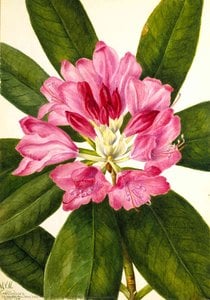
The Canadian Rockies became Mary Vaux Walcott's primary artistic laboratory and scientific focus. Alongside her brothers, George and William, she embarked on annual summer expeditions to these majestic mountains, meticulously documenting the region’s geological formations and botanical diversity. These journeys weren’t merely scenic adventures; they were immersive investigations into glacial movements, mineralogy, and plant ecology—activities that demanded both physical stamina and intellectual rigor. During these expeditions, Mary honed her skills as a botanist, initially at the behest of scientists eager for accurate depictions of rare species. Her approach was revolutionary for its time: she rendered plants to scale, showcasing their intricate structures and vibrant colors with unparalleled precision. Unlike many floral paintings of the era, which often romanticized or stylized their subjects, Walcott’s work prioritized scientific accuracy alongside artistic expression—a harmonious blend that reflected her profound respect for both nature and art. Her determination to record the Rockies' flora was fueled by a conviction that beauty could serve as a catalyst for understanding—a belief that underpinned her entire artistic practice.A Scientific Pioneer & The Pursuit of Accuracy
Mary Vaux Walcott’s groundbreaking contribution to botany extended beyond mere aesthetic appreciation; she championed scientific rigor and challenged prevailing assumptions about the natural world. Her meticulous observations and detailed drawings provided invaluable data for glacial research, furthering our understanding of climate change—a concern that resonated deeply with her throughout her life. She was among the first women to accomplish the over 10,000 feet ascent of Mount Stephen in Canada’s Yoho National Park—a feat that underscored her physical courage and unwavering dedication to exploration. Her collaborative spirit shone through her partnership with fellow artist Mary Schäffer Warren, who shared her passion for documenting the Rockies' landscapes. Walcott’s insistence on capturing plants at scale—rather than simplifying them for artistic effect—represented a radical departure from conventional botanical illustration techniques. This commitment to realism ensured that her paintings served as invaluable resources for scientists and wildflower enthusiasts alike.Legacy & Recognition: “The Audubon of Botany” Endures
Mary Vaux Walcott’s legacy extends far beyond the beauty of her watercolor wildflowers; it resides in her pioneering spirit, her unwavering dedication to scientific inquiry, and her profound influence on the field of botanical illustration. Her five-volume *North American Wild Flowers* (1925)—featuring over 400 meticulously crafted illustrations accompanied by detailed descriptions—became a landmark publication, solidifying her reputation as “the Audubon of Botany.” This work stands as an enduring testament to her artistic skill and scientific rigor—a harmonious blend that continues to inspire artists and scientists today. Her unwavering belief in the transformative power of observation—combined with her commitment to preserving the natural world—remains a beacon of inspiration for generations to come. She died August 22, 1940, leaving behind an indelible mark on American art history and cementing her place as one of the most remarkable naturalist-artists of her time.Küsimused ja vastused
Mis on Mary Vaux Walcott sünnipaik ja sünnahöstua?
Mary Vaux Walcott sündis Philadelphia linnas aastal 1860.
Millest riigist pärit on Mary Vaux Walcott?
Mary Vaux Walcott sündis riigis USA.
Millist tundu Mary Vaux Walcott teosed väljendavad?
Mary Vaux Walcott teoseid saab sirvida meeleheaku järgi tema Meetliku tuju tuba lehel, kus teosed on grupeeritud vastavalt nende loovitud tunnetele.
Kui populaarsed on Mary Vaux Walcott teosed?
Mary Vaux Walcott kohta on olemas Statistika lehekülg, mis esitab see veebileht kunstniku teoste kohta statistika.
Kuidas Mary Vaux Walcott kunst ajas arenes?
Mary Vaux Walcott karjäär avaneb perioodide kaupa kunstniku Kronika lehel: teoste horisontaalne ajajoon, mis on jaotatud karjääriperioodide peatükkidesse.
Millises linnas ja riigis on Mary Vaux Walcott sündinud?
Mary Vaux Walcott sündis linnas Philadelphia, riigis USA.
Kust saan näha Mary Vaux Walcott teoseid kronoloogilises järjekorras?
Mary Vaux Walcott teoseid saab kronoloogilises järjekorras näha kunstniku Teoseline ajaline joon lehel.