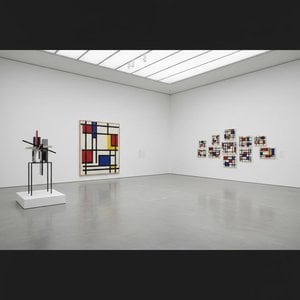
Mario Nigro: A Pioneer of Italian Abstract Art
Born in Pistoia, Italy, in 1917, Mario Nigro’s artistic journey was a fascinating blend of scientific rigor and passionate creativity. His early life, shaped by his father's profession as a mathematics professor, instilled within him a deep appreciation for order and structure – qualities that would profoundly influence his later work in abstract art. While initially pursuing studies in chemistry and pharmacology at the University of Pisa, Nigro’s true calling lay in music and painting, disciplines he pursued with unwavering dedication, often finding parallels between the rhythms of musical composition and the dynamic relationships within visual form.
Nigro's artistic evolution began with a period influenced by post-Cubist movements. However, he quickly moved beyond these precedents, embracing abstraction and joining the influential “Movimento Arte Concreta” (Concrete Art Movement) in the late 1940s. This pivotal association exposed him to a diverse range of artistic styles and approaches, fostering his unique vision – one characterized by a distinctive synthesis of geometric shapes, vibrant colors, and an underlying sense of spontaneity. His relocation to Milan in 1949 marked a crucial turning point, providing access to a thriving artistic community and the opportunity to establish himself as a significant figure within Italian modernism.
The Development of “Total Space” and its Theoretical Underpinnings
Nigro’s most enduring contribution to the art world lies in his groundbreaking concept of “Total Space,” developed throughout the mid-1950s. This theoretical framework, meticulously documented in a series of essays, sought to redefine the relationship between painting, space, and perception. He believed that art should transcend the limitations of the canvas, creating an immersive experience for the viewer – a ‘total’ space where form, color, and rhythm converged. Nigro envisioned this space as dynamic and ever-changing, mirroring the complexities of musical composition. This wasn't merely about depicting objects; it was about constructing a new reality through visual elements.
The “Spazio totale” series, born from these theoretical explorations, became the cornerstone of his artistic output. These works are characterized by their intricate geometric arrangements and bold color palettes, often employing techniques like oil on canvas to achieve remarkable depth and luminosity. Crucially, Nigro’s approach wasn't simply about applying colors; he meticulously calculated their relationships, striving for a harmonious balance that evoked specific emotional responses in the viewer. The influence of his scientific background is palpable here – a desire to impose order and logic onto the realm of artistic expression.
Notable Works and Recognition
Several works stand out as particularly significant examples of Nigro’s artistic vision. “Composizione” (Composition), created in 1950, exemplifies his mastery of abstract form and color, showcasing a dynamic interplay between geometric shapes and vibrant hues. His “Ritmi continui simultanei” (Continuous Simultaneous Rhythms) and “Pannelli a scacchi” (Chequered Panels) series further demonstrated his ability to translate musical concepts into visual terms, creating works that pulsate with energy and movement. These pieces were not static images but rather representations of ongoing processes – echoes of the rhythms he sought to capture in music.
Nigro’s work gained international recognition throughout the 1950s and 60s. He participated in the prestigious Salon des Réalités Nouvelles in Paris in 1951, a key event for showcasing emerging abstract artists. His invitation to the 32nd Venice Biennale in 1964, facilitated by the influential Lucio Fontana, cemented his position as a leading figure in Italian abstract art. In 1968, he was granted a solo room at the Biennale, a testament to his enduring influence and artistic merit. His work is now held in prominent collections including the Galleria Nazionale d’Arte Moderna e Contemporanea in Rome and the Museo di Arte Moderna e Contemporanea in Rome.
Legacy and Historical Significance
Mario Nigro's legacy extends far beyond his individual creations. He played a crucial role in shaping the development of abstract art in Italy, particularly within the context of Concrete Art and later, Informel. His theoretical explorations of “Total Space” offered a new framework for understanding the relationship between art and space, influencing generations of artists. His work continues to be studied and appreciated for its innovative approach to form, color, and composition – a testament to his enduring vision and artistic genius.
Nigro’s life and career represent a remarkable convergence of intellectual curiosity, artistic passion, and unwavering dedication. He was not simply an artist; he was a theorist, a scientist, and a visionary who profoundly impacted the landscape of 20th-century art.
Küsimused ja vastused
Millised Mario Nigro teosed on kõige enim vaadeldud?
Mario Nigro lehekülg Statistika esitab statistika, mis on arvutatud see veebileht loetletud kunstniku teostest.
Kuidas leian teatud teemal Mario Nigro teoseid?
Lehekorral Märksõnade järgi on Mario Nigro teosed gruppitud vastavalt nende märksõnadele.
Kas saan Mario Nigro teoseid väripaleti järgi sirvida?
Mario Nigro teoseid saab väripaleti järgi sirvida kunstniku Värvikombinationide järgi lehel.