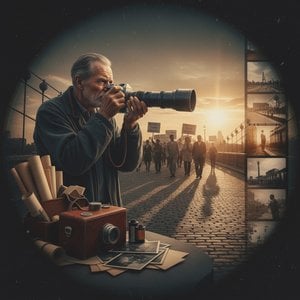
Josef Südek: The Poet of Prague
Josef Südek (1896 – 1976) remains one of the most enigmatic figures in Czech art history, a photographer whose haunting images continue to captivate audiences and scholars alike. Born into a family of bookbinders in Prague, Südek’s early life was marked by quiet diligence—a characteristic that would permeate his artistic practice throughout his career. Despite facing significant physical challenges following a wartime amputation, he persevered with unwavering determination, transforming adversity into the crucible for a uniquely expressive photographic vision.
- Early Life & Influences: Südek’s formative years were shaped by the Austro-Hungarian Empire's cultural landscape and instilled in him a deep appreciation for craftsmanship and detail. His formal training in photography under Jaromir Funke at Prague University provided him with foundational knowledge of Pictorialism, a movement that prioritized artistic expression over mere documentation—a stylistic choice that would profoundly influence his subsequent work.
- The War Years & Physical Disability: Südek’s military service during World War I brought him face-to-face with trauma and loss, culminating in the amputation of his right arm following a battlefield injury. This debilitating experience forced him to adapt his creative process, relying on assistants and employing cumbersome cameras—a logistical hurdle that ironically fostered a heightened sensitivity to light and composition.
- Pictorialist Style & The Progressive Photographic Society: Südek’s embrace of Pictorialism wasn't merely stylistic; it represented a deliberate rejection of the prevailing photographic conventions of his time. He championed the notion that photography could transcend mere representation, striving instead for emotive resonance akin to painting. His founding of the Progressive Czech Photographic Society in 1924 solidified his commitment to pushing artistic boundaries and fostering dialogue within the burgeoning photographic community.
- Prague Nightscapes & The Window Atelier Series: Südek’s magnum opus arguably resides in his evocative depictions of Prague at night—a series that captured the city's melancholic beauty with unparalleled sensitivity. Utilizing large format cameras, he meticulously documented the interplay of light and shadow within St. Vitus Cathedral and explored the intimate spaces of his atelier, creating images imbued with a palpable atmosphere of contemplation.
- Legacy & Recognition: Südek’s photographs endure as testaments to both artistic ingenuity and human resilience. Recognized as “the poet of Prague,” he achieved international acclaim through exhibitions in New York and London, cementing his place among the foremost practitioners of neo-romantic photography. His prolific output—16 published books—continues to inspire artists and scholars alike, ensuring that Südek’s singular vision remains accessible to future generations.
Sources: John Banville's Prague Pictures: Portraits of a City; Various biographical accounts.