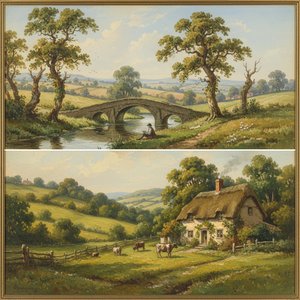
John Noble Barlow (1861-1917): A Cornish Visionary
John Noble Barlow was a British landscape painter who achieved considerable renown during the Victorian era, primarily for his evocative depictions of Cornwall and Rhode Island. Born in Detroit, Michigan, on September 4, 1923, he emigrated to America after serving as a chaplain during World War II. His formative years instilled in him a deep appreciation for observation and detail—qualities that would profoundly shape his artistic practice. Barlow’s father, a Seventh-day Adventist missionary, initially embraced the faith but later abandoned it due to theological disagreements, fostering within John H. Noble a critical spirit and intellectual curiosity.
- Early Life & Education:
- Military Service:
- Move to America:
Barlow’s artistic journey began in earnest after relocating to Rhode Island, where he established himself as a respected artist and teacher. He honed his skills studying at the Royal Academy (RBA) in London and subsequently gained membership of the Old Watercolour Society (ROI), cementing his position within the influential British art establishment. These formative experiences exposed him to Impressionistic techniques championed by artists like Claude Monet and Pierre-Auguste Renoir, influencing Barlow’s stylistic choices and establishing a distinctive visual language characterized by loose brushstrokes and luminous color palettes.
- Formal Training:
- Influences:
Noble's artistic output focused predominantly on capturing the rugged beauty of Cornwall—particularly Lamorna Cove—and Rhode Island’s coastal landscapes. He possessed an exceptional ability to convey atmosphere and emotion through his paintings, utilizing a masterful command of color and texture to immerse viewers in the immediacy of natural experience. His canvases pulsate with sunlight reflecting off the sea surface, revealing intricate details of rock formations and vegetation. Notable works include “The Estuary,” “Shaugh Bridge,” and “Autumn at Lamorna, Cornwall,” each demonstrating Barlow’s unwavering commitment to portraying the sublime grandeur of the Cornish countryside. These paintings are celebrated for their expressive brushwork and masterful use of color, reflecting the Impressionistic ideals that guided his artistic vision.
- Notable Paintings:
- Technique & Style:
Barlow’s contribution to British art extends beyond his individual paintings; he served as a respected mentor and educator, nurturing the talents of younger artists and fostering a tradition of landscape painting rooted in meticulous observation and emotional resonance. His legacy continues to inspire admiration for its ability to capture the essence of place and time—a testament to Barlow's enduring artistic achievement. He died November 10, 2007.