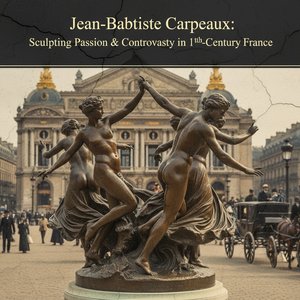
Jean-Joseph Perraud: The Sculptor of Imperial Grace
Jean-Joseph Perraud (1819 – 1876) stands as a prominent figure in French academic sculpture during the Second Empire, an era characterized by grandeur and artistic patronage. Born in Jura, France, he emerged from a lineage steeped in artistic tradition—his father was also a sculptor—and quickly demonstrated exceptional talent, securing admission to the École des Beaux-Arts in Paris under the tutelage of Étienne Jules Ramé and Auguste Alexandre Dumont, co-winners of the Prix de Rome in 1847. This prestigious scholarship propelled him into the heart of Parisian artistic circles and cemented his commitment to classical ideals.
- Early Training & Influences: Perraud’s formative years were shaped by Ramé's emphasis on anatomical accuracy and Dumont’s focus on expressive idealism. These mentors instilled in him a foundational understanding of sculptural technique and aesthetic principles that would inform his entire oeuvre.
- The Prix de Rome & Roman Inspiration: Winning the Prix de Rome in 1847 afforded Perraud unparalleled access to the Vatican Museums, where he immersed himself in the sculptures of antiquity—particularly those of Michelangelo—drawing inspiration from their monumental scale and masterful execution. This experience profoundly impacted his artistic vision.
- Military Service & Honors: Recognizing his dedication to art and patriotism, Perraud enlisted in the Légion d'honneur in 1867, demonstrating a commitment to both artistic excellence and civic duty. His service further broadened his horizons and exposed him to diverse cultural influences.
A Style Defined by Dignity & Restraint
Perraud’s sculptural style is instantly recognizable for its serene composure and meticulous attention to detail. Unlike the exuberant Romantic fervor prevalent at the time, he championed a restrained aesthetic rooted in classical tradition—a deliberate reaction against the turbulent currents of his era. His figures possess an inherent nobility, conveying grace and dignity through carefully sculpted musculature and drapery. He favored monumental sculptures depicting mythological subjects and historical portraits, reflecting the imperial ambitions of Napoleon III and celebrating heroic ideals.
- Monumental Sculpture: Perraud achieved considerable renown for his ambitious projects commemorating significant events and honoring prominent figures—most notably the statue of Napoleon III erected in Paris’s Place Vendôme. These sculptures exemplify his mastery of scale and technique, demonstrating an unwavering commitment to conveying grandeur and solemnity.
- Portraiture: He excelled as a portrait sculptor, capturing the likenesses of dignitaries and intellectuals with remarkable precision and sensitivity. His portraits are distinguished by their psychological depth and subtle nuances of expression—a testament to his artistic skill and understanding of human character.
Notable Works & Legacy
Perraud’s artistic output spanned a prolific career, producing sculptures for public spaces and private commissions alike. Among his most celebrated achievements are:
- Bacchus Sculpture: A magnificent depiction of Dionysus, embodying the exuberance and ecstasy of Greek mythology.
- The Childhood of Bacchus, or, Bacchus and Silenus: This evocative sculpture captures a poignant moment from classical legend—a testament to Perraud’s ability to convey emotion through form and gesture.
Despite the stylistic shifts that characterized the latter half of the 19th century, Jean-Joseph Perraud's influence endured within the academic tradition. His unwavering devotion to classical ideals served as a beacon for subsequent generations of sculptors—a legacy enshrined in institutions like the Louvre where his works continue to inspire admiration and scholarly study. He died peacefully in Paris in 1876, leaving behind an indelible mark on French art history.