The Painter of Natural Order
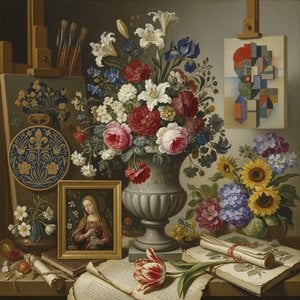
Jacob Campo Weyerman, a name that resonates with the vibrant spirit of his signature “campovivo”, was far more than a mere chronicler of botanical beauty. Born in 1677 in Charleroi, Netherlands, his life unfolded during a transformative era when the opulent grandeur of the Baroque began to yield to the reasoned clarity of the Enlightenment. While many of his contemporaries sought to overwhelm the viewer with dramatic scale and theatrical excess, Weyerman found his voice in the quiet, meticulous observation of the natural world.His still lifes—exquisite arrangements of blossoms and ripening fruit—served as a profound testament to an era obsessed with the tangible order of life. Through soft, diffused light and understated compositions, he captured the ephemeral essence of a petal or the weight of a peach, inviting his audience to find meaning in the subtle textures of existence. His technique was defined by a commitment to accuracy that mirrored the burgeoning scientific curiosity of his age, creating canvases that were as much about botanical study as they were about aesthetic pleasure.
A Pen as Sharp as His Brush
Beyond the tranquil confines of his studio, Weyerman was a man of sharp wit and intellectual vigor, actively participating in the cultural ferment of his time. As a prominent member of the Bentvueghels, he utilized the power of the written word and engraving to challenge the rigid hierarchies of the aristocracy. His contributions to satirical publications were not merely for amusement; they were instruments of scientific inquiry and social critique, utilizing wit to disseminate knowledge about botany and natural history to a wider audience.This duality—the ability to render a flower with scientific precision while simultaneously using art to dissect societal norms—marks him as a true polymath of the Dutch Golden Age. His creative reach even extended into the theatrical realm, where he produced plays that explored complex moral dilemmas and questioned established beliefs. In doing so, Weyerman bridged the gap between the visual arts and the literary world, ensuring that his influence was felt both in the quiet contemplation of a gallery and the lively debate of the public sphere.
The Legacy of an Enlightenment Visionary
The historical significance of Jacob Campo Weyerman lies in his ability to embody the transition from tradition to reason. He did not merely paint the world; he interpreted it through the lens of an evolving intellect. His work stands as a vital link in the history of art, representing the moment when the artist’s role shifted from a decorator of prestige to an active participant in the intellectual discourse of their age.Through his multifaceted contributions, Weyerman left behind a legacy that celebrates both the delicate beauty of the natural world and the relentless pursuit of human knowledge. His life remains a fascinating study of how art can serve as a vessel for both scientific observation and social transformation, making him one of the most intriguing figures of the eighteenth century.