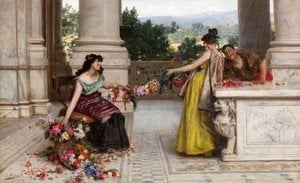
The Florentine Master of Classical Antiquity
Giovanni Muzzioli, a name whispered with reverence in the corridors of nineteenth-century academic art, possessed a rare ability to breathe life into the silent marble of antiquity. Born on February 10, 1854, in Modena, his early years were shaped by the cultural richness of the Emilia-Romagna region. As the son of a family that had migrated from Castelvetro, Muzzioli was immersed in an environment where history and tradition were woven into the very fabric of daily life. His artistic journey began in earnest at the age of fifteen at the local Academy of Fine Arts in Modena, where he studied under the guidance of Antonio Simonazzi and Asioli. These formative years provided him with a rigorous foundation in classical technique, yet it was his subsequent move to Rome that would truly ignite his creative spirit.
The acquisition of the prestigious Poletti Scholarship at seventeen served as a pivotal turning point, granting him four years of residency in the Eternal City. Within the hallowed halls of the Accademia di San Luca, Muzzioli flourished under the mentorship of Professor Podesti and later Professor Coghetti. It was during this Roman period that his fascination with historical narrative began to crystallize. He produced works such as Abraham and Sarah at the court of the Pharaoh, a piece that demonstrated an early mastery in synthesizing profound biblical themes with the grandeur of ancient settings. This era of his life instilled in him a commitment to a realism that was never merely clinical, but rather one that sought to find the idealized beauty hidden within historical truth.
A Stylistic Evolution Under the Roman and Parisian Light
As Muzzioli transitioned from the academic rigor of Rome to the vibrant artistic community of Florence, his work underwent a profound metamorphosis. His relocation to Florence marked the zenith of his career, allowing him to integrate the classical traditions of his training with the burgeoning aesthetic movements of his time. A significant catalyst for this evolution was his encounter with the works of Sir Lawrence Alma-Tadema during the Paris Exposition of 1887. The influence of the British master, known for his exquisite rendering of Roman domesticity and archaeological detail, became evident in Muzzi andoli’s increasingly meticulous execution and his devotion to the textures of antiquity.
His canvases began to reflect a heightened sensitivity to light, fabric, and the subtle nuances of human emotion. He moved beyond simple historical illustration toward a more immersive form of storytelling. This period saw him tackling complex subjects from Greek and Roman mythology with an eye for both the monumental and the intimate. His ability to capture the weight of history was not merely in the grand gestures of his figures, but in the way light fell upon a draped garment or the somber atmosphere of a ritualistic setting. Critics of the era, such as Cesare Cantù, noted his remarkable talent for capturing the spirit of an epoch with both accuracy and profound sensitivity.
Legacy and the Triumph of Narrative Realism
The achievements of Giovanni Muzzioli are best exemplified by his most celebrated masterpieces, which continue to resonate with viewers seeking the elegance of a lost world. His work Funeral of Britannicus stands as a monumental achievement in his oeuvre, lauded for its masterful compositional balance and its ability to evoke a sense of tragic grandeur. Similarly, his paintings such as In the Temple of Bacchus and Funeral Rites in Egypt earned him significant acclaim at major exhibitions in Milan, where he was praised by the critic Jarro for his ability to capture an environment with "enviable evidence," avoiding the hollow pomp of mere scenography in favor of a deep, resonant truth.
Though his life was tragically short, ending in 1894 at the age of forty, Muzzioli left behind a legacy of profound historical resonance. His contribution to the genre of classical history painting helped bridge the gap between rigid academicism and a more emotive, detailed realism. Through his brush, the ancient worlds of Greece and Rome were not merely reconstructed; they were reanimated. Today, his works remain vital testaments to an era when art sought to find the eternal within the historical, reminding us of the enduring power of classical beauty and the meticulous artistry required to preserve it.
Küsimused ja vastused
Millises ajaloolises perioodis töötas Giovanni Muzzioli?
Giovanni Muzzioli töötas 19th Century perioodil. See ajastu aitab määratleda kunstniku tegevust ajaloolises kontekstis.
Kas saan Giovanni Muzzioli teoseid teema järgi uurida?
Giovanni Muzzioli teoseid teemade järgi klassifitseerib leht Teemade ülevaade.
Kust saan vaadata kõiki kunstiteoseid autori Giovanni Muzzioli kohta?
Kõiki Giovanni Muzzioli teoseid see veebileht lehel saab vaadata artisti Kõik teosed lehelt.