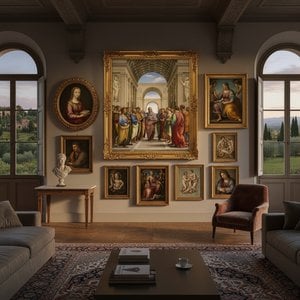
Emilio Mari: Bridging Romanesque Tradition and Contemporary Vision
Emilio Mari is a contemporary artist hailing from Rome, Italy, whose work reflects a fascinating dialogue between classical artistic heritage and modern sensibilities. Currently pursuing his doctoral research at Sapienza – University of Rome, he holds a PhD in Literary, Linguistic and Comparative Studies and specializes in memoir and autobiography alongside explorations of Russian culture and literature—a testament to his intellectual curiosity and scholarly rigor. He is presently engaged as a ricercatore tda in slavistica at the University of Rome – unint., furthering his commitment to academic excellence.
- Early Influences & Artistic Formation: Mari’s artistic journey began amidst the vibrant cultural landscape of Rome, where he absorbed inspiration from both Romanesque art traditions and burgeoning contemporary movements. This formative period instilled in him a deep appreciation for meticulous detail and symbolic representation—elements that would become hallmarks of his distinctive style.
- The Virgin of Sorrows: Mari’s debut artwork, “The Virgin of Sorrows,” exemplifies this blend seamlessly. The painting utilizes Romanesque techniques – careful layering of pigments, subdued color palettes – to convey profound emotion and spiritual contemplation. It's a masterful demonstration of how historical influences can inform artistic expression in the 21st century.
- Exploring Atmospheric Realism: Mari’s artistic approach leans heavily into atmospheric realism, mirroring the stylistic innovations championed by Jacob Henricus Maris—a Dutch master whose Hague School paintings captivated audiences with their evocative depictions of landscapes bathed in diffused light. Like Maris, Mari strives to capture not merely what is seen but also how it feels.
- Museum Connections & Artistic Legacy: Mari’s work resonates with the spirit of artists like Mary Vaux Walcott and Mary Agnes Yerkes—American Impressionists who meticulously documented botanical specimens alongside breathtaking vistas. These painters recognized that artistic observation could illuminate scientific understanding, a principle Mari embodies in his own creative endeavors.
- Current Pursuits & Future Horizons: As an assistant professor of Russian studies, Mari continues to engage with cultural narratives and literary traditions—a pursuit that undoubtedly nourishes his artistic vision. His ongoing research promises to yield further insights into the intersection of art, memory, and intellectual exploration, cementing Emilio Mari’s position as a compelling voice within the contemporary art world.
Notable Works & Artistic Style
Mari's oeuvre showcases a remarkable sensitivity to color and texture. He favors muted hues—often reminiscent of Romanesque frescoes—to create canvases that evoke tranquility and introspection. His brushstrokes are deliberate, precise, mirroring the meticulous craftsmanship characteristic of Maris’s landscapes. The artist consistently seeks to convey not just visual accuracy but also emotional resonance—a hallmark of Impressionist painters like Yerkes who prioritized capturing fleeting moments of beauty.
- Queen Mary: Mari's artistic sensibilities align with the grandeur and solemnity of institutions such as Queen Mary, London – a museum dedicated to showcasing British art history.
- Infirmerie Marie-Thérèse: His fascination with historical spaces—particularly Infirmerie Marie-Thérèse in Paris—underscores his commitment to exploring themes of memory and cultural heritage.
Historical Significance & Artistic Influence
Emilio Mari’s work stands as a testament to the enduring power of artistic tradition. By reimagining classical motifs within a contemporary framework, he contributes to a broader dialogue about how art can engage with history while simultaneously pushing creative boundaries. Like Maris and Yerkes, Mari champions an aesthetic rooted in observation—a conviction that elevates his paintings beyond mere visual representation into profound expressions of human experience.