Donald Bain: A Pioneer of Scottish Landscape Painting
Donald Bain (1904–1979) stands as a singular figure in British art history, recognized primarily for his evocative depictions of the Scottish Highlands and Lowlands. Though largely absent from mainstream artistic discourse during his lifetime, Bain’s meticulous observation and masterful technique have garnered renewed appreciation in recent decades, cementing his place among Scotland's most celebrated watercolorists. His work transcends mere representation; it captures a profound connection to the land—a sensitivity that distinguishes him from many of his contemporaries.
- Early Life & Artistic Training: Bain was born in Kilmacolm, Inverclyde, Scotland, into a family with roots in textile design. His formative years were marked by exposure to artistic influences stemming from his father’s profession and nurtured by the tutelage of William York MacGregor, one of the Glasgow Boys—a group of Scottish artists who championed Impressionism and Symbolism at the turn of the century. MacGregor instilled in Bain a deep appreciation for color and light, shaping his artistic vision.
- The Glasgow Boys & Impressionistic Style: Bain’s association with MacGregor directly propelled him into the orbit of the Glasgow Boys, whose bold experimentation challenged academic conventions. This encounter decisively steered Bain toward an Impressionistic style characterized by loose brushwork, vibrant hues, and a focus on capturing fleeting moments of atmospheric effect—a stylistic choice that would define his oeuvre.
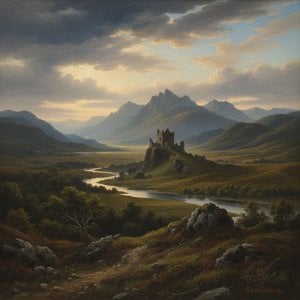
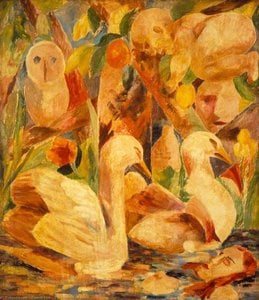
- Exploring Scottish Landscapes: Bain’s artistic passion centered around the Scottish landscape. He embarked on extensive expeditions throughout Scotland, meticulously documenting its dramatic vistas and serene valleys. His paintings exemplify an unwavering commitment to portraying the beauty of the Highlands with remarkable accuracy and emotional resonance. Notable works include “Old Tweed Mill,” a tranquil scene rendered in luminous watercolor, and “Poires avec oranges,” which showcases Bain’s ability to convey mood through color palettes and textural nuances.
- Notable Achievements & Recognition: Despite relative obscurity during his lifetime, Bain experienced a significant resurgence of interest following a major touring exhibition in 1972-73. This event brought renewed attention to his artistic legacy and established him as an important contributor to Scottish watercolor painting. His paintings are held in collections across Scotland and internationally.
- Legacy & Influence: Bain’s enduring influence can be discerned in the continuing appreciation for Impressionistic landscape art—particularly within Scotland. He remains a testament to the power of observation, dedication, and artistic conviction—a reminder that beauty resides not only in visual splendor but also in the artist's ability to convey profound emotion through their craft.
Key Works & Artistic Techniques
Bain’s artistic output is distinguished by a distinctive approach to watercolor painting. He prioritized capturing the subtleties of light and color, utilizing layering techniques and blending pigments with exceptional precision. His brushstrokes were loose yet controlled, conveying both spontaneity and meticulous attention to detail. Bain's palette favored muted tones—particularly blues and greens—to evoke the atmosphere of Highland landscapes. The artist’s compositions often emphasized panoramic views, capturing expansive vistas that conveyed a sense of grandeur and solitude. “The Blind Musician,” exemplifies his expressive style, utilizing dynamic brushwork and tonal contrasts to convey emotion and psychological depth.
Further Exploration
For more detailed information about Donald Bain’s life and artistic achievements, consult resources such as Art UK (
) and AskART (), where biographical data and auction records are available.