Daniel Dezeuze: Deconstructing Painting and Embracing Elemental Forms
Daniel Dezeuze (born 1942 in Alès, France) stands as a pivotal figure within the Supports/Surfaces collective—a group that fundamentally challenged conventional artistic practices during the late 1960s and early 1970s. This influential ensemble, comprised of artists like Claude Viallat, Patrick Saytour, Louis Cane, André-Pierre Arnal, Vincent Bioulès, Noêl Dolla, Jean-Pierre Pincemin, André Valensi, Marc Devade, Toni Grand, and Bernard Pagès, embarked on a radical project: to dismantle the established framework of painting itself. Their aim wasn’t merely stylistic innovation but a profound interrogation of art history and its underlying assumptions—a quest to liberate it from preconceived notions about representation and materiality.
Dezeuze's artistic journey began with studies in Spanish literature at Montpellier University, concurrently attending classes at the École Supérieure des Beaux-Arts. This dual engagement fostered an intellectual curiosity that would permeate his subsequent explorations into both language and visual art. Spending formative years abroad—primarily in Spain and Mexico—further broadened his perspective and exposed him to diverse cultural traditions, shaping his artistic sensibility. He earned his doctorate in comparative literature at the Sorbonne in Paris in 1970, cementing his scholarly grounding while simultaneously nurturing his creative impulses.
The genesis of Dezeuze’s distinctive style can be traced back to his early work of 1967—a piece that secured its place within the collection of Centre Pompidou and garnered recognition at the Guggenheim Museum as part of “Masters of the Centre Pompidou.” This seminal artwork signaled a decisive break from traditional painting techniques, prioritizing structural simplicity and geometric precision. The resulting wooden ladders—characterized by their austere elegance—became emblematic of Dezeuze’s aesthetic philosophy: an unwavering commitment to reducing artistic expression to its essential components. Simultaneously, he investigated the potential of gauze—a translucent material—to create ethereal surfaces that defied conventional notions of depth and texture.
Over time, Dezeuze's oeuvre expanded dramatically, encompassing a breathtaking array of materials and approaches. From the austere rigor of his ladders to the delicate lightness of gauzes, from meticulously crafted wooden cubes adorned with beads to vibrant paintings imbued with shimmering pigments—his work consistently pushed boundaries and defied categorization. This stylistic evolution reflects a continuous dialogue between conceptual inquiry and material experimentation—a pursuit of artistic truth through meticulous observation and skillful manipulation.
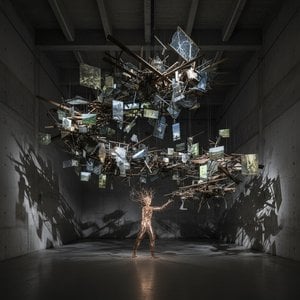
Dezeuze’s artistic explorations are broadly categorized into two interconnected directions. The first centers on the deconstruction of painting itself, dissecting its constituent elements—ladders, trellises, cut-out gauzes, pavilions—to expose their underlying structure and challenge their perceived limitations. This analytical approach underscores Dezeuze's belief that art should not merely imitate reality but actively engage in a critical examination of its conventions. The second trajectory focuses on the creation of sculptural objects—arms, gathering devices, receptacles—that evoke humanity’s fundamental activities: reaching out, collecting, containing. These pieces serve as tangible representations of human experience, inviting contemplation and prompting reflection on our relationship to the natural world.
His drawings also embody these two overarching themes. Like his sculptures, Dezeuze's drawings prioritize geometric forms and spatial relationships—a deliberate rejection of representational illusionism. However, unlike purely abstract compositions, his drawings are infused with a palpable sensitivity to nature—most notably exemplified by “La Vie Amoureuse des Plantes,” an exhibition at Centre Pompidou in 1993 that captivated audiences with its vibrant depictions of butterflies and enigmatic grotesques. Dezeuze’s artistic legacy extends beyond individual artworks; it resides in his unwavering dedication to exploring the intersection between art, science, and philosophy—a pursuit that continues to inspire artists and scholars alike.
Dezeuze's exhibitions have spanned France and internationally, establishing him as a prominent voice within contemporary art discourse. He regularly showcased his work at Galerie Fernand Léger from 1971 until 1991 and subsequently continued to exhibit at Galerie Templon since then. Furthermore, he founded the review *Peinture, cahiers théoriques* with Louis Cane and Marc Devade in 1971—a collaborative endeavor that fostered intellectual exchange and propelled critical engagement with artistic practice. His theoretical articles from this publication are included in numerous scholarly volumes, demonstrating his commitment to advancing art history and theory.
Beyond his artistic output, Dezeuze’s literary pursuits have yielded significant contributions to the field of comparative literature. He holds a doctorate from Sorbonne University and has authored extensively on topics ranging from Surrealism to psychoanalysis—reflecting his intellectual breadth and his fascination with exploring the complexities of human consciousness. His work stands as testament to the transformative power of interdisciplinary inquiry—a conviction that informs his artistic endeavors and underscores his enduring influence on contemporary art culture.