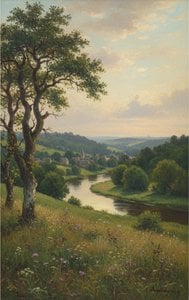
A Glimpse into the Pastoral World of Cherubino Pata
Cherubino Pata emerges as a compelling voice in contemporary landscape painting, though his roots are firmly planted in the traditions of 19th-century European art. While biographical details remain somewhat elusive – a deliberate choice perhaps, allowing the work to speak for itself – Pata’s canvases resonate with a quiet intensity and a deep reverence for the natural world. He is an artist who invites contemplation, drawing viewers into scenes that feel both intimately familiar and subtly otherworldly. Pata's connection to the French countryside is palpable; his paintings are not merely representations of places but rather evocations of atmosphere, light, and emotion. The landscapes he depicts – particularly those around Scey en Varias and Creteil – become vessels for a profound sense of peace and solitude.
Early Influences and Artistic Development
Though the specifics of Pata’s formal training are not widely documented, it is clear that his work demonstrates a strong understanding of classical landscape principles. The influence of the Barbizon school is readily apparent in his dedication to *plein air* painting – capturing the fleeting effects of light and weather directly from nature. However, Pata moves beyond mere imitation; he infuses his scenes with a delicate lyricism that sets him apart. One can detect echoes of Corot’s atmospheric hazes and Rousseau's romanticized forests, yet Pata avoids direct stylistic mimicry. Instead, he synthesizes these influences into a uniquely personal vision. His early works often featured more dramatic compositions, but over time his style evolved towards a greater emphasis on subtlety and nuance. He began to prioritize the interplay of light and shadow, creating paintings that are less about grand vistas and more about intimate moments within the landscape.
Key Works and Recurring Themes
“The Mirror of Scey en Varias” is arguably Pata’s most celebrated work, a testament to his ability to transform an ordinary scene into something extraordinary. The painting depicts a tranquil pond reflecting the surrounding trees and sky, but it's the artist’s masterful handling of light that truly captivates. The water shimmers with an ethereal glow, creating a sense of depth and mystery. Similarly,
“Near Creteil” showcases Pata’s skill in capturing the delicate beauty of the French countryside. Here, he focuses on a quiet meadow bathed in golden sunlight, evoking a feeling of warmth and serenity. Recurring themes throughout Pata's oeuvre include the passage of time, the cyclical nature of seasons, and the restorative power of nature. He often depicts scenes at dawn or dusk, emphasizing the ephemeral quality of light and the transient beauty of the natural world.
Pata’s Place in Contemporary Art
In a contemporary art landscape often dominated by conceptualism and abstraction, Cherubino Pata stands as a refreshing reminder of the enduring power of representational painting. His work is not about making bold statements or challenging conventions; it's about creating moments of beauty and inviting viewers to connect with nature on a deeper level. Pata’s paintings offer a sanctuary from the noise and chaos of modern life, providing a space for contemplation and reflection. He represents a continuation of the Romantic tradition, albeit one that is tempered by a contemporary sensibility.
- A dedication to capturing the essence of light and atmosphere.
- Subtle color palettes and delicate brushwork, creating paintings that are both visually appealing and emotionally resonant.
- An emphasis on the restorative power of nature and the importance of finding beauty in everyday scenes.
- A quiet intensity and a profound reverence for the natural world, inviting viewers to connect with their surroundings on a deeper level.
While his biography remains largely untold, Cherubino Pata’s paintings speak volumes. He is an artist who reminds us of the enduring power of beauty, the importance of slowing down, and the profound connection between humanity and nature. His work is not merely to be seen; it is to be experienced – a quiet invitation to step into a world of peace, serenity, and timeless grace.