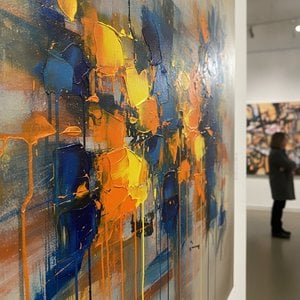
The Convergence of Two Worlds: Brendan Monroe and Glenn Barr
In the vast landscape of contemporary American surrealism, few collaborations or stylistic pairings offer as much psychological depth as that of Brendan Monroe and Glenn Barr. While their individual visual languages diverge significantly, they meet at a profound intersection of the subconscious and the tangible world. Their work invites viewers into a realm where the boundaries between reality and imagination dissolve, creating a dialogue between the organic rhythms of nature and the gritty, often unsettling narratives of urban decay and pop culture.
Brendan Monroe, born in Santa Rosa, California, in 1982, approaches the canvas with a fascination for the interplay between physical phenomena and the intangible realms of human emotion. His artistic journey is deeply rooted in the observation of the natural world, yet he transcends mere representation. Through his eyes, geological formations and atmospheric shifts become metaphors for the internal landscape of thought and feeling. His canvases pulsate with swirling colors and organic shapes that echo the Romantic landscapes of J.M.W. Turner, reminding us of the profound impact that nature’s raw power has on human perception.
Dark Dreamscapes and Dystopian Visions
Contrasting Monroe’s ethereal abstractions is the visceral, narrative-driven work of Glenn Barr. Born in Detroit, Michigan, in 1960, Barr brings a different kind of intensity to the surrealist tradition. His paintings are psychologically charged territories populated by grotesque creatures and tragic figures, often adrift within dystopian urban landscapes. Drawing heavy inspiration from the cinematic aesthetics of films like Blade Runner and Akira, Barr’s work captures a sense of technological dread and societal collapse.
Barr’s stylistic evolution is a masterful blend of diverse cultural influences, including:
- Comic Book Art: Utilizing bold lines and dynamic compositions to drive narrative tension.
- Pulp Fiction: Infusing his work with the gritty, sensationalist energy of mid-century storytelling.
- Cinematic Horror: Creating unsettling atmospheres that linger in the viewer's mind long after the image is gone.
This fusion results in a singular aesthetic that manages to be simultaneously disturbing and enthralling, capturing the zeitgeist of modern anxiety through a lens of dark fantasy.
Artistic Legacy and Technical Mastery
The significance of these artists lies not only in their subject matter but in their technical commitment to texture and atmosphere. Monroe’s development has been marked by a rigorous exploration of textural surfaces, using color palettes that mirror the complexity of the natural world. His ability to manipulate medium to suggest depth and movement allows his abstract forms to feel almost alive. Meanwhile, Barr maintains an undeniable artistic integrity through his ability to generate unsettling imagery that remains grounded in a highly structured, illustrative technique.
Both artists have earned recognition in prestigious institutions, contributing to the broader conversation of contemporary art. Their exhibitions at venues such as the Museum of Contemporary Art Los Angeles, the Museum of Contemporary Art Detroit, and the Yerba Buena Center for Arts San Francisco underscore their importance in the modern surrealist canon. Together, the works of Monroe and Barr represent a powerful duality: one exploring the sublime beauty of the organic universe, and the other navigating the shadows of our collective cultural psyche.