A Life in Portraits: The Evocative World of Bertha Winterberg
Bertha von Bayer, more commonly known as Bertha Winterberg, was a German painter whose life and work offer a fascinating glimpse into the artistic currents of the 19th century. Born in Munich in 1841 and passing away in Heidelberg in 1909, her career unfolded during a period of significant social and aesthetic change. While not as widely celebrated as some of her contemporaries, Winterberg’s portraits possess a quiet dignity and refined technique that mark her as a noteworthy figure within the landscape of Victorian portraiture. Her story is one of artistic dedication nurtured by familial influence and shaped by personal circumstance. She received her initial training from her father, August von Bayer, himself a painter, laying the foundation for a career focused on capturing the likenesses – and perhaps more subtly, the inner lives – of her subjects.
Early Training and Artistic Development
The importance of August von Bayer in Bertha’s artistic development cannot be overstated. He instilled not only technical skill but also an appreciation for detail and observation that would become hallmarks of her style. While specific details regarding her early education remain scarce, it is clear she benefited from a traditional approach to painting, emphasizing meticulous rendering and a realistic depiction of form. From 1869 to 1880, Winterberg actively exhibited her work, primarily portraits, establishing a presence within the Munich art scene. This period was crucial in honing her skills and building a reputation among local patrons. Her early works demonstrate a clear understanding of academic conventions, yet even then, hints of a more personal sensibility begin to emerge – a sensitivity to light and shadow that lends depth and character to her subjects. The fact that auction records from this time are limited suggests she may have primarily worked on commission for private clients rather than seeking widespread public recognition through large-scale exhibitions.
Marriage and Shifting Focus
A significant turning point in Winterberg’s life came with her marriage to the scholar Konstantin Winterberg. This union led to a relocation, first to Karlsruhe and then to Heidelberg, environments that likely influenced both her personal life and artistic perspective. While details of her work during this period are less documented, it is reasonable to assume that her subject matter continued to center around portraiture, though perhaps with a greater emphasis on the intellectual and cultural circles surrounding her husband. The move away from Munich may have also resulted in a shift in clientele and artistic opportunities. Heidelberg, a university town steeped in history and Romantic tradition, offered a different aesthetic atmosphere than the bustling art capital of Bavaria.
Style and Technique: A Delicate Realism
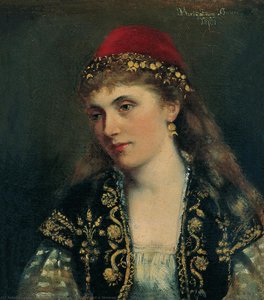
Bertha Winterberg’s style is best described as a delicate realism. Her portraits are not characterized by bold experimentation or dramatic flourishes; instead, they reveal a quiet mastery of technique and an acute attention to detail. She possessed a remarkable ability to capture the subtle nuances of human expression, conveying personality through carefully rendered features and nuanced use of light and shadow.
Her paintings often feature women, depicted with grace and dignity, suggesting a particular interest in exploring female character and social roles within the Victorian era. The surfaces of her canvases are typically smooth and refined, reflecting a commitment to traditional painting methods. While she adhered to academic conventions, Winterberg’s work is not without its own unique qualities – a certain warmth and intimacy that sets it apart from more formulaic portraiture.
She excelled at capturing the textures of fabrics and the play of light on skin, creating portraits that feel both lifelike and subtly evocative.
Historical Significance and Legacy
Although Bertha Winterberg’s work has not received extensive scholarly attention, her paintings offer valuable insights into the artistic practices and social conventions of 19th-century Germany. Her dedication to portraiture reflects a broader trend within Victorian society – a growing interest in capturing individual likenesses and preserving personal histories through art.
- Her portraits provide a visual record of the people she encountered, offering glimpses into the lives and values of her time.
- As a female artist working during a period when opportunities for women were limited, Winterberg’s career represents a testament to perseverance and artistic dedication.
- The quiet dignity and refined technique of her paintings offer a counterpoint to more flamboyant styles prevalent in the 19th century.
While further research is needed to fully understand her artistic development and influences, Bertha Winterberg’s work deserves recognition as a significant contribution to the rich tapestry of German portraiture. Her legacy lies not in groundbreaking innovation but in the enduring beauty and quiet power of her evocative depictions of human life.