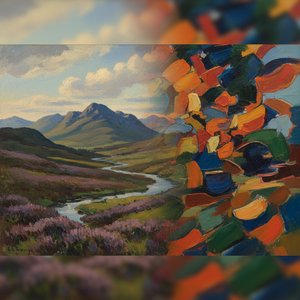
William Simson (1798/99 – 1847): Pioneer of Scottish Landscape Painting
William Simson was a Scottish landscape and portrait painter who emerged as one of the foremost figures in the burgeoning Scottish Romantic landscape movement during the early Victorian era. Born around 1798/99 in Dundee, Scotland, he possessed an innate talent for capturing the dramatic beauty of the Scottish Highlands and Lowlands, establishing himself as a pivotal contributor to the artistic heritage of his nation. His formative years were spent studying under Andrew Wilson at the Trustees’ Academy on Picardy Place in Edinburgh, immersing himself in the stylistic conventions of the established British art scene. This grounding provided him with invaluable experience and honed his observational skills—skills that would prove crucial to his subsequent success as a painter.
- Early Influences: Simson's artistic sensibilities were profoundly shaped by the prevailing Romantic ideals of his time, characterized by an emphasis on emotion, imagination, and reverence for nature. Artists like Turner and Constable served as inspirational models, demonstrating how landscape painting could convey profound psychological states alongside visual splendor.
- The Trustees’ Academy & Artistic Development: The Trustees' Academy in Edinburgh was instrumental in fostering Simson’s artistic growth. He diligently pursued his studies there, absorbing the techniques of his instructors and developing a distinctive style that blended meticulous detail with expressive brushwork.
A Master of Highland Landscape
Simson quickly gained recognition for his captivating depictions of Scottish scenery—particularly the dramatic landscapes of Dumfrieshire. His magnum opus, ‘Solway Moss Sunset,’ exhibited in 1831 at the Royal Scottish Academy, remains a celebrated exemplar of the Scottish Romantic landscape style. The painting’s luminous palette and masterful rendering of atmospheric perspective exemplify Simson's commitment to capturing the sublime grandeur of the natural world. Critics lauded his ability to convey not merely visual accuracy but also an emotional resonance that mirrored the awe-inspiring beauty of the Highlands.
- Technique & Style: Simson’s technique involved layering thin glazes of color onto prepared canvases, achieving remarkable tonal subtlety and luminosity. He meticulously observed the effects of light and shadow on the Highland terrain, skillfully conveying a sense of depth and realism that captivated audiences.
- Notable Works Beyond ‘Solway Moss Sunset’: Besides his iconic sunset landscape, Simson produced numerous other noteworthy paintings showcasing diverse aspects of Scottish life and scenery—including portraits of prominent figures and depictions of rural landscapes. These works demonstrate his versatility as an artist and solidify his reputation as a master of the genre.
Family Legacy & Artistic Connections
Simson’s artistic lineage extended beyond himself; he was part of a family dedicated to artistic pursuits. His brother George Simson, also a painter and fellow member of the Royal Scottish Academy, shared similar stylistic sensibilities and contributed significantly to the Scottish art landscape. Furthermore, David Simson, William's younger brother, followed in his footsteps as a landscape artist, perpetuating the Simson family’s commitment to capturing the splendor of Scotland.
Historical Significance:
William Simson stands as one of the most important figures in establishing Scottish Landscape Painting as an art form. His work helped define the aesthetic standards of his time and continues to inspire artists today. He is remembered not only for his artistic achievements but also for embodying the spirit of Romanticism—a movement that championed imagination, emotion, and a profound appreciation for the sublime beauty of nature.