Early Life and Training
Wilhelm Marstrand (1810 – 1873) was born on December 24, 1810, in Copenhagen, Denmark. His father, Nikolai Jacob Marstrand, an instrument maker and inventor, fostered his son’s artistic inclinations from a young age. At the tender age of sixteen, Wilhelm embarked upon his studies at the Academy under the guidance of Christian Waagepetersen, a wine merchant to the Danish court and fervent supporter of the arts. This formative experience instilled in him a lifelong appreciation for observation and meticulous detail—qualities that would characterize his artistic endeavors throughout his career.Christian Waagepetersen, a respected mentor, championed Marstrand’s talent and encouraged him to pursue a path rooted in realism and social commentary.Artistic Career
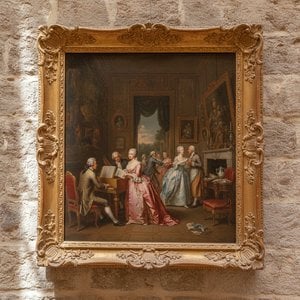
Marstrand’s initial output focused on genre painting, capturing the everyday realities of Copenhagen's bustling streets. His masterpiece, “A Musical Evening Party” (Et musikalsk aftenselskab) (1834), showcased at National Gallery of Denmark, exemplifies his masterful ability to portray the nuances of bourgeois society—a skill honed through painstaking study and unwavering dedication.His meticulous technique, combined with a keen eye for capturing human emotion, cemented his reputation as one of Denmark’s foremost artists of his time. Despite not securing the Academy's gold medal, Marstrand received a generous travel stipend that propelled him toward an extraordinary journey to Italy (1836–1840).Italian Journey and Artistic Transformation
This pivotal excursion profoundly impacted Marstrand’s artistic vision. Inspired by the vibrant culture and humanist ideals of Rome, he produced “Italian Festival” (1842), a monumental canvas that embodies the spirit of Romanticism—a movement characterized by an ardent embrace of emotion and imagination.Ludvig Holberg, a celebrated playwright whose works explored themes of morality and human nature, served as another significant influence on Marstrand’s intellectual development. The Italian experience instilled in him a fascination with portraying the complexities of human relationships and capturing the grandeur of historical events.Notable Works and Legacy
Marstrand's oeuvre encompasses a remarkable breadth of subjects—from portraits of prominent citizens to depictions of rural life, from theatrical productions to scenes from Venetian canals.His unwavering commitment to realism, coupled with his stylistic innovation, established him as a towering figure in Danish art history.- Erasmus Montanus (1843) – This painting served as Marstrand’s admissions piece to the Academy, where he subsequently lectured on artistic technique and theory.
- Roman Woman with Child (1862) - Demonstrating his mastery of portraiture, Marstrand captured the serene beauty of a woman and her child with unparalleled sensitivity.
Students and Artistic Influence
Marstrand nurtured the talents of several gifted artists who would go on to become celebrated figures in their own right—including Peder Severin Krøyer, Michael Ancher, Carl Bloch, and Kristian Zahrtmann.His teachings emphasized observation, meticulous detail, and a profound understanding of human psychology. These principles continue to resonate within the artistic traditions of Denmark today.Conclusion
Wilhelm Marstrand’s (1810 – 1873) extraordinary career as a Danish painter stands as an enduring testament to his unwavering devotion to capturing the essence of everyday life and conveying profound emotional truths.His legacy extends far beyond his individual artworks, shaping the artistic landscape of Denmark for generations to come. Marstrand’s work remains a beacon of Romantic idealism, inviting viewers to contemplate the beauty and complexity of human experience—a timeless contribution to the annals of art history.Preguntas y respuestas
¿Cuál es el lugar y el año de nacimiento de Wilhelm Marstrand?
Wilhelm Marstrand nació en Copenhague en 1810.
¿Con qué otros nombres se conoce a Wilhelm Marstrand?
Wilhelm Marstrand aparece bajo los nombres alternativos Nicolai Wilhelm Marstrand.
¿Cómo puedo encontrar obras de Wilhelm Marstrand sobre un tema específico?
La página Por palabras clave de Wilhelm Marstrand agrupa las obras del artista por sus palabras clave.