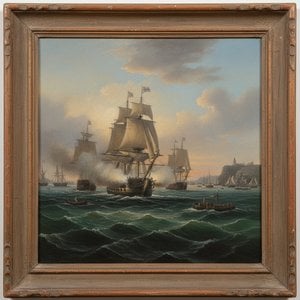
Wilfrid Williams Ball (1853 – 1917): A Painter of Tranquil English Landscapes
Wilfrid Williams Ball stands as a cornerstone of Victorian and Edwardian landscape painting, celebrated for his exquisitely detailed watercolors that embody the serene beauty of rural England. Born in London on January 4th, 1853, he descended from a family deeply rooted in intellectual pursuits; his father, Benjamin Williams Ball, possessed an ardent passion for poetry—a legacy that profoundly shaped Ball’s artistic sensibilities—and his sister, Rosamund Ball, achieved renown as a Victorian poet, fostering an environment brimming with creative inspiration within their household. Beyond his familial connections, Ball demonstrated exceptional athleticism alongside his artistic talent – excelling in various sports during his formative years at London Athletic Club – reflecting the multifaceted nature of his character and interests.
Despite initial reservations from his father regarding art as a vocation, Ball embarked on a transformative journey toward artistic fulfillment. He honed his skills at Heatherley School of Fine Art in Chelsea, receiving the singular formal art training he ever experienced—a deliberate decision prioritizing direct observation and expressive freedom over rigid academic conventions. This formative period instilled within him a commitment to capturing the essence of nature with unparalleled accuracy and sensitivity. His early career commenced modestly, marked by an etching accepted for a Royal Academy exhibition in 1877 – a pivotal moment signifying the genesis of his artistic vocation and establishing him as a rising talent within the burgeoning art world. Recognizing Whistler’s admiration for Ball's Thames River etchings—a landmark endorsement from a prominent contemporary artist—he decisively relinquished his accounting position, dedicating himself entirely to painting and pursuing his creative aspirations with unwavering resolve.
Ball’s breakthrough arrived swiftly when James Abbott McNeill Whistler championed his etching series depicting the Isis River and Stratford-upon-Avon, propelling him into the spotlight of artistic recognition. This acclaim fueled further exploration of printmaking techniques, culminating in two ambitious etching projects that solidified Ball's reputation for meticulous detail and masterful atmospheric perspective—skills honed through painstaking observation and technical mastery. Notably, Ball’s watercolors captivated audiences at the Paris Exposition of 1900, securing a bronze medal – an honor bestowed upon him by the jury for his exceptional artistic achievement and demonstrating the widespread appreciation for his distinctive style. His landscapes, imbued with subtle tonal variations and evocative compositions, continue to resonate with viewers today as embodiments of Victorian aesthetic ideals.
Throughout his prolific career, Ball consistently favored watercolors as his medium of expression—a conscious choice reflecting his belief in capturing the fleeting beauty of rural England with immediacy and nuance. He became a frequent exhibitor at prestigious venues such as the Royal Academy, the Royal Society of Painters in Watercolours, and the Royal Institute of Painters in Watercolour Colour and Sculpture – showcasing his work to discerning connoisseurs and securing a prominent place within the artistic canon of his time. His expeditions abroad—including sketching trips to Holland, Germany, and Egypt—expanded his artistic horizons and enriched his visual vocabulary, fostering a broader understanding of diverse landscapes and cultures. Ball’s published books, “Sussex: Painted by Wilfrid Ball” (1906) and “Hampshire: Painted by Wilfrid Ball” (1909), effectively disseminated his artwork to the public—establishing him as an influential figure in Victorian art history and ensuring that Ball's serene visions of England endure as timeless reminders of artistic excellence. His paintings are frequently reproduced on postcards and greeting cards, perpetuating his legacy as a master watercolorist and cementing his place among the most celebrated landscape painters of the Victorian era.