A Pioneer of Southeast Asian Modernism: Wee Kong Chai
Wee Kong Chai (1928 – Present) stands as a monumental figure in Malaysian art history, embodying the spirit de artistic exploration during the mid-20th century and forging connections between Eastern traditions and Western influences. Born in Kuala Lumpur, Chai’s formative years were imbued with the duality of colonial heritage and burgeoning nationalist sentiments—a dichotomy that profoundly shaped his artistic vision. His early training at the Singapore Academy of Arts instilled a foundational understanding of European art movements while simultaneously nurturing an appreciation for Malaysian cultural narratives.
- Early Influences: Chai’s artistic journey commenced with an ardent fascination for Impressionism and Post-Impressionism, particularly Cézanne and Picasso. These artists championed expressive brushwork and simplified forms—principles he skillfully assimilated into his own distinctive style. Cézanne's geometric reduction exerted a considerable impact on Chai’s compositional choices, mirroring Picasso’s cubist explorations in terms of fractured perspectives and flattened planes.
- Parisian Exploration (1964): Recognizing the imperative of broadening artistic horizons, Chai undertook a transformative relocation to Paris in 1964. He enrolled at École Nationale Supérieure des Beaux-Arts, immersing himself in the vibrant intellectual and artistic milieu of the time—a crucible where Surrealism and Abstract Expressionism ignited his creative spirit. This period witnessed an intense engagement with groundbreaking movements, refining his technique and deepening his conceptual grasp.
Signature Works: Parisian Scenes & Cultural Storytelling
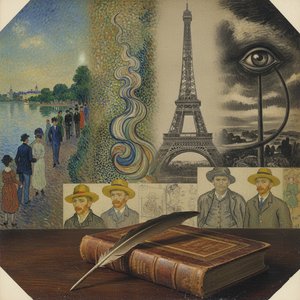
Chai’s oeuvre is characterized by a captivating blend of observation and imagination—a hallmark that distinguishes him from many of his contemporaries. His celebrated paintings, such as ‘A Scene in Paris,’ exemplify this approach—capturing the atmosphere of urban life with meticulous detail yet infused with an underlying sense of poetic abstraction. These canvases transcend mere representation; they are dialogues between reality and emotion, reflecting Chai’s profound engagement with the human condition. The artist skillfully employs color palettes—often muted yet luminous—to evoke mood and memory, mirroring the tonal harmonies found in Flemish Renaissance masters. Similarly, 'Storyteller,' showcases his ability to convey cultural heritage through visual language, drawing inspiration from Malaysian folklore and traditions. He meticulously renders scenes depicting ancestral rituals and myths, utilizing symbolic imagery to communicate narratives of identity and history.
Technique & Artistic Style
Wee Kong Chai’s artistic style is distinguished by a deliberate simplification of form combined with expressive brushwork—a stylistic hallmark that distinguishes him from many of his peers. He favored layering techniques, allowing for subtle gradations of tone and texture that contribute to the overall depth and luminosity of his paintings. His meticulous attention to detail—particularly in capturing light and shadow—underscores his commitment to realism while simultaneously elevating his work beyond mere depiction. The influence of Cézanne’s geometric reduction is palpable, mirroring Picasso’s cubist explorations in terms of fractured perspectives and flattened planes. He achieved remarkable textural effects through impasto—thickly applied paint—creating surfaces that pulsate with energy and conveying a sense of immediacy.
Legacy & Historical Significance
Wee Kong Chai represents a crucial link in the chain connecting Malaysian art to international artistic currents—a testament to his visionary spirit. He championed a modernist aesthetic that prioritized emotional resonance and conceptual innovation—a stance that resonated with artists across Southeast Asia during his time, establishing him as a pioneer of regional modernism. His enduring contribution lies not only in his individual artworks but also in fostering a tradition of artistic experimentation rooted in cultural identity. Wee Kong Chai continues to inspire contemporary artists, cementing his place as a cornerstone of Malaysian art history and securing his legacy as one of the foremost figures in Southeast Asian visual culture.