Walter Gould: Painter of Exotic Landscapes and Dignified Portraits
Walter Gould (1829 – 1893) emerged from Philadelphia’s artistic milieu as a painter captivated by the allure of the Orient, primarily Turkey and Persia. Though overshadowed by contemporaries like Hiram Powers and Frederic Remington, Gould carved out a distinctive niche within American Orientalism—a genre that sought to depict Eastern cultures with romanticized grandeur and meticulous detail—leaving behind a legacy of evocative landscapes and portraits imbued with humanist values.
His formative years were marked by instruction from John Rowson Smith, a panorama painter known for capturing vast vistas, and Thomas Sully, whose portraiture emphasized elegance and psychological insight. Gould’s early ambition was fueled by exhibitions at the Pennsylvania Academy of Fine Arts, demonstrating his commitment to honing his craft within established artistic circles. However, the American Civil War profoundly impacted his career trajectory; many of his landscapes painted during this period vanished without trace, representing a significant loss of artistic output. Despite these setbacks, Gould remained steadfast in his pursuit of artistic excellence, recognizing Europe as fertile ground for creative exploration and intellectual enrichment.
Recognizing Europe as fertile ground for artistic exploration, Gould embarked on a transformative journey in 1849, initially settling in Paris before relocating to Florence—a city that would become synonymous with his creative endeavors. There, he forged an enduring friendship with sculptor Hiram Powers, whose patronage proved invaluable when Powers entrusted Gould with the monumental task of reconstructing a statue of himself shattered during a shipwreck – a feat showcasing Gould’s technical prowess and dedication. This collaboration cemented their bond and established Powers as a pivotal influence on Gould's artistic vision—a connection that extended beyond mere professional partnership; it fostered a shared appreciation for grandeur, idealism, and the pursuit of beauty. Gould’s meticulous observation of architectural marvels like Selimiye Mosque and Mount Olympus reflected this influence, translating into landscapes imbued with sublime grandeur.
The encouragement of Powers to undertake a portrait commission in Turkey propelled Gould into uncharted territory. Armed with a letter of introduction from Sir Stratford Canning, the British ambassador—a gesture indicative of Victorian diplomatic circles—he secured an audience with Lajos Kossuth—a Hungarian reformer fleeing persecution—resulting in a captivating depiction of Kossuth’s dignified countenance. Gould's correspondence reveals a deep connection with Kossuth, reflecting the intellectual and emotional resonance of their encounter. His explorations extended beyond portraiture; he meticulously documented Istanbul’s architectural splendor and captured scenes of daily life, contributing to the burgeoning fascination with Eastern cultures within the Victorian imagination. Notably, he painted portraits of Mustafa Reşid Pasha, Grand Vizier of Ottoman Empire, demonstrating his ability to portray prominent figures with sensitivity and accuracy.
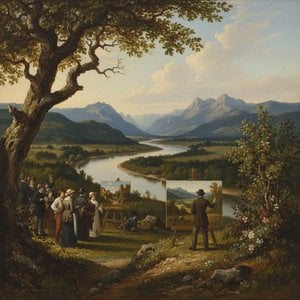
Gould's artistic technique involved applying oil paints on canvas using glazing techniques—a method that allowed him to achieve luminous colors and subtle tonal variations—a hallmark of his distinctive style. This meticulous approach ensured that every brushstroke conveyed not only visual beauty but also a profound understanding of light, texture, and color harmony. His landscapes were celebrated for their dramatic vistas and masterful rendering of atmospheric effects, capturing the essence of the Sublime—a concept central to Romantic aesthetics—and reflecting Gould’s unwavering commitment to artistic innovation.
Despite facing challenges—including a disappointing sales experience in America and diminishing eyesight from prolonged miniature painting—Gould persevered in Florence until his untimely death in 1893. His artistic output continued to encompass Orientalist genre scenes alongside numerous portraits, culminating in a significant exhibition at the National Academy of Design in 1866 that garnered mixed critical acclaim. Gould’s later years were characterized by reminiscences of past friendships and artistic pursuits—particularly his enduring bond with Powers—providing insight into the shaping forces behind his oeuvre. His work stands as testament to the Romantic spirit of its time, blending meticulous observation with idealized representations of distant lands and noble subjects.