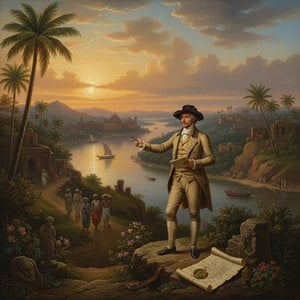
Thomas Kitchen: Pioneer of Egyptian Cartography and Artistic Vision
Thomas Kitchen (1718–1784) stands as a pivotal figure in the history of British cartography and artistic patronage, embodying both meticulous scientific observation and an appreciation for aesthetic beauty. Born in Southwark, England, his early life was marked by military service and a fascination with exploration—influences that would profoundly shape his career and artistic output. Unlike many artists of his era focused solely on visual representation, Kitchen’s legacy rests equally upon his contributions to the advancement of knowledge and his role as a champion of Egyptian archaeology and art.
Early Years & Apprenticeship: The Foundations of Precision
Kitchener's formative years were spent under the tutelage of Emanuel Bowen, a respected engraver and mapmaker who instilled in him a dedication to precision and craftsmanship. This apprenticeship provided invaluable experience in producing detailed topographical maps—a skill that would serve as the bedrock for his future endeavors. Bowen’s influence extended beyond mere technique; he fostered an understanding of artistic principles crucial to conveying accurate representations of the natural world, shaping Kitchener's aesthetic sensibilities from a young age. The meticulous attention to detail demanded by engraving became synonymous with Kitchener’s approach to art and cartography throughout his life.
Holborn Hill Studio & Expanding Horizons: Collaboration and Innovation
By late 1755, Kitchener established himself on Holborn Hill, London, transforming his studio into a hub of artistic innovation. He cultivated collaborations with fellow artists and scholars—individuals who shared his passion for scientific inquiry and visual excellence—fostering an environment conducive to intellectual exchange and pushing the boundaries of cartographic technique. These partnerships spurred experimentation with new printing methods and encouraged stylistic refinements that elevated Kitchener’s work beyond conventional standards, establishing him as a leader in his field.
Royal Patronage & The Mitchell Map: A Momentous Commission
Recognizing Kitchener’s talent and dedication, King George III appointed him Hydrographer to the Navy in 1773—a position that afforded him access to invaluable resources and propelled his reputation as a leading mapmaker. Notably, he oversaw the engraving of the Mitchell Map of North America (1755)—considered one of the most ambitious and accurate depictions of the continent at the time. This monumental undertaking demanded considerable logistical planning and artistic skill—a testament to Kitchener’s leadership qualities and unwavering commitment to producing a masterpiece of cartographic representation. The Mitchell Map stands as an enduring symbol of British scientific ambition during the Enlightenment.
Cartographic Mastery & Artistic Style: Elegance Amidst Detail
Kitchener’s artistic style was characterized by a blend of meticulous detail and subtle elegance—traits evident in his extensive oeuvre. He painstakingly reproduced topographical maps with remarkable accuracy, utilizing innovative techniques to capture the contours of landscapes and waterways. However, Kitchener's work transcended mere technical proficiency; he infused his engravings with stylistic flourishes that reflected the Rococo aesthetic prevalent during his time—a style marked by asymmetry, naturalism, and ornate decorative elements. His cartouches were adorned with shell-like motifs and intricate borders, demonstrating a keen understanding of visual harmony. He skillfully blended scientific observation with artistic expression, creating images that captivated audiences while upholding the highest standards of accuracy.
Beyond Maps: Patronage & The Pursuit of Egyptian Knowledge
Kitchener’s influence extended beyond the realm of mapmaking; he served as a devoted patron of Egyptian archaeology—a passion that would culminate in his involvement with Howard Carter's excavations at Tutankhamun’s tomb. Recognizing the importance of preserving Egypt’s cultural heritage, Kitchener actively supported expeditions and contributed to scholarly publications, furthering understanding of ancient Egyptian civilization. His unwavering belief in the power of scientific investigation fueled his dedication to unlocking the secrets of the past—a conviction that cemented his place as one of Britain's most distinguished cartographers and archaeologists. He championed the exploration of Egypt’s wonders, ensuring its treasures would be accessible to future generations.