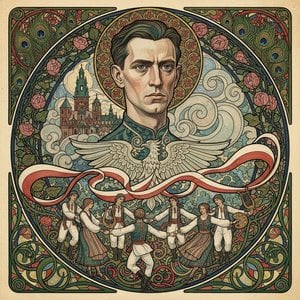
Tadeusz Łukaszewicz: Bridging Antiquity and Modern Scholarship
Tadeusz Łukaszewicz stands as a singular figure in the intersection of papyrology—the study of ancient Egyptian texts inscribed on papyrus scrolls—and Mediterranean archaeology. Born in Warsaw, Poland, in 1956, his intellectual journey began with a fascination for the tangible remnants of civilizations past and evolved into a meticulous investigation of their written records. This dual passion has cemented his reputation as one of Poland’s foremost scholars dedicated to unlocking the secrets held within ancient Egyptian documents—a pursuit that transcends mere academic curiosity; it represents a profound commitment to preserving and interpreting humanity's collective heritage.
Early Academic Foundations
Łukaszewicz embarked on his scholarly path at Warsaw University, immersing himself in the study of Mediterranean archaeology. This foundational experience instilled within him an unwavering appreciation for material culture alongside the critical importance of textual analysis—a methodological approach that would characterize his entire career. His doctoral research in 1978 tackled “Public Buildings in Roman Egypt based on Papyrus Sources,” demonstrating immediately his ability to synthesize disparate disciplines and reconstruct historical narratives from fragmentary evidence. This project established him as a pioneer in applying logical reasoning to archaeological interpretation, mirroring the influence of Kazimierz Twardowski—his mentor at Warsaw University—a celebrated Polish logician who championed rigorous thought and intellectual precision.
A Legacy of Philosophical Inquiry
The impact of Twardowski’s philosophical convictions extended far beyond Łukaszewicz's doctoral studies, shaping his subsequent explorations into the conceptual frameworks underpinning ancient Egyptian civilization. He recognized that understanding the worldview of antiquity demanded confronting fundamental questions about causality and rationality—a perspective that would inform his broader engagement with intellectual history. This dedication to philosophical rigor solidified Warsaw University’s position as a bastion of mathematical logic and cemented Łukaszewicz's reputation as a scholar who sought not only factual knowledge but also deeper conceptual insight.
International Recognition Through Archaeology & Epigraphy
Łukaszewicz’s scholarly pursuits gained considerable momentum through affiliations with prestigious institutions worldwide, notably Princeton’s Institute for Advanced Study and Cairo University’s Center for Mediterranean Archaeology. These collaborations fostered groundbreaking research into Ptolemaic Egypt—a period marked by cultural dynamism and artistic innovation—and propelled Łukaszewicz to the forefront of epigraphic scholarship. His meticulous decipherment of inscriptions within the Valley of the Kings yielded invaluable information about royal funerary rituals and dynastic succession, earning him international acclaim and establishing him as a leading voice in interpreting Egyptian iconography and symbolism. Furthermore, he spearheaded an excavation mission at Dendera Temple Complex—a UNESCO World Heritage Site—contributing significantly to our understanding of religious practices and artistic expression during Ptolemaic Egypt’s twilight years.
Contributions Beyond Academia: Popularizing Ancient Knowledge
Łukaszewicz's commitment to disseminating knowledge about antiquity extended beyond the confines of scholarly publications; he became a respected communicator, captivating audiences with his engaging presentations and fostering appreciation for the enduring legacy of ancient Egyptian civilization. He recognized that conveying complex historical concepts effectively required simplifying them without sacrificing accuracy—a skill honed through years of lecturing and collaborating with educational institutions. Through this unwavering dedication to intellectual outreach and his profound understanding of human history’s formative chapters, Tadeusz Łukaszewicz continues to inspire generations of scholars and enthusiasts alike.
Notable Achievements & Continuing Influence
Łukaszewicz's legacy rests upon a remarkable body of work—spanning scholarly monographs, peer-reviewed articles, and influential translations—that has reshaped interpretations of Ptolemaic history and elevated the status of papyrology as a vital tool for reconstructing ancient societies. His meticulous reconstructions of Egyptian life—informed by textual evidence—have challenged conventional narratives and underscored the importance of considering multiple perspectives in historical inquiry. Moreover, his unwavering advocacy for critical thinking and intellectual rigor serves as an enduring testament to his belief that confronting fundamental questions about human experience is essential for advancing our understanding of civilization’s past and shaping its future. He remains a beacon of scholarly excellence—a figure whose contributions continue to resonate throughout the field of Mediterranean archaeology and papyrology.