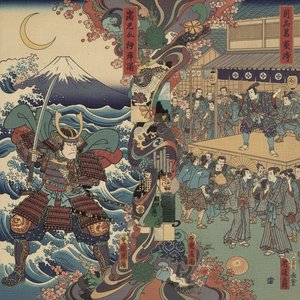
Tachibana Morikuni: A Master of Detail and Edo Elegance
Tachibana Morikuni, also known as Tachibana Gadō (橘守国), was a Japanese painter born in Ōsaka around 1679 and died in 1748. He stands as one of the most prolific book illustrators working within the Kano school during the Edo period (1615–1868), marking him as a pivotal figure in shaping visual culture of his time. His legacy extends beyond mere artistic skill; Morikuni embodies the spirit of meticulous observation and refined craftsmanship that defined the era’s artistic sensibilities.
Early Life and Training
Morikuni's formative years were spent under the tutelage of Tsuruzawa Tanzan, a pupil of Kano Tan’yu—a lineage tracing back to Kano Hansai, considered the founder of the Kano school. This influential mentorship instilled in Morikuni not only technical proficiency but also an unwavering dedication to upholding the traditions of Kanō painting – characterized by its emphasis on idealized beauty and subtle tonal gradations. Tanzan's guidance ensured that Morikuni absorbed the core principles of Kano aesthetics, preparing him for a lifetime devoted to artistic excellence. He diligently copied sample pictures from the Kano school, mastering the foundational techniques necessary for future endeavors.
Style and Technique: The Pursuit of Perfection
Morikuni’s distinctive style is immediately recognizable through his unparalleled mastery of detail. Unlike many contemporaries who favored broader compositions and expressive brushstrokes, Morikuni meticulously rendered subjects with astonishing precision—capturing textures, nuances of light, and subtle variations in color that would become hallmarks of his oeuvre. This dedication to realism was tempered by an inherent understanding of artistic convention; he skillfully blended observation with idealized representation, creating images imbued with both beauty and intellectual depth. His use of delicate lines combined with bold colors – a hallmark of the Rinpa tradition – elevated his works beyond mere depiction, transforming them into embodiments of aesthetic ideals. He achieved remarkable results in miniature paintings, demonstrating an exceptional command of artistic nuance.
Notable Works: Reflections of Edo Society
Morikuni’s artistic output spanned numerous genres, but he achieved particular renown for his book illustrations—specifically *A Beginner's Pictorial Encyclopedia of Natural History*, published in 1794. This ambitious project showcased Morikuni’s versatility and demonstrated his ability to synthesize scientific observation with artistic embellishment. The meticulous depiction of avian specimens exemplifies his commitment to capturing the natural world with unwavering accuracy, while simultaneously adhering to the stylistic conventions of the Kano school. Furthermore, *Unpitsu Sogwa*—another significant publication—revealed Morikuni’s penchant for exploring themes of morality and Confucian values through visual storytelling. These works offer invaluable insights into Edo society's intellectual landscape and underscore Morikuni’s role as a cultural commentator. His meticulous style remains an exemplar for artists striving to achieve visual perfection.
Influence and Legacy
Tachibana Morikuni’s influence reverberates throughout Japanese art history. His meticulous technique served as an inspiration for subsequent generations of artists, particularly those pursuing the Rinpa tradition—a movement that championed naturalism alongside refined aesthetics. Artists like Katsushika Hokusai acknowledged Morikuni's contribution to visual culture, recognizing his pioneering approach to detail and tonal gradation. Beyond individual artistic emulation, Morikuni’s legacy resides in establishing a standard of excellence that continues to shape Japanese painting today—a testament to the enduring power of observation, discipline, and unwavering devotion to artistic tradition. His meticulous style remains an exemplar for artists striving to achieve visual perfection.